





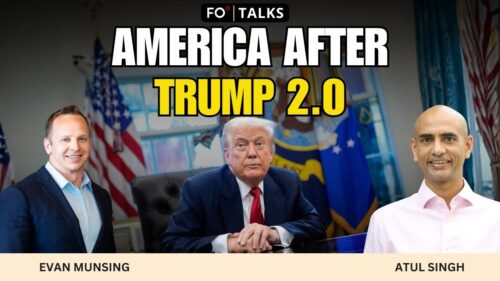
Editor-in-Chief Atul Singh and Evan Munsing, candidate for Colorado’s competitive 8th Congressional District, Marine Corps veteran and entrepreneur, examine why American national security feels harder to define now than it did a decade ago. Munsing frames the moment as a hinge in history, echoing former German Chancellor Olaf Scholz and his famous Zeitenwende speech. In his view, the United States now faces renewed great-power rivalry with China and Russia while also confronting cheaper, faster-moving threats that blur the line between war, crime and politics.
A turning point with two adversaries
Munsing believes the US is entering an era where strategic competition is no longer theoretical or confined to distant theaters. As he says, “There’s an emergence of great-power competition” that has returned China and Russia to the center of US threat perceptions in ways Americans have not experienced in a long time. Where the post-Cold War period encouraged assumptions about integration and stability, Munsing suggests Washington has to operate again with peer competitors in mind.
Challengingly, the US has capable rivals willing to test boundaries across multiple arenas at once. Deterrence therefore, becomes more than ships and missiles. It becomes a question of whether the US can protect the homeland, sustain economic growth and keep alliances credible under constant pressure.
Multi-domain conflict comes home
Though not facets of the traditional battlefield, Munsing highlights cyber operations, economic coercion and information warfare as essential parts of modern competition. He warns that the falling cost of technology has widened the pool of potential disruptors. Drones, commercial tools and increasingly accessible AI systems mean individuals and small groups can create outsized effects, including attacks on infrastructure or disruptions to civilian life.
To make the point tangible, he references the drone sightings near New Jersey airports that disrupted air traffic. Vulnerabilities once associated with war zones now appear in domestic settings, and the systems that keep daily life functioning can be probed by state actors and non-state actors alike.
China and Russia require different playbooks
Munsing urges Americans not to condense Beijing and Moscow into one category. China is territorially focused yet deeply enmeshed in the global economy, which creates leverage but also mutual exposure. He calls the country the “pacing challenge,” arguing that “they’ve been neck and neck with us both in terms of military technology development but also the strength of their economy for some time.” In that framing, policy must combine credible deterrence in flashpoints like Taiwan and the South China Sea with an economic strategy that pressures unfair practices without locking the world into permanent decoupling.
Russia, by contrast, appears to be more willing to use direct force quickly. Munsing cites Russia’s invasions of Georgia and Ukraine as evidence of a leadership prepared to gamble, even when the costs are high. It implies that Russian deterrence looks closer to Cold War containment, with NATO as the central instrument. He doubts that Europe moves as one unit, noting that proximity shapes urgency, and that countries like Poland treat Russia differently than states farther west.
Still, Munsing believes Europe’s conventional capabilities need rebuilding and that the US should encourage Europe to shoulder more of its own defense burden, while preserving interoperability and alliance cohesion.
Afghanistan and the problem of institutional self-belief
Munsing’s experience with the war in Afghanistan shapes his distrust of blind trust in career politicians and his insistence on accountability. Many veterans did not share the confidence that the Afghan National Army could hold after a US withdrawal, and he criticizes institutional bias inside large organizations. His remedy: stronger “red teaming,” routine efforts to poke holes in official assessments and consequences for major predictive failures.
That critique extends to the broader US intelligence ecosystem, including the post-September 11 architecture overseen by US Director of National Intelligence Tulsi Gabbard. Munsing suggests the volume of surprises indicates that the system does not deliver what its scale and budget imply.
If leaders send troops into harm’s way, the goals must be concrete, limited and worth the cost — as a former officer, Munsing knows this. He warns that the US should be “very leery of any kind of sense of overseas adventurism” untethered from direct national interests.
Cyber, supply chains and the military-industrial bottleneck
When Singh presses him on what voters in Colorado gain from foreign policy debates, Munsing tries to make national security local. He points to the opioid crisis and fentanyl flows as issues with border and international dimensions. Cyber insecurity hits ordinary Americans through scams, data leaks and persistent hacking, including Chinese state-linked activity like Salt Typhoon and “pig slaughtering” fraud operations.
Munsing wants a more aggressive cyber posture and suggests deterrence must include offensive capability. Asked directly whether that implies hacking adversaries, he answers, “Absolutely. I mean, if they’re us then we should be hacking them.” Alongside cyber, he emphasizes industrial resilience. Covid-19-era shortages of personal protective equipment and the 2022 infant formula shortage illustrate how supply-chain fragility becomes a US security issue, and that fragility connects to workforce gaps such as the Navy’s difficulty finding skilled welders.
Finally, Munsing turns to defense procurement as a cautionary tale and a target for reform. The system is dominated by major “prime” contractors, slow processes and weak accountability. Greater competition, smaller pathways for startups and clearer consequences for failure would improve outcomes for taxpayers and warfighters. He frames it as a political project that requires public pressure as well as congressional will, because entrenched interests do not surrender quietly.
[Lee Thompson-Kolar edited this piece.]
The views expressed in this article/video are the author’s own and do not necessarily reflect Fair Observer’s editorial policy.


























Comment