





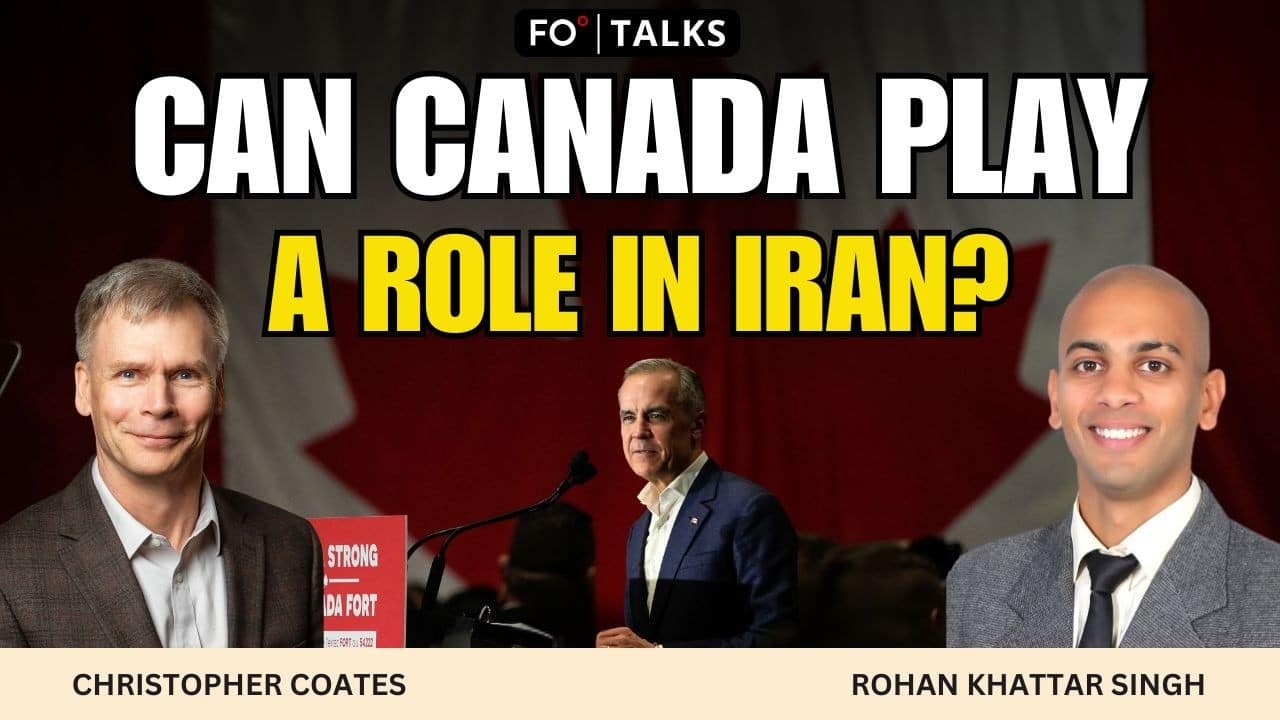
Fair Observer’s Video Producer Rohan Khattar Singh speaks with retired Lieutenant General Christopher Coates, former deputy commander of the North American Aerospace Defense Command (NORAD), about modern air power, defense industry and the limits of military sustainability. They discuss Canada’s defense procurement debate as well as the US–Israel air campaign against Iran, where tactical sophistication is colliding with industrial constraints. Coates argues that advanced systems can deliver extraordinary effects, but only if states can produce, replace and sustain them at wartime speed. The episode asks whether modern militaries are preparing for the wars they may actually have to fight.
A defense strategy or an industrial strategy?
Khattar Singh opens with Canadian Prime Minister Mark Carney’s pledge to stop spending so much of Canada’s defense money in the United States. Coates sees the logic. Canada’s armed forces need major investment after years of underfunding, and Ottawa wants more of that money to benefit Canadian firms.
Yet he argues that the policy is not primarily driven by military requirements. “The defense investment strategy that says that is far more of a domestic industrial strategy than it is a defense strategy,” Coates says. The plan begins with jobs rather than capabilities. That may make political sense, but it risks producing equipment Canada can build rather than the military Canada needs.
The problem is also structural. Canada spends about $60 billion a year on defense, with roughly $10 billion going to acquisitions. Between 60% and 75% of that acquisition spending currently goes to the US. Simultaneously, Canadian firms benefit from access to the American defense market under a 1956 production-sharing framework. If Ottawa pushes too aggressively to exclude US firms, Coates warns, Canadian companies could face pressure in return.
The fighter jet dilemma
That tension is clearest in the debate over replacing Canada’s aging CF-18 Hornet aircraft. The F-35 had been chosen as the planned replacement, but the decision has become politically contested, with renewed public interest in Sweden’s Gripen.
Coates doubts the Canadian government would delay the replacement. The CF-18 fleet has a finite service life, and Canada had planned its transition around the arrival of the F-35. As pilots, crews and resources begin shifting toward the next platform, the existing fighter force becomes harder to sustain. The air force can manage risk, but not indefinitely.
For Coates, interoperability matters more than symbolism. Canada does not need to fly exactly the same platforms as the US, but it must operate systems that can integrate with American and Five Eyes networks — intelligence-sharing alliances comprising Australia, Canada, New Zealand, the United Kingdom and the US. A Canadian-built fighter is not a realistic near-term option. That leaves Ottawa balancing industrial ambition against operational necessity.
Air power meets industrial limits
The discussion then turns to Iran, where Coates sees both the promise and the fragility of modern air power. The US–Israel campaign has displayed remarkable coordination, intelligence integration, refueling capacity and precision strike capability. He describes it as “exquisite military capability,” a demonstration of what advanced air forces can do.
But there’s a deeper logistical lesson to be learned here. The rate at which advanced weapons are being used appears to exceed the rate at which they can be produced. Stockpiles are falling, and industrial capacity cannot be switched on instantly.
That creates an opening for asymmetric warfare. Iran’s use of cheaper drones and missiles forces the US, Israel and regional partners to respond with far more expensive interceptors and high-end systems. A Shahed-style drone may cost tens of thousands of dollars, while the missile used to destroy it can cost millions. Coates argues that this imbalance exposes an unresolved problem: advanced militaries have not yet created a fully sustainable “system of systems” for long wars against cheap, numerous threats.
NORAD and the drone problem
Khattar Singh asks whether NORAD could defend North America against the kinds of drones and missiles seen in the Iran conflict. When he served at NORAD, Coates bluntly explains, it could not fully meet that challenge.
Modernization is underway, including over-the-horizon radars and updates to the North Warning System. But small drones create a different problem from Soviet bombers, cruise missiles or post-September 11 air threats. Domestic airspace is shared with commercial, civilian and law enforcement users. A suspicious track might be a drone, an aircraft, a balloon or even a bird.
This means NORAD is becoming less a single defender than an organizer of sensors, agencies and authorities. As Coates puts it, NORAD now acts as “a bit of an orchestrator,” coordinating with others to identify threats and direct the right response.
NATO, Hormuz and Canada’s limits
Khattar Singh also raises NATO divisions, noting that several allies closed their airspace to US aircraft involved in the Iran campaign. Coates does not see this alone as the beginning of the end. Similar tensions occurred before, including during the Libya conflict. He views the closures as diplomatic signaling rather than a rejection of NATO itself.
The Strait of Hormuz crisis exposes another Canadian vulnerability. Canada is a net oil exporter, so it is unlikely to face shortages, but Coates notes that fuel prices have still risen sharply. Canada also lacks the pipeline and export infrastructure to move energy to allies such as India at scale.
That limits Ottawa’s geopolitical role. Coates says Canada may have good ideas, but leading a coalition requires resources, assets and military mass. For now, Canada remains better positioned to contribute to others’ coalitions than to lead one itself.
[Lee Thompson-Kolar edited this piece.]
The views expressed in this article/video are the author’s own and do not necessarily reflect Fair Observer’s editorial policy.








































Comment