


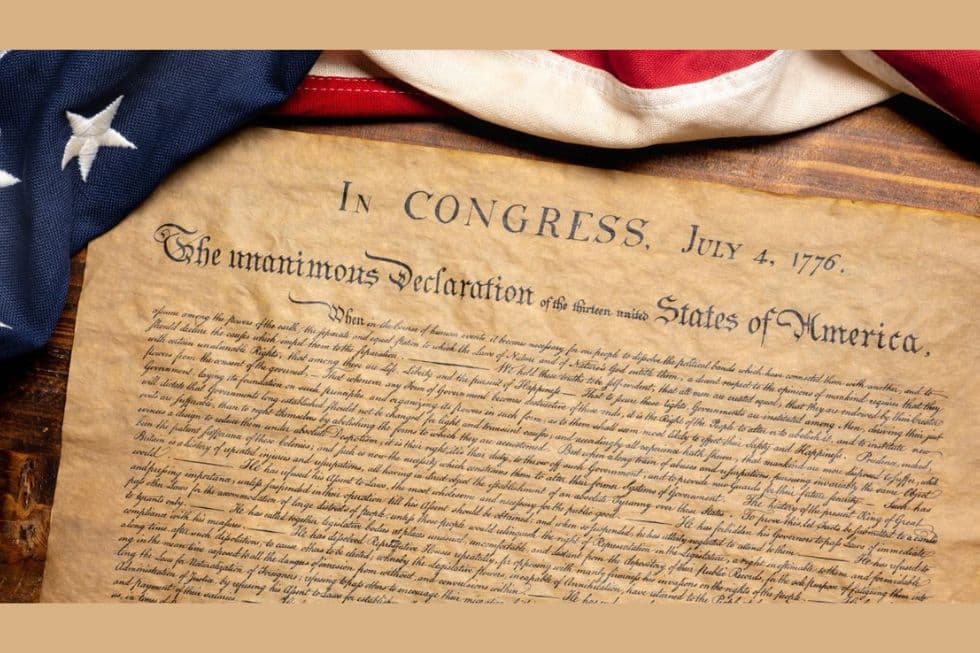



For many Americans, the 250th anniversary of the US was a time for celebration, but as with all milestones, it could and should also be an opportunity for reflection. Independence Day is the anniversary of the public announcement of the Declaration of Independence. This classic work of American writing was authored primarily by Founding Father and former President Thomas Jefferson, but he was also assisted by other Founding Fathers, such as John Adams, Benjamin Franklin, Roger Sherman and almost certainly Thomas Paine. (Never let it be said that excellent work cannot be done by a committee!) Its lofty principles of universal liberty and its beautiful prose have rightfully served for 250 years as a paean to freedom, a challenge to tyrants, and an inspiration to both Americans and many others around the world.
The central idea of universal liberty — that all people possess inherent rights that governments exist to secure — is one of the strongest currents in American political culture. But there is a second, very different American expression of the desire for freedom. It has existed just as long, and it can be succinctly described as “freedom for me, but not for thee,” or, as I call it, “selfish liberty.”
American history is rife with examples of selfish liberty taking precedence over universal liberty. The most obvious example is the nearly 250 years of chattel slavery that began at the very beginning of the colonial period, ending only in the wake of the bloody conflagration of the Civil War. But there are other examples, such as the Trail of Tears and the related treatment of Native Americans, the internment of Japanese Americans during the Second World War and Jim Crow, all of which remind us that universal liberty has often been only an aspiration, not a guarantee.
“What to the Slave Is the Fourth of July?”
If the Declaration of Independence is America’s greatest statement of universal liberty, then, as a counterpoint, abolitionist Frederick Douglass’s speech “What to the Slave Is the Fourth of July?” is the Declaration’s greatest indictment of its failure to live up to that ideal.
In this famous speech, Douglass powerfully exposed the conflict between these mutually exclusive conceptions of freedom. But he did not reject the ideals expressed in the Declaration of Independence. Instead, he argued that the nation had betrayed its own principles by recognizing liberty for some people while denying it to millions of others who were enslaved.
His speech insisted that the Declaration’s promise of equal rights was either a genuine universal commitment or an empty slogan. In doing so, he framed the struggle against slavery not as a demand for new rights, but as a demand that the US simply live up to its professed commitment to universal liberty rather than continue its tradition of selfish liberty.
Universal vs selfish liberty in modern America
While Frederick Douglass’s vision of abolition ultimately prevailed, albeit at great cost, the tension between universal liberty and selfish liberty continues to this day. This year, as Americans observed their national birthday, selfish liberty was once again ascendant in their country.
They live under an administration whose policies have sought to restrict immigration and asylum, curtail protections for transgender Americans, sharply reduce refugee admissions, eliminate many diversity initiatives and redefine the federal government’s approach to civil rights. Critics argue that these measures represent another resurgence of America’s longstanding tradition of selfish liberty: protecting the freedoms and privileges of some while narrowing the rights or opportunities of others. They stand in stark contrast to the original motto of the US, e pluribus unum — “from many, one.”
To be fair, many who support these policies argue that they advance legitimate goals such as border security, parental rights, religious liberty or other public interests despite their disparate effects. Others regard the resulting tradeoffs as both acceptable and desirable.
But for many who continue to promote the American ideal of universal liberty, this low point in their fortunes has been dispiriting. Polls show an accelerating decline among adults in the US in patriotism and in pride in being American. Yet rather than lose heart, those who believe in the Declaration of Independence’s egalitarian ideals should remember that the document was only the first step.
The American Crisis
The British military response to the Declaration of Independence was swift and strong. Just five months after it was signed, the Continental Army was forced to retreat repeatedly to avoid annihilation. It was at this time, when things seemed darkest, that a third entry in the American canon was written, one especially relevant to this Independence Day in particular: The American Crisis by Thomas Paine.
Known for its famous first line, “These are the times that try men’s souls,” this pamphlet was meant to restore courage to those fighting for the principles of universal liberty outlined in the Declaration of Independence.
Paine reminded Americans that devotion to universal liberty is tested not in moments of triumph but in moments of discouragement. His words remain relevant because every generation must decide whether the Declaration’s promises belong to everyone or only to us (and who “us” includes).
The struggle between universal liberty and selfish liberty did not end with independence, emancipation or the civil rights movement. It is renewed in every generation. So on America’s 250th birthday, the question was not merely whether we celebrate the Declaration of Independence, but whether we still believe in its promise for each and every one of us.
[Kaitlyn Diana edited this piece.]
The views expressed in this article are the author’s own and do not necessarily reflect Fair Observer’s editorial policy.
What’s in a Parade? Tocqueville’s America at 250
French historian Alexis de Tocqueville’s 1831 observations of American democracy now stand in stark contrast to modern America. His warnings...
Happy Fourth: Hope in Magnificently Messy America at 250
America turns 250 today. In 1776, America was anxious and divided as it is now. Despite massive problems, there are...
250 Years of American Scripture
On America’s 250th anniversary, it may be time to think about how the Founders were mythologized into secular saints, embodying...
Support Fair Observer
We rely on your support for our independence, diversity and quality.
For more than 10 years, Fair Observer has been free, fair and independent. No billionaire owns us, no advertisers control us. We are a reader-supported nonprofit. Unlike many other publications, we keep our content free for readers regardless of where they live or whether they can afford to pay. We have no paywalls and no ads.
In the post-truth era of fake news, echo chambers and filter bubbles, we publish a plurality of perspectives from around the world. Anyone can publish with us, but everyone goes through a rigorous editorial process. So, you get fact-checked, well-reasoned content instead of noise.
We publish 3,000+ voices from 90+ countries. We also conduct education and training programs
on subjects ranging from digital media and journalism to writing and critical thinking. This
doesn’t come cheap. Servers, editors, trainers and web developers cost
money.
Please consider supporting us on a regular basis as a recurring donor or a
sustaining member.
Will you support FO’s journalism?
We rely on your support for our independence, diversity and quality.





Comment