


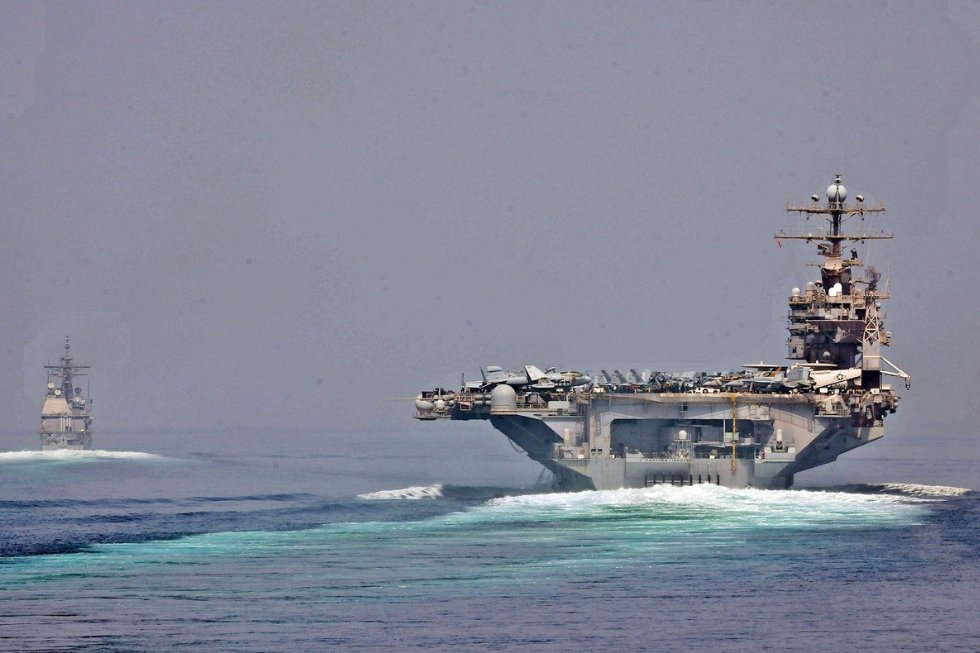




On February 28, American and Israeli forces began strikes on Tehran that eventually eliminated Iran’s Supreme Leader. Within days, Iran declared the Strait of Hormuz closed, and roughly 20 million barrels a day of crude and petroleum liquids, about one-fifth of global consumption, stopped moving through a channel 39 kilometers wide at its narrowest.
Iran had threatened this for four decades and had never once done it. The threat by itself was enough, and it worked so reliably that a generation of analysts treated the strait as a permanent unexercised option in Tehran’s hand. That option is now spent.
What the closure has cost the world is considerable and widely reported. Brent Crude went from roughly $65 to above $100 a barrel. The less examined question is what the closure has cost Iran, and the answer is the threat itself.
Oil futures do not price how many barrels go missing. Instead, prices are determined based on how long those barrels are expected to stay missing. An unexecuted threat carries no end date, which is why four decades of Iranian threats moved global prices while Iranian exports kept loading. An executed closure does carry an end date, and the market has already estimated it. On August 7, the strait was still shut, and the Intercontinental Exchange (ICE) Futures Europe forward curve projected Brent back near $69 a barrel by 2030.
Traders have never once priced this closure as permanent. Iran has traded an open-ended source of leverage for a dated one that shuts its own export route, stranding the customer buying 80-90% of its oil. It also works only once. Before February, there was no observed price path for an actual closure, only for threats, so the market had to guess what one would be worth. Since August, the curve has been that path. The next threat gets priced against it.
The effects are seen well beyond Tehran. Because most crude sells at a differential to a benchmark rather than at its own price, trouble inside the channel reprices cargoes forced to avoid it. Refiners have paid a Hormuz premium for four decades without a barrel ever going missing to justify it. Fear is cheaper than force, and Iran just proved it by executing the threat at its own expense. Why that is true, and what a futures market is actually measuring when it measures fear, can be found in how oil is priced.
A barrel is not a barrel
Crude is not one single commodity. It varies along two dimensions, and both decide what a refinery will pay. The first is density, measured on the American Petroleum Institute (API) gravity scale. Higher gravity means lighter oil, which needs less processing. Heavier crude is more expensive to process. The second is sulfur, which wrecks machinery and is restricted by regulators. The International Maritime Organization’s 2020 rule cut the amount of permitted sulfur in marine fuel from 3.5% to 0.5%, which reshaped its demand across the industry.
The crude leaving the Gulf is mostly medium and sour, not the light sweet grades the benchmarks are built on. Medium sour normally sells at a discount for that reason. Since March, it has been selling at a premium. Two mechanisms turn those two variables into a single number people can quote.
The first is futures. A futures contract fixes a price today for a commodity delivered later, and crude futures trade on the New York Mercantile Exchange (NYMEX) in New York and ICE in London. What moves those contracts is expected supply rather than realized supply. Sanctions show this cleanly. They rarely remove barrels; they reroute and reprice them, and prices move on expectations long before flows change. For example, a cargo ship leaving the Gulf carries a price that an exchange fixes before it’s chartered. The second mechanism is differential pricing. Each grade cannot be priced independently, so one serves as a baseline, and the rest is priced against it.
Three types of oil dominate the market: Brent from the North Sea, light and sweet, referenced by most globally traded crude; West Texas Intermediate (WTI), the US domestic marker, lighter and sweeter still; and Dubai and Oman, the sour Middle Eastern markers that Asian buyers use. The closure did not move them together. Sour Gulf grades, the ones that actually transit the strait, stopped trading at their usual discount to light sweet and started trading at a premium. WTI, backed by domestic supply that never goes near Hormuz, moved the least of the three.
What moves the benchmark
Two variables move the benchmark prices themselves. Organization of the Petroleum Exporting Countries and its allies (OPEC+) quotas and demand growth set the baseline, and both move slowly enough that traders can model them. What they cannot model is the geopolitical risk premium. When a shock looks possible, buyers buy futures at a premium to guarantee supply if it escalates instead of waiting to see how it resolves.
A second channel gets less attention and measures the same fear more precisely: war-risk insurance. Underwriters cover tankers against loss and charge an additional premium for each transit through a zone flagged as high risk. The Joint War Committee, which represents hull war underwriters in the London market, decides which waters carry that flag. When it widens a listed area, underwriters reprice transits within the day. The current war-risk premiums have surged to between 3-10% of hull value, against 0.25% before the war. A $100 million tanker now faces $3 million to $10 million a voyage, against roughly $250,000 in peacetime. Marsh’s global head of marine told The National that war rates have been on a roller coaster mirroring the oil price. Those costs flow straight into the delivered price of crude.
The pattern that February ended
Before the closure, the higher risk premium didn’t require anything to actually happen. Saudi Arabia, Iraq and the United Arab Emirates (UAE) shipped 13.1 million barrels a day through the strait in 2025. Pipelines can absorb only about 4.2 million barrels a day of that, leaving approximately nine million with nowhere to go.
The last clean demonstration came four weeks before the closure. On February 3, 2026, Iranian gunboats and a drone intercepted the Stena Imperative, an American tanker in the strait, and signaled it to halt for boarding. A US Navy destroyer escorted the vessel away; nothing was seized, and the episode ended within hours. Regardless, the price of Brent rose.
The same signature appeared on May 12, 2019, when saboteurs damaged four commercial vessels off Fujairah, just outside the strait: two Saudi tankers, a Norwegian tanker and an Emirati bunkering ship. A US assessment found explosive holes near the waterline, but there were no casualties, no pollution occurred and Fujairah kept operating normally.
One month later, attackers hit two tankers in the Gulf of Oman, leaving one ablaze and adrift. The cost of Brent climbed as high as $62.64 in early London trading, and $1.44 above the previous close. The Joint War Committee widened its listed areas across the region.
Global supply was unaffected by the incidents. Compared with 20 million barrels a day, the physical loss was negligible. The only affected variable was the war-risk premium, and with it the price of every cargo insured to cross that water.
That mechanism has been replaced by a closure with a date on it, which the forward curve has already priced in as temporary. Understanding why requires a detour through the one case that appears to refute the whole argument.
The case that should break this argument
If threats move prices because they signal lost supply, an actual loss of supply should move prices further and for longer. Plenty of historical examples test this.
On September 14, 2019, Saudi Aramco’s processing facility at Abqaiq and the Khurais oil field were hit by drones and missiles. The attack removed 5.7 million barrels a day, more than half of its total production and approximately 5% of the global supply. The Baker Institute calls it the largest outage in volume terms in the modern history of oil.
The price response matched the intensity of the loss. Brent Crude opened 19.5% higher at $71.95, the biggest jump on record, and closed up 14.6% at $69.02. The US Energy Information Administration logged it as the largest single-day increase in a decade. It quickly evaporated when Aramco had Abqaiq produce two million barrels a day over three days and expected full restoration by the end of the month. About two weeks later, the Baker Institute confirmed that the sense of urgency was gone.
The largest physical disruption ever recorded produced a premium that died within a fortnight, while incidents in which nobody lost a barrel moved prices at all. This shows that volume cannot be the variable; duration is.
Abqaiq terrified traders for exactly as long as Saudi repair timelines stayed uncertain, and stopped terrifying them the moment those timelines became credible. A threat to Hormuz physically removed no barrels at all, and it still outperformed Abqaiq for one reason: the lack of a deadline.
What the closure has become
The February closure showed that Iran’s leverage is its ability to prolong disruptions to the strait, not its ability to destroy supply. Without signaling, Iran shut the waterway and cross-strait traffic largely halted, stranding hundreds of vessels and thousands of mariners in the Persian Gulf. The UK Maritime Trade Operations center counted no more than five transits a day versus 138 before the war, and at least 16 commercial vessels came under attack. One analysis calls it the most severe energy supply shock in modern market history, and the UAE’s state oil company does not expect full flows to resume until 2027. The International Energy Agency released 400 million barrels from emergency stockpiles against an estimated daily shortfall of 15-20 million, and traders barely blinked.
Looking past the front month, we can see how long traders expect this to last. On August 7, 2026, with the strait still shut, ICE Futures Europe settled October 2026 Brent Crude at $82.38. December 2026 settled at $79.05, December 2027 at $72.76, December 2029 at $69.97, and December 2030 at $69.35. This shows a steep, unbroken decline across four years, which means traders will pay a large premium for a barrel this quarter and progressively less for every subsequent quarter. They have never once priced this closure as permanent. Even while it holds, the curve stays normal by the end of the decade.
The front month was more chaotic. Prices were roughly $65 a barrel before the war, peaked near $99 in May, and slid back down to about $72 in early July, then rose again to $94 in mid-July and $82 in August. The spot price screamed, yet the curve stayed calm. The front month repriced every time the estimated deadline moved, but the curve barely moved because the market’s view of the ultimate outcome has not changed.
Iran has since let some ships through, reportedly charging tolls as high as $2 million per vessel and proposing its own control of parts of the strait using a tiered system allowing ships of specific countries to pass, sometimes for a fee. Iran held this option for four decades and exercised it in February, proving that the threat was worth more than the act.
The price of dependence
The unexecuted threat costs nothing, repeats indefinitely, and carries no end date. For four decades it moved global oil prices without costing Iran a barrel, whereas the executed closure of the Strait of Hormuz cost Iran its own exports, which leave through the same waterway. It also costs China, which buys 80-90% of Iran’s oil exports.
For India, none of this is a foreign quarrel, but a structural exposure, and its shape has changed more than most commentary has noticed. India imports roughly 85% of the crude it refines, and the sensitivity is well established: the annual import bill moves by $1-2 billion for every $1 change per barrel.
But 85% import dependence is not 85% Hormuz exposure. In 2025, 41% of India’s crude came through the strait. By the eve of the closure, it had climbed to 52%, as refiners backed away from Russian barrels. Six weeks later, India was sourcing 70% of its crude from outside Hormuz. Exposure peaked at half and fell to under a third.
India’s dedicated strategic reserve holds about nine and a half days of crude at full capacity, and it has not been full. Commercial stocks at the refiners stretch total cover to roughly two months. Either way, it is insurance sized for a disruption measured in weeks.
This year, Iran closed the Strait of Hormuz, affecting 20 million barrels a day for months. The instructive part is how fast the market decided it could live with that. The front month fluctuated all spring, and the far end of the curve barely moved.
For forty years, Iran collected a tax levied by expectation, and collecting it cost nothing because the threat of more closures had no deadline. The execution of this threat in February proved that the waterway was worth more when everybody was only afraid of it.
[Lora Karch edited this piece.]
The views expressed in this article are the author’s own and do not necessarily reflect Fair Observer’s editorial policy.
FO Exclusive: Global Economy Teetering on Brink of Major Crisis
In this section of the August 2026 episode of FO Exclusive, Atul Singh and Glenn Carle warn that mounting debt,...

US vs. Iran: Battle of Wills in the Gulf
The Iran War has inflicted severe economic pain on Iran and political strain on the United States after six months....

Waterways Will Shape the Middle East’s Future
The battle for control of the Strait of Hormuz and Bab al-Mandab is reshaping the post-war political map of the...
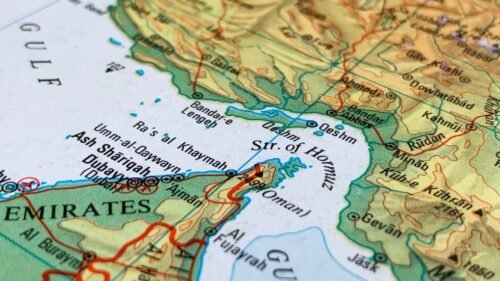
Support Fair Observer
We rely on your support for our independence, diversity and quality.
For more than 10 years, Fair Observer has been free, fair and independent. No billionaire owns us, no advertisers control us. We are a reader-supported nonprofit. Unlike many other publications, we keep our content free for readers regardless of where they live or whether they can afford to pay. We have no paywalls and no ads.
In the post-truth era of fake news, echo chambers and filter bubbles, we publish a plurality of perspectives from around the world. Anyone can publish with us, but everyone goes through a rigorous editorial process. So, you get fact-checked, well-reasoned content instead of noise.
We publish 3,000+ voices from 90+ countries. We also conduct education and training programs
on subjects ranging from digital media and journalism to writing and critical thinking. This
doesn’t come cheap. Servers, editors, trainers and web developers cost
money.
Please consider supporting us on a regular basis as a recurring donor or a
sustaining member.
Will you support FO’s journalism?
We rely on your support for our independence, diversity and quality.





Comment