





Last year, Sudan’s army was flying drones with a clear origin. Satellite images caught Mohajer-6 airframes parked on the runway at Wadi Sayyidna — an Iranian-designed platform the Rapid Support Forces (RSF) said it had shot down over Omdurman for the third time. Tehran, seeking a foothold on the Red Sea, had quietly become the Sudanese Armed Forces’ (SAF) most important military patron, running cargo flights into Port Sudan and reportedly negotiating restored diplomatic ties as the drones landed.
This year, the wreckage in Sudan’s fields carries a different label. In May, the Sudanese army used a Turkish-made Bayraktar Akıncı to shoot down a rival Akıncı-type drone believed to be flown by the RSF, in what analysts called the first confirmed case of one-armed drone destroying another over Sudanese airspace. RSF fighters have separately posted footage of their own downed Akıncı airframes near El-Fasher. The shift from Iranian to Turkish wreckage on Sudan’s battlefields is not a procurement coincidence. It is the clearest available evidence of a regional realignment triggered by Iran’s own war.
Iran doesn’t have drones to spare right now. The US and Israel spent months bombing its missile and weapons facilities, and Tehran responded with a barrage of its own: Roughly 4,400 one-way attack drones fired at Israel and Gulf targets in the war’s first weeks alone. That kind of expenditure eats into the same industrial base that once supplied Sudan. Iran will likely rebuild its own stockpiles before anyone else’s, and Tehran will likely trim deliveries to more distant clients like the SAF rather than its closer proxies. Months into the conflict, the SAF has made the call itself, halting Iranian purchases to look better to Washington ahead of ceasefire talks.
So, into that vacuum has stepped a trio of suppliers — Turkey, Egypt and Pakistan — each pursuing its own interests.
Iran’s retreat, new suppliers
Turkey’s role is the most consequential. Baykar, maker of the Bayraktar line, covertly funneled more than $120 million in drones, warheads and command systems to the SAF, equipment credited with helping the army retake Khartoum, el-Gezira and North Kordofan. A secret launch site reportedly even exists inside Egypt itself: a base at East Oweinat in the country’s southwest, from which Turkish-made Akıncı drones are reportedly flown against the RSF with Cairo’s approval.
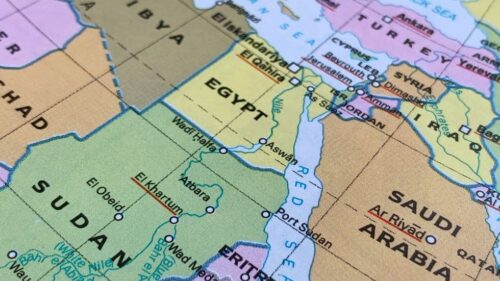
Cairo, however, does more than host Ankara’s hardware. Egypt has its own supply line to Sudan. After the RSF took El-Fasher almost a year ago, Egyptian officials began coordinating troop movements with the SAF and providing operational guidance and weapons directly. Yet, the relationship began earlier. After Sudanese General Abdel Fattah al-Burhan flew to Ankara in 2023, Egypt handed over the SAF Bayraktar TB2 drones and trained Sudanese crews to fly them. According to Cairo, it’s all about the Nile and its border security. Regardless of the stated reason, Egypt and Turkey are now the SAF’s most reliable arms suppliers.
Pakistan is the newest and largest entrant. The Sudanese army received Pakistani-made Mohafiz armored vehicles and Shahpar reconnaissance drones this summer, part of a reported $1.5 billion package that also includes K-8 light attack aircraft, more than 200 unmanned aerial vehicles (UAVs) and possibly JF-17 fighter aircraft. The deal is said to be financed by a third party, with Saudi Arabia’s ambassador to Islamabad publicly credited with brokering it.
However, Riyadh’s fingerprints extend further still, into the war economy itself.
Gold, Gulf capital, war finance
Sudan’s gold, not oil, is what keeps the SAF’s weapons flowing. Chatham House researchers have traced how roughly 60% of gold produced in army-held Northern, River Nile and Red Sea states is smuggled into Egypt, entering formal trading circuits that ultimately fund arms purchases. A separate GIS Reports account, drawing on Chatham House research, notes Cairo’s central bank has adjusted policy specifically to absorb that Sudanese gold. Layered atop that gold-backed liquidity is direct Gulf financing, with Saudi Arabia, wary of Iranian influence along the Red Sea, emerging as the SAF’s chief Gulf patron and the presumed underwriter of the Pakistani deal.
What links Cairo, Ankara, Islamabad and Riyadh is not ideology but opportunity. Iran’s drone diplomacy in Sudan was built on cheap, exportable hardware and a willingness to sell to a sanctioned army few others would touch. Weakened by its own war, Tehran has ceded that market.
The SAF still wants what Iran once supplied: precision strike capability against a paramilitary force it cannot otherwise dislodge. Egypt, Turkey and Pakistan, each for reasons rooted in their own regional calculations, have been only too willing to answer that demand, with Gulf gold and Saudi capital paying the bill.
[Kaitlyn Diana edited this piece.]
The views expressed in this article are the author’s own and do not necessarily reflect Fair Observer’s editorial policy.
FO Live: The Red Sea Crisis — Power Struggles in Yemen and Sudan
In this episode of FO Live, Atul Singh, Fernando Carvajal and Abdul Galil Shaif examine how Islamist factions obstruct political...

Is Sudan’s Bloody War Reaching a Tipping Point?
Sudan’s civil war has grown well beyond national conflict — it threatens to explode into a greater war across the...
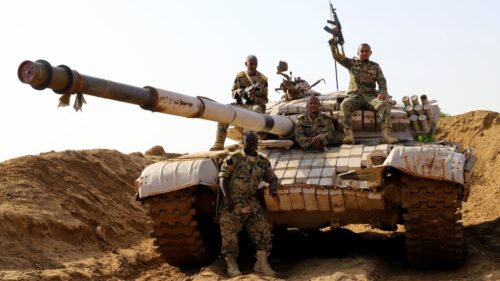
Riyadh’s Sudan Contradiction: Mediator by Day, Arms Broker by Night
Saudi Arabia’s role in Sudan’s war reveals a stark contradiction: It positions itself as a neutral mediator, while also allegedly...
Support Fair Observer
We rely on your support for our independence, diversity and quality.
For more than 10 years, Fair Observer has been free, fair and independent. No billionaire owns us, no advertisers control us. We are a reader-supported nonprofit. Unlike many other publications, we keep our content free for readers regardless of where they live or whether they can afford to pay. We have no paywalls and no ads.
In the post-truth era of fake news, echo chambers and filter bubbles, we publish a plurality of perspectives from around the world. Anyone can publish with us, but everyone goes through a rigorous editorial process. So, you get fact-checked, well-reasoned content instead of noise.
We publish 3,000+ voices from 90+ countries. We also conduct education and training programs
on subjects ranging from digital media and journalism to writing and critical thinking. This
doesn’t come cheap. Servers, editors, trainers and web developers cost
money.
Please consider supporting us on a regular basis as a recurring donor or a
sustaining member.
Will you support FO’s journalism?
We rely on your support for our independence, diversity and quality.





Comment