


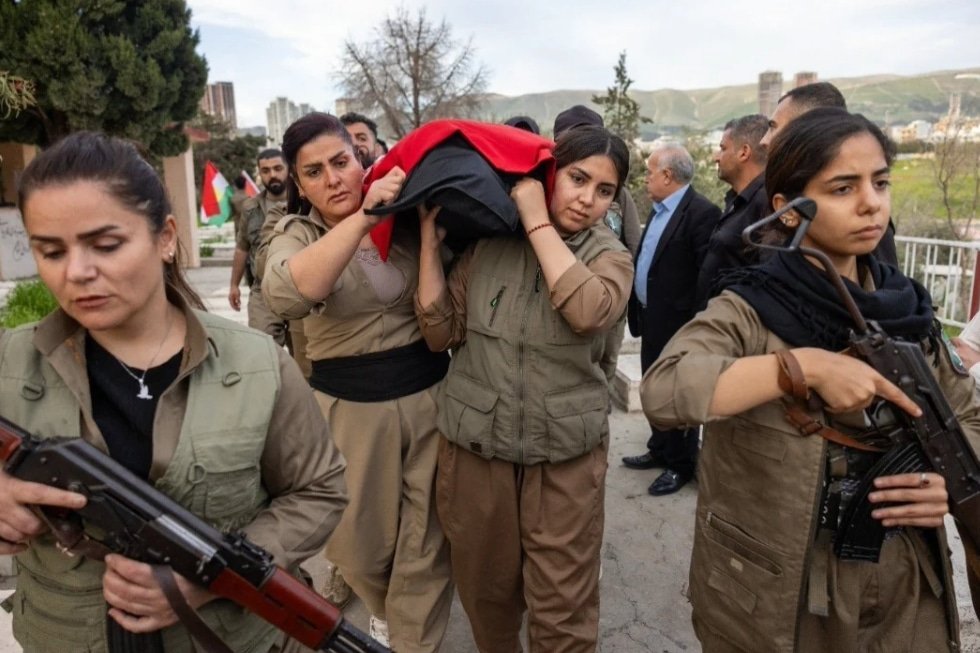


On September 30, the US-led international anti-Islamic State of Iraq and Syria (ISIS) coalition completely left the Kurdistan Region of Iraq. The coalition, formed in 2014 to fight ISIS, enacted the withdrawal as part of a two-phase plan agreed on in September 2024 by the Biden administration and the Iraqi government. The plan aimed to end the coalition’s military mission in Iraq, and the first phase was completed in January 2026.
The withdrawal raised fears among Kurdish citizens that the region could be targeted by continued drone and missile strikes, or face a resurgence of jihadist militants. These fears were immediately reinforced given that on the same day of the withdrawal, a drone strike hit an empty cemetery belonging to the Iranian Kurdish opposition party Democratic Party of Iranian Kurdistan (PDKI). So far, there have been five Iranian drone and missile attacks on Iranian Kurdish opposition parties since the Coalition withdrawal on 30 September.
According to Hana Yazdanpana — a member of the foreign relations department of the Iranian Kurdish opposition party, the Kurdistan Freedom Party (PAK), whose party was targeted with ballistic missile strikes on October 21 — the International Coalition forces’ withdrawal will create a security vacuum in the region:
Those with the greatest opportunity to exploit that vacuum are Iran and the groups under the command of the Quds Force in Iraq, Syria, Lebanon, and Bahrain, as well as ISIS. They may return to the field under different names and banners than those we have seen in the past … The first nation in the Middle East likely to become a target of Iran’s hard and soft power, and of these various groups, is the Kurdish people. This applies both to the Kurdistan Region and to other parts of Kurdistan, because the Kurds are also the first nation to stand in opposition to their ideology, values, policies, and conduct. Do you remember when it was said that the Kurds were fighting ISIS on behalf of the entire world and protecting the world?
Her comments reflect Kurdish anxieties that the reduced US military presence could create a vacuum exploited by either Iran or ISIS. For the Kurdistan Region, it will also result in greater pressure by Iran and Iran-backed Iraqi factions, since the Kurds now lack air defenses and are more exposed. These anxieties are not merely theoretical; a surge in Iranian diplomatic and media pressure is actively reinforcing them to justify further intervention.
On October 20, Iran’s Ambassador claimed that Iran reached a deal with Baghdad to expel Iranian Kurdish opposition groups or surrender them to Iran. Iraq’s national security advisor denied the ambassador’s claims. Iranian state media also recently claimed that Ukrainian drones were based in the Kurdistan Region, posing a threat to Iran — a claim that was quickly denied by the Ukrainian embassy in Baghdad. Iran’s Consul General also told Rudaw on October 8 that Iran could still hit targets in the Kurdistan Region after the US withdrawal, arguing that the CIA is still present.
These statements, alongside Tehran’s escalating military and diplomatic pressure, underscore the growing vulnerability of Iraqi Kurdistan. The Coalition’s departure has not only reduced the international security presence but also left the Kurds more exposed. With limited air-defense capabilities and an increasingly uncertain security environment, the Kurdistan Region must now rely more heavily on Baghdad while seeking renewed Western assistance to protect its territory and preserve its security.
Iran’s attacks
Since February 28, the Kurdistan Region has faced over 1,000 drone and missile attacks during the US–Iran war. These attacks targeted Coalition troops, Iranian Kurdish opposition parties and Kurdish security forces, and have affected civilians, killing over 30 people.
Even before the US–Iran war, Iran and Iran-backed groups have targeted the Kurdistan Region, including oil fields, Iranian Kurdish opposition parties, the Coalition and Kurdish businessmen. Iran has especially targeted Iranian Kurdish opposition parties that, according to a CNN report in March, were armed by the CIA to spark a Kurdish uprising in the country. However, Iranian Kurdish groups have denied receiving any weapons.
Yazdanpana added:
I believe that the Region will face challenges and pressure from Iran, the (Iraqi) Popular Mobilization Forces (PMF), and ISIS. The United States and its allies bear responsibility for any threat, danger, or plot directed against the Kurds in general and the Kurdistan Region in particular.
Speaking on October 4 at an event, Kurdistan Democratic Party (KDP) President Masoud (PM) Barzani stated that half of these attacks came directly from Iran, while others were launched by armed groups inside Iraq affiliated with Iran. He also underlined that whenever the issue was raised with Iranian officials, those responsible offered excuses such as mistakes or faulty intelligence, and that the attacks resumed after the fighting had subsided to some extent.
On August 17, the personal office of the Kurdistan Regional Government (KRG) PM Masrour Barzani and the home of the head of the Security and Intelligence Agency were targeted by Iranian drone attacks. At the time, Iranian Foreign Minister Abbas Araghchi denied that Iran was involved in the attack, claiming it was a false-flag ploy.
“During the course of the war between Iran and the US, the Iranians and pro-Iranian Iraqi militias attacked Iraqi Kurdistan over a thousand times with drones and ballistic missiles,” David Witty, a retired US Army Special Forces Colonel and Foreign Area Officer, told me. “If the fight between Iran and the US resumes, I expect Kurdistan will again be in the crosshairs.”
Furthermore, he added that there is the threat of Iranian-backed factions that have carried out attacks on the Kurdistan Region:
They were primarily using the US presence in Kurdistan as the justification, but they have also cited the presence of anti-Iranian regime forces in Kurdistan, and the Iranians themselves sometimes referred to an alleged Israeli presence there. Iraqi PM Zaidi pledged to disarm the militias by 30 September of this year, but the deadline has been revised to the end of June 2027.
Addressing Kurdish fears, on October 3, Abu Waala al Wa’eli, leader of the Iran-backed Iraqi armed group Kataib Sayyid al-Shuhada, underlined that the Coalition withdrawal should not be a cause of concern for the Kurdistan Region:
We affirm to our brothers in the Kurdistan Region of Iraq that their security and stability are an inseparable part of Iraq’s security and stability, and that any threat facing the Region is a national responsibility concerning all Iraqis. Therefore, the US withdrawal should not be a cause for their concern, but rather an occasion to reaffirm the ability of Iraqis to protect their country and land and safeguard their unity and sovereignty.
ISIS threats
After the Coalition’s withdrawal, there have also been incidents with ISIS. On October 5, a clash broke out between security forces and ISIS in Kirkuk’s Hawija district. The clash left one police officer dead and two others injured, and also led to the arrest of an ISIS leader. The KRG’s Interior Minister also recently warned on October 13 that ISIS has not been eliminated yet.
The Kurdistan Region Security Agency, also on October 5, announced the arrest of 22 ISIS members, who were planning to establish an emirate in the region of Hawraman. Then, on October 6, KRG PM Masrour Barzani downplayed the risk of the Coalition’s withdrawal for Kurds. He underlined that even during the fight against ISIS, most of the fighting was carried out by the Peshmerga and Iraqi forces. During the war, they both received advice, weaponry and training:
Today, the Iraqi forces are at a better level, while the Peshmerga forces are ready, well-equipped and at a very good level, capable of confronting any threat that may target Iraq, particularly the Kurdistan Region … Therefore, we are not concerned about a security vacuum emerging.
This indicates that the Kurds see the continued drone attacks by Iran as a bigger risk than ISIS, especially since tensions are continuing between Iran and the United States and that so far no deal has been made by the two sides.
Air defenses
KRG PM Masrour Barzani said the Kurdistan Region’s main priority is to obtain counter-drone systems, meaning air-defense capabilities: “I believe we need more assistance from our friends in this regard. We remain in dialogue with the federal government, and we are also in continuous discussions with our friends to secure forces and air-defense capabilities.”
Joel Wing, Iraq expert and author of the Musings on Iraq blog, told me that the Kurds were relying upon American air defense systems to protect Erbil from strikes from Iran and Iranian-backed Iraqi resistance factions. “There are still systems in place at the US consulate, but that’s probably not capable of covering as wide an area as before, so the city is now more vulnerable.”
He added that:
Tehran and its Iraqi allies have singled out the Kurds for attacks because they are the closest to the US and Israel. Baghdad should be providing air defense to Kurdistan, but it has been so slow in protecting itself, there’s no telling when that will happen.
The Coalition withdrawal also makes the Kurds more dependent on Baghdad. Iraqi Defense Ministry spokesman Major General Yahya Rasool told Al Sumaria on October 2 that he had ordered the Kurdistan Region to provide an air defense system within three years, while work continues to complete missile and radar systems of various ranges.
“The US withdrawal will leave Kurdistan vulnerable to attacks from Iran and its proxy militias, making air defenses essential,” former spokesman for the deputy PM of Iraq Entifadh Qanbar, and head of the Head of the US-based Kurdish Protection Committee, told me. Adding that “[T]he solution goes beyond simply providing defensive weapons. Washington must abandon its one-size-fits-all approach and adopt two distinct policies: one for Kurdistan and another for the rest of Iraq.”
In the past, Washington has provided weapons to the Kurdistan Region only with Baghdad’s approval, as part of its “One Iraq” policy. “The Pentagon should provide weapons directly to the Peshmerga, bypassing Baghdad, including urgently needed air defenses,” Qanbar concluded.
Iraq’s Kurds, long-standing Western partners and key allies in the fight against ISIS, now feel more exposed and abandoned. This is to be expected with the Coalition’s withdrawal and the fact that Iran could target them again if renewed clashes break out between the US and Iran before or after the US midterm elections. To protect themselves, the Kurds urgently need effective counter-drone and air-defense systems. Yet Iraq’s centralized approach to military assistance, and its slow progress in developing adequate air-defense capabilities, risk leaving the Kurdistan Region without the means to respond to further attacks.
Ultimately, the Coalition’s departure should not mean the abandonment of the Kurds or the end of Western responsibility toward a partner that played a central role in defeating ISIS. Without sustained international support and meaningful defensive capabilities, Iraqi Kurdistan risks becoming increasingly vulnerable to Iranian coercion, renewed militant activity and the consequences of another US–Iran confrontation.
[Kaitlyn Diana edited this piece.]
The views expressed in this article are the author’s own and do not necessarily reflect Fair Observer’s editorial policy.
Ethnic Strife Looms Large As Trump’s Weighs Options In Iran
Recently, Shiite clerics in Bahrain were arrested, while Baloch and Kurdish religious figures were assassinated in Iran. These events risk...
Why Ghassemlou’s Vision Endures Among the Kurds in Iran
As Secretary General of the Democratic Party of Iranian Kurdistan (PDKI), Dr. Abdul Rahman Ghassemlou provided a coherent vision for...
Iran Turns Kurdistan Region Into a Proxy Battlefield
The Kurdistan Region of Iraq (KRI) has faced relentless attacks from Iran and its proxies, despite its declared neutrality in...
Support Fair Observer
We rely on your support for our independence, diversity and quality.
For more than 10 years, Fair Observer has been free, fair and independent. No billionaire owns us, no advertisers control us. We are a reader-supported nonprofit. Unlike many other publications, we keep our content free for readers regardless of where they live or whether they can afford to pay. We have no paywalls and no ads.
In the post-truth era of fake news, echo chambers and filter bubbles, we publish a plurality of perspectives from around the world. Anyone can publish with us, but everyone goes through a rigorous editorial process. So, you get fact-checked, well-reasoned content instead of noise.
We publish 3,000+ voices from 90+ countries. We also conduct education and training programs
on subjects ranging from digital media and journalism to writing and critical thinking. This
doesn’t come cheap. Servers, editors, trainers and web developers cost
money.
Please consider supporting us on a regular basis as a recurring donor or a
sustaining member.
Will you support FO’s journalism?
We rely on your support for our independence, diversity and quality.





Comment