






Singapore is often seen as a symbol of stability and prosperity, embodying a model of efficiency. In 2025, the country remains resilient. The GDP climbed by 4.4% in the second quarter, significantly surpassing expectations. Growth forecasts have ranged between 1.5% and 2.5% for the year. This is welcome news after a period marked by uncertainty. But such performance should not obscure the challenges the city-state is confronting.
Adapting to global volatility
Global supply chains remain exposed. Tensions between China and the United States continue to escalate, casting a shadow over regional economies, including Singapore’s. Demand across major markets remains fragile. Protectionist policies — not unique to any one country — are beginning to weigh on Singapore’s export-driven model.
Despite the turbulence, Singapore continues to adapt. The government has launched a comprehensive review of its economy in an effort to align itself with rapid technological shifts and to safeguard competitiveness in the long term. The review isn’t simply a bureaucratic exercise; it’s a nationwide conversation about what kind of economy Singapore should build for the future.
Planning for the next chapter
This strategic review is more than an academic vision. It brings together business leaders, academics and citizens. Its purpose is not only to chart a course but to build shared ownership of the path forward. Singapore has long chosen to pre-empt rather than react. The review, expected to conclude around May 2026, could become a pivotal moment in the country’s economic evolution.
While long-term plans take shape, some sectors are already showing signs of resilience. The Singapore Exchange (SGX), often viewed as a barometer of investor sentiment, is experiencing something of a renaissance. More companies are choosing to list, and SGX revenues have hit record highs. It’s a signal that confidence in Singapore as a financial center remains firm, even amid uncertainty.
Geopolitics: a persistent challenge
Still, the geopolitical landscape cannot be ignored. Tensions between China and the United States are no longer abstract but are beginning to affect trade policies. US tariffs on certain Singaporean exports could erode the country’s competitiveness, especially in critical technology and pharmaceutical sectors. If these areas are directly targeted, the consequences could be serious.
Singapore’s economy, highly dependent on global trade, is inherently vulnerable to these shifts. The stakes are high, and the room for error is narrowing.
In this environment, Singapore continues to serve as a strategic business hub — a middle ground between competing global powers. But the global order is shifting. What worked in the past may no longer be enough. The country must continue to evolve while holding firm to the values that have long defined it: openness, stability and competitiveness.
Here, the ongoing strategic review takes on deeper meaning. It’s more than policy — it’s preparation. A clear intention is emerging: Singapore must remain ahead of future disruptions and maintain relevance in a world that is becoming harder to predict.
Reinvention is the key
Vision alone, however, is not enough. Execution matters. The prosperity Singapore enjoys today will depend on whether it can translate plans into action — and do so with urgency and precision. The world is moving fast. So too must Singapore.
Competition is intensifying globally. Rules are changing. Geopolitical relationships are increasingly volatile. Singapore, small though it may be, has repeatedly shown it can thrive in adversity. The challenge now is not just to survive, but to innovate and lead.
The coming months will be decisive. If Singapore can navigate this moment of transition, it may well emerge even stronger, not just as a regional hub but as a global contender. But the path forward is narrow. The stakes are rising.
If history is any guide, Singapore is more than capable of rising to the occasion. Its future depends on its willingness to keep reinventing itself, before it is forced to.
[Natalie Sorlie edited this piece.]
The views expressed in this article are the author’s own and do not necessarily reflect Fair Observer’s editorial policy.
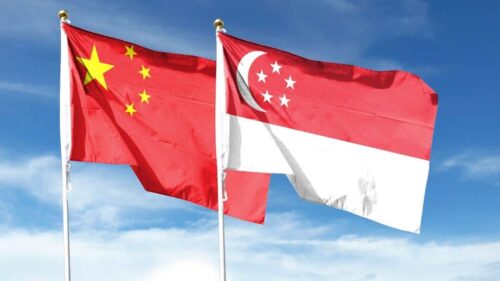
China and Its Mentor, Singapore
China’s rapid transformation owes much to former leader Deng Xiaoping’s reforms, which were deeply inspired by Singapore’s model of state-led...
Tariffs, Strategy and the Cost of Misplaced Power
US tariffs aimed at constraining China have spurred Beijing to strengthen its strategic position. It’s embedded its manufacturing and innovation...
Geopolitics by Design: Rethinking Power in the Age of Critical Technologies
In this era of techno-sovereignty, national power increasingly depends on one’s ability to develop and integrate critical technologies like AI,...

The Enduring Relevance of Development Economics in an Unequal World
Some economists argue that as developing countries’ incomes rise and mainstream economics converge with development studies, the distinctiveness of development...

Support Fair Observer
We rely on your support for our independence, diversity and quality.
For more than 10 years, Fair Observer has been free, fair and independent. No billionaire owns us, no advertisers control us. We are a reader-supported nonprofit. Unlike many other publications, we keep our content free for readers regardless of where they live or whether they can afford to pay. We have no paywalls and no ads.
In the post-truth era of fake news, echo chambers and filter bubbles, we publish a plurality of perspectives from around the world. Anyone can publish with us, but everyone goes through a rigorous editorial process. So, you get fact-checked, well-reasoned content instead of noise.
We publish 3,000+ voices from 90+ countries. We also conduct education and training programs
on subjects ranging from digital media and journalism to writing and critical thinking. This
doesn’t come cheap. Servers, editors, trainers and web developers cost
money.
Please consider supporting us on a regular basis as a recurring donor or a
sustaining member.
Will you support FO’s journalism?
We rely on your support for our independence, diversity and quality.
Andaman Sea “Ghost” Fleet: The Invisible Oil Fueling Myanmar’s Genocide
In the Andaman Sea, the Rohingya exodus and the “Shadow Fleet” converge in a “Ghost Protocol”. By deactivating AIS transponders,...

Feeding Indonesia’s Future, or Poisoning its Promise?
Indonesia’s Free Nutritious Meals program was established to provide millions of children with nutritious meals. Unfortunately, children have experienced food...
Security in South Asia: Shifting Ways of the Islamic State
A top official of the Islamic State Khorasan Province was killed, signaling shifting dynamics within the organization. After years of...





Comment