

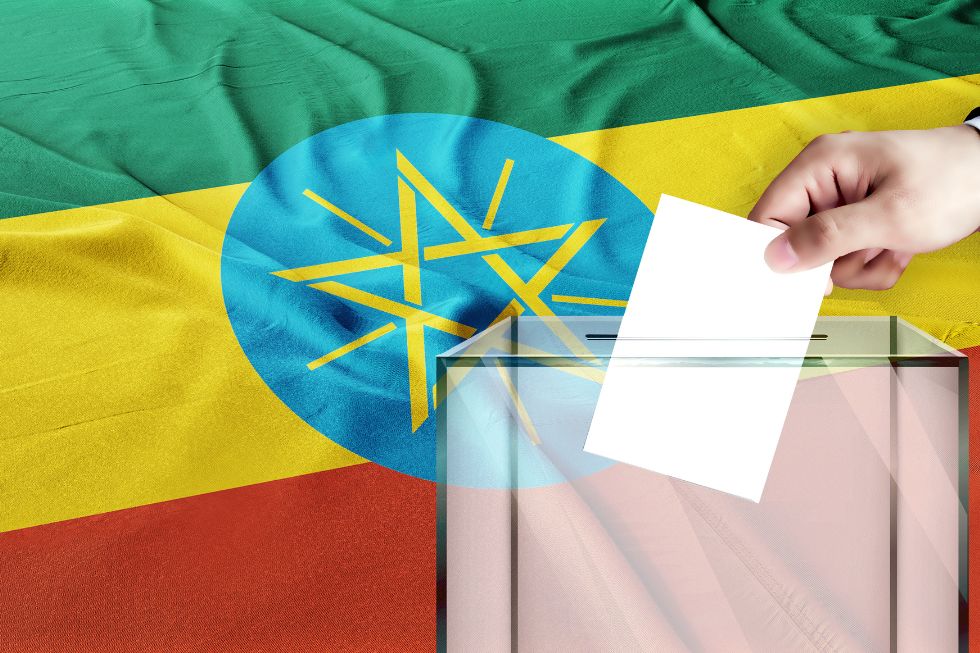




In the dust and uncertainty of contemporary Ethiopia, one image from the June 2026 election lingers with unusual force: Millions of citizens stand patiently in lines to vote while vast parts of the country remain scarred by war, displacement and grief. More than 50 million Ethiopians registered to vote, with turnout reportedly approaching 90% in areas where polling took place. It was one of the largest electoral exercises ever conducted on the African continent.
Yet it was also an election defined as much by absence as participation. Entire constituencies in Tigray did not vote. Hundreds of polling stations in Amhara and Oromia were closed because of security concerns. Over 4 million internally displaced people continue to live between uncertainty and survival.
The contradiction is impossible to ignore. Ethiopia demonstrated a remarkable capacity to organize an election under extraordinarily difficult circumstances. Electoral logistics such as digital registration systems and biometric voter identification showcased institutional resilience. Observers from the African Union (AU), an organizational body made up of the 55 African states, reported smooth voting where polling occurred. Yet the deeper question confronting Ethiopia is not whether ballots could be counted. It is whether democratic participation can evolve into a political culture capable of resolving conflict through institutions rather than confrontation. That question will shape not only Ethiopia’s future but also the strategic trajectory of the Horn of Africa.
Ethiopians chose democracy over disengagement
For much of the past decade, Ethiopia has embodied both Africa’s promise and its peril. Home to roughly 130 million people, it is the continent’s second-most populous nation, a diplomatic heavyweight, a critical security actor and one of the fastest-growing economies of the 2000s before conflict reversed much of that progress. The country’s civil war in Tigray, alongside continuing violence in Amhara and Oromia, has exacted staggering costs.
The Tigray conflict generated more than five million displacements in 2021 alone, one of the largest displacement crises recorded anywhere in recent history. Human rights organizations continue to document allegations of atrocities, attacks on civilians and severe humanitarian distress across conflict-affected regions.
Against this backdrop, the election became a test of whether the Ethiopian state still possessed enough legitimacy to persuade citizens that political participation remains preferable to armed struggle.
The answer, surprisingly, may be yes. Despite years of violence, millions still chose the ballot box. That matters. Across fragile states, public disengagement often arrives before institutional collapse. Ethiopia has not yet reached that point. The willingness of citizens to participate despite profound hardship suggests that faith in the idea of democratic politics has not entirely disappeared. In many respects, that may be the most important result of the election.
Yet democratic resilience should not be mistaken for democratic consolidation. Political scientists often distinguish between elections and democracy. Elections are events. Democracy is a system of conflict management. The latter requires institutions that citizens trust even when they lose. It requires courts that are independent, media that are free, opposition parties that can organize safely and security forces that protect citizens rather than political interests.
Those foundations remain fragile in Ethiopia. Opposition parties released a statement claiming that the parties were marginalized, co-opted or excluded from meaningful competition. Concerns about arrests, restrictions on civic space and uneven political participation continue to cloud perceptions of electoral credibility. When citizens conclude that elections cannot produce meaningful political change, the temptation to seek alternatives outside institutional channels inevitably grows.
Peace relies on stabilizing democracy
History offers sobering lessons. Countries emerging from conflict rarely achieve lasting peace through electoral exercises alone. Sierra Leone’s post-war stabilization required years of institutional reform and community reconciliation. South Africa’s democratic transition succeeded not because elections solved political grievances but because institutions gradually became trusted mechanisms for managing them. Bosnia’s fragile peace survived because constitutional arrangements created incentives for negotiation rather than violence.
Ethiopia now faces a similar challenge. The country’s future stability will depend less on who won the 2026 election than on whether political actors increasingly view institutions as legitimate arenas for contestation. The central question is whether disagreements over power, identity and resources can be channeled through constitutional mechanisms rather than armed mobilization.
This challenge is particularly acute because Ethiopia’s conflicts are deeply intertwined with competing visions of the state itself. Debates over ethnic federalism, regional autonomy and national identity have become central fault lines in contemporary politics. Military victories cannot settle these questions permanently. Nor can electoral victories. Only sustained political dialogue can.
Encouragingly, pathways exist. The Institute for Security Studies has repeatedly emphasized the importance of reviving Ethiopia’s stalled transitional justice agenda. Meaningful accountability for wartime abuses, combined with broader national dialogue, could help rebuild trust between communities and institutions. Transitional justice is often politically uncomfortable, but unresolved grievances rarely disappear. They merely await new opportunities to re-emerge.
The outcome may have an international ripple effect
The significance extends far beyond Ethiopia. As one of Africa’s most consequential states, Ethiopia’s trajectory will influence regional stability, migration patterns, economic integration and security dynamics across the Horn and the wider Red Sea corridor.
The international dimension also deserves greater attention. Ethiopia’s democratic future is unfolding amid intensifying geopolitical competition across the Red Sea and Horn of Africa. Gulf powers, Turkey, Egypt, China, the United States and European actors all possess significant strategic interests in the region. The Bab el-Mandeb Strait, which connects the Red Sea to the Indian Ocean, carries roughly 12% of global trade and is affected by proxy wars. Maritime access and regional influence increasingly shape external engagement.
Too often, however, international policy towards Ethiopia reflects a familiar contradiction. External actors routinely celebrate democratic progress while prioritizing security partnerships and geopolitical calculations when crises emerge. Ethiopia has been described as “too big to fail,” creating incentives for foreign governments to tolerate instability so long as broader strategic interests remain protected.
That approach carries risks. Stability built primarily on security calculations tends to prove temporary. Durable stability emerges when citizens believe institutions can deliver justice, representation and opportunity. The most hopeful interpretation of Ethiopia’s 2026 election is therefore that democracy remains possible.
There is hope for Ethiopia’s democracy
In a world increasingly defined by polarization, conflict and democratic backsliding, the sight of millions participating peacefully in political life retains profound significance. It signals that the social contract has been damaged but not destroyed. It suggests that despite war and displacement, many Ethiopians still see politics as a vehicle for shaping the future rather than merely surviving the present.
The harder work begins now. Ethiopia’s greatest test is no longer organizing elections. It is transforming electoral participation into institutional trust. It is proving that ballots matter after polling day. It is demonstrating that courts, legislatures, dialogue mechanisms and local governance structures can address grievances before they become insurgencies.
The country stands at a rare historical crossroads. One path leads towards recurring cycles of conflict punctuated by elections that legitimise authority but fail to resolve underlying tensions. The other leads towards a more ambitious project: a political culture in which disputes are settled through institutions rather than force, and where democratic participation becomes the foundation for national renewal.
Ethiopia’s future will ultimately depend on whether its hard-won electoral participation can mature into something deeper: a shared belief that institutions, however imperfect, are more powerful than violence. If that transition succeeds, the country will have built the foundations for a more stable future. If it fails, the ballot box risks becoming another symbol of opportunities deferred rather than destinies fulfilled.
[Cheyenne Torres edited this piece.]
The views expressed in this article are the author’s own and do not necessarily reflect Fair Observer’s editorial policy.







Join the conversation
Share your perspective
Log in to share your thoughts and take part in the discussion.