


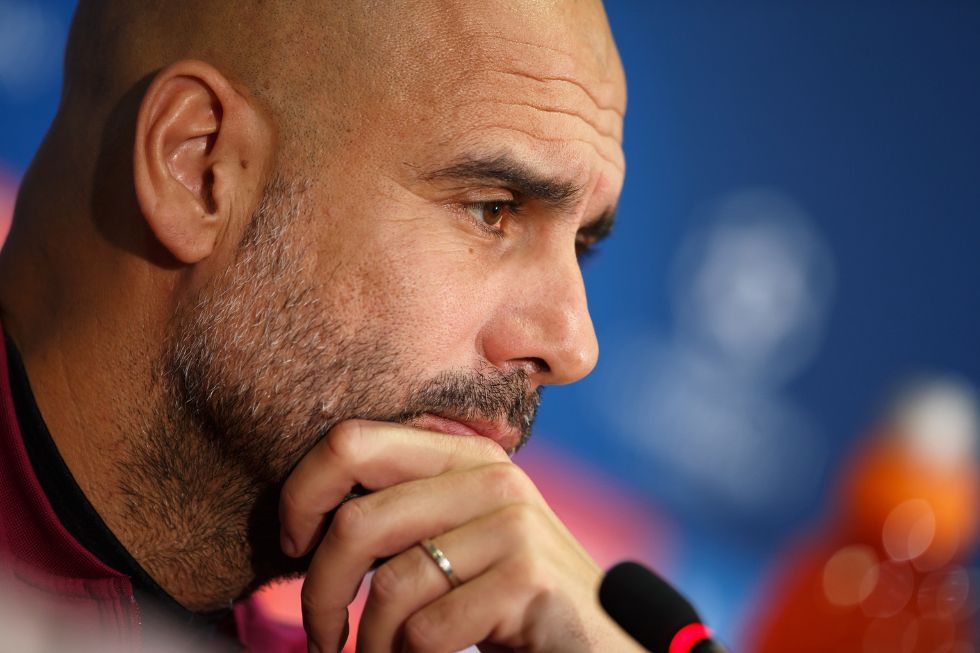


In February, Pep Guardiola, arguably the defining football coach of his generation, missed his weekly news conference and went to a charity event in Barcelona, where he delivered a speech in support of Palestinian children. Signaling his solidarity by wearing a Bedouin keffiyeh — a traditional headdress worn in the Middle East and North Africa — he addressed the crowd with the common Arabic greeting, “Salam alaikum” (Peace be upon you), before making what he called “a statement for Palestine and … a statement for humanity.”
Ten years of change
Guardiola was employed by Premier League club Manchester City at the time. The club is owned by the Abu Dhabi Group, the majority shareholder of which is Emirati royal and billionaire Sheikh Mansour bin Zayed Al Nahyan. One wonders what would have happened had Guardiola been employed by London club Tottenham Hotspur, which is owned by an investment company ENIC, controlled by British billionaire Joe Lewis and his family. The club’s strong historical ties to the Jewish community in North London has long shaped its identity, with its ownership and fanbase reflecting that association for decades.
Guardiola has now left the Manchester Club after ten years, during which his team won every honor available. His tactical approach, influenced by basketball, has affected other coaches around the world: possession, screens and set pieces became commonplace in the sport.
Barely a month after Guardiola started at the club in July 2016, another incident shaped sport, this time in an altogether different way. NFL player Colin Kaepernick sat during the American national anthem on August 26, 2016, before a preseason game. He later switched to kneeling to show more respect to military veterans, but his meaning was still clear. That summer had seen deadly police shootings in the United States: Police shot and killed Alton Sterling in Louisiana and Philando Castile in Minnesota, leading to widespread protests across the nation.
Remember: With notable exceptions, wider events ostensibly do not affect sports. Governing organizations warn athletes not to express opinions, views or perspectives of any kind on controversial topics. The template came about during Avery Brundage’s presidency of the International Olympic Committee, from 1952 to 1972. Brundage incorporated this into the Olympic charter and other sports followed. American athletes Tommie Smith and John Carlos created a major cause célèbre in 1968 when they affirmed their allegiance to Black Power, a radical movement that emerged in the 1960s, on the victory rostrum of the Mexico Olympics. They were sent home and punished, as if to send a warning to others.
Times had changed by the time of Kaepernick’s action. Indifference had given way to anger and sports governors, as well as competitors, were either prepared or forced to break with convention. Even England’s usually cautious football authorities not only allowed the knee, but freed up a period of time before games for players to make the gestures. Tennis players, especially Naomi Osaka, publicly articulated her views, sometimes wearing special face masks. Women’s sport mobilized as a platform for LGBTQ+ rights and became arguably the most effective advocacy organization ever.
If they want to suspend me … it’s OK
“I am not neutral,” said Guardiola during his February address. The Jewish Representative Council of Greater Manchester condemned similar comments in support of the Palestinian cause made last summer, writing to Manchester City’s chairman, Khaldoon Al Mubarak, that the 55-year-old’s comments “put the lives of British Jews in Manchester, including those who support your football club, in danger.”
Apart from Palestine, Guardiola’s other main commitment is Catalan independence. “I was delighted to be called up, but you can’t deny what you feel, and I feel very connected to my country, to Catalonia.”
In Manchester, Guardiola wore a yellow ribbon in press conferences and on the touchline in support of Catalonia political figures who had been arrested during violence when Spain’s national government banned Catalan’s independence referendum in 2017.
This was too much even for the newly-aware English football. The Football Association wrote to Guardiola on at least two occasions, instructing him to stop wearing the ribbon — it contravened rules against displaying political messages. The Association fined him £20,000, but he continued wearing it for months, even during the League Cup final against Arsenal in February 2018.
This provoked Guardialo to respond: “They can suspend me for doing that, but the other people are in jail. If they want to suspend me — UEFA, Premier League, FIFA — it’s OK.”
For over a century, sport cultivated an image of neutrality. Athletes were expected to compete, shake hands and leave the world’s conflicts outside the stadium. Administrators enforced the principle consistently. From Brundage’s Olympics to the punishment of Smith and Carlos in 1968, the message was clear: Politics and sport did not, or at least should not, mix.
The last decade has changed that understanding. Kaepernick’s protest coincided with a broader cultural shift in which silence increasingly came to be seen not as neutrality but as acquiescence. The rise of Black Lives Matter, the #MeToo movement and campaigns for LGBTQ+ rights encouraged competitors to use their visibility as a platform. What had once been regarded as an abuse of sporting status became, for many, a responsibility attached to it.
Yet the new freedom has limits. Athletes and coaches have not acquired an unrestricted licence to comment on anything they choose. The boundaries of acceptable expression have moved. Guardiola’s own career illustrates the point. His support for Palestine has attracted criticism, but it has not threatened his position at a club owned by Abu Dhabi interests. One might reasonably ask whether the same tolerance would have applied had he chosen a different cause. What if he had repeatedly criticized restrictions on gay rights in parts of the Gulf? What if he had used his platform to champion LGBTQ+ campaigns in a manner that embarrassed his club’s ownership? The answer is unknowable, but the question itself is worth asking.
The transformation of sport since 2016 has not abolished limits on political expression, but it has redrawn them. Some causes have become legitimate, even expected: inclusivity, anti-racism and opposition to discrimination. Others remain sensitive, awkward or potentially career-threatening, particularly where they intersect with state power, commercial sponsorship or entrenched cultural norms. The old ideal of neutrality has weakened; it has not been replaced by unlimited freedom.
Maverick or emblem?
Seen in this context, Guardiola is less a maverick than an emblem of a new sporting age. His interventions on Palestine and Catalonia are controversial not because they are unique, but because they expose the growing difficulty of separating sport from the societies in which it operates. Clubs are owned by states, leagues are global businesses and athletes possess audiences that rival those of conventional media organizations. The expectation that they remain publicly neutral now appears increasingly artificial.
Yet the disappearance of neutrality has not produced unlimited freedom. The new sporting culture permits some forms of advocacy more readily than others. Causes associated with race, gender and sexuality have gained institutional legitimacy; criticism directed at owners, sponsors or governing bodies may still encounter resistance. The key shift is not the arrival of political speech in sport, but its uneven regulation.
The question is not whether sport is political. That argument was settled long ago. The more revealing question is who gets to speak, on what issues and under what conditions?
Guardiola’s significance lies precisely here. His decade at Manchester City coincided with sport’s transition from a culture of barely stifled silence to one of selective expression. Far from standing outside this transformation, he became one of its most visible symbols.
[Ellis Cashmore is the author of Celebrity Culture.]
[Lee Thompson-Kolar edited this piece.]
The views expressed in this article are the author’s own and do not necessarily reflect Fair Observer’s editorial policy.
Will Trump Turn the World Cup into a MAGA Triumph?
The FIFA World Cup kicks off on June 11, and America is hosting several matches. But does US President Donald...
FIFA Under Fire: Trump’s Transgender Ban Sparks Dilemma
The topic of transgender people competing in sports has been hotly debated recently. The new US President Donald Trump has...
A Sociologist’s Perspective on the Olympics and EURO2024 as Protest Platforms
Despite the common belief that they should remain separate, sports and politics have always been intertwined. Major sports events often...
Football and Politics: An Old Love Affair
The inaugural World Cup got off to an inauspicious start. The competition was cold-shouldered by the European powers. They objected...
Sports Fans Say Qatar Has Now Politicized the World Cup
Qatar was the blueprint for the future, according to a brand new research that asked 1,200 fans how they thought...
Support Fair Observer
We rely on your support for our independence, diversity and quality.
For more than 10 years, Fair Observer has been free, fair and independent. No billionaire owns us, no advertisers control us. We are a reader-supported nonprofit. Unlike many other publications, we keep our content free for readers regardless of where they live or whether they can afford to pay. We have no paywalls and no ads.
In the post-truth era of fake news, echo chambers and filter bubbles, we publish a plurality of perspectives from around the world. Anyone can publish with us, but everyone goes through a rigorous editorial process. So, you get fact-checked, well-reasoned content instead of noise.
We publish 3,000+ voices from 90+ countries. We also conduct education and training programs
on subjects ranging from digital media and journalism to writing and critical thinking. This
doesn’t come cheap. Servers, editors, trainers and web developers cost
money.
Please consider supporting us on a regular basis as a recurring donor or a
sustaining member.
Will you support FO’s journalism?
We rely on your support for our independence, diversity and quality.





Comment