


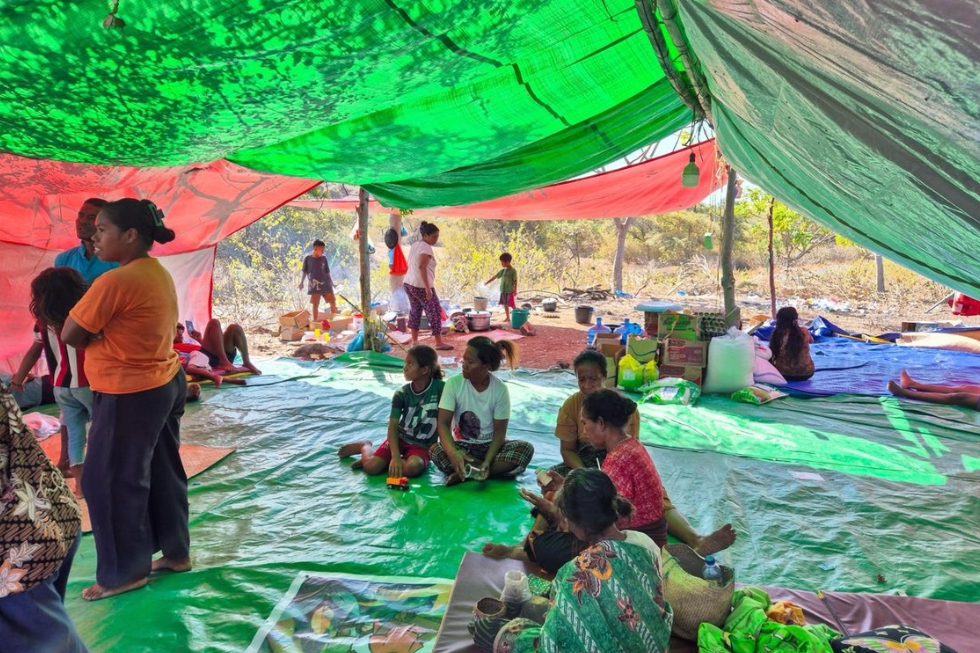



There is something deeply unsettling about the way the Indonesian government is signaling its priorities.
When an earthquake struck East Nusa Tenggara (NTT), the government, state-owned enterprises and Danantara opened a public fundraising drive as part of Indonesia’s Independence Day celebrations. Quick-response (QR) codes were displayed at three public entertainment stages, collecting 2.16 billion rupiah for communities affected by the disaster.
Public donations are not inherently wrong. Gotong royong, the Indonesian tradition of mutual assistance, is an important form of social solidarity, particularly during times of crisis. But solidarity becomes more complicated when citizens are mobilized to help cover needs for which the state itself bears primary responsibility.
The contrast was particularly striking because, during the same Independence Day celebrations, the government continued to spend public money on elaborate ceremonial activities. One procurement that drew criticism was the 305.25 million rupiah allocation for the release of pigeons during the 81st Independence Day ceremony at the Presidential Palace. Indonesia Corruption Watch questioned the urgency of such spending at a time of fiscal restraint and pressing public needs. The point is not that 305 million rupiah could finance disaster recovery across NTT. Of course it could not. The issue is what every rupiah of public spending communicates about the government’s priorities.
The NTT disaster exposes a troubling fiscal priority: Billions can be mobilized for flagship programs that have faced widespread public criticism, while disaster relief is partly left to public donations. Especially concerning is the Free Nutritious Meals program (MBG), with more than 1,980 people reportedly affected by suspected MBG-related food poisoning in just the first few days of September.
Budgets are perhaps the clearest expression of what a government considers important. Speeches can promise solidarity. Ceremonies can celebrate national unity. But ultimately, the state budget tells us which problems receive money, institutional capacity and political urgency, and which are expected to wait.
That is where the uncomfortable questions begin.
When political priorities face few fiscal constraints
Consider the scale of spending elsewhere. Indonesia’s National Nutrition Agency received a budget ceiling of 268 trillion rupiah for 2026, with 248 trillion rupiah reportedly allocated to the government’s flagship MBG. The comparison matters because it demonstrates what happens when a program becomes a political priority: Fiscal space can be found, institutions can be mobilized and implementation can be accelerated.
A similar political commitment is evident in the government’s ambitious Red-and-White Village Cooperative program, or Kopdes Merah Putih. Large-scale flagship programs are being pushed rapidly as strategic national agendas even as questions remain about their effectiveness, governance and fiscal risks.
Now compare that political energy with disaster preparedness. Critics have pointed to the relatively limited fiscal capacity of the National Disaster Management Agency (BNPB). Its initial 2026 budget ceiling was reportedly only 491 billion rupiah before being increased to around 1.05 trillion rupiah in June. This remained far below its 4.9 trillion rupiah allocation in 2024. The comparison should not be read too mechanically. The budget for a nutrition program cannot simply be transferred wholesale to a disaster agency, and different government programs have different mandates, financing mechanisms and beneficiaries. But the orders of magnitude reveal something important about political priority.
Indonesia is one of the most disaster-prone countries in the world. Earthquakes, floods, landslides, volcanic eruptions, forest fires and extreme weather are not unforeseeable shocks. The precise timing of an earthquake cannot be predicted, but the country’s exposure to disasters certainly can. Disaster preparedness should therefore be treated as a basic function of the state, not as an unexpected expense that becomes politically urgent only after homes collapse and lives are lost.
The government did respond, and that matters
A fair assessment must acknowledge that the Indonesian government has not simply abandoned NTT. By the fifth day after the earthquake, the government reported that 253 tonnes of assistance had been transported to affected areas, and further aid did follow.
However, the contrast in government priorities is difficult to ignore. As of August 23, President Prabowo had yet to visit disaster-affected communities in NTT, despite the limited government assistance available. Instead, he attended the wedding of one of his personal aides, an image that only deepened public frustration over the apparent lack of urgency toward the crisis.
Yet just a day later, Coordinating Minister for Food Affairs Zulkifli Hasan announced the continued expansion of MBG, including 1,703 MBG meal-service units (SPPG), which prepare and distribute meals to beneficiaries, designated for disadvantaged, frontier and outermost (3T) areas. This is particularly striking because MBG itself remains under intense scrutiny over alleged fraud, conflicts of interest, weak governance and suspected food-poisoning cases reportedly affecting more than 43,000 people. Yet the government continues to accelerate its expansion, while NTT is still grappling with the disaster’s immediate aftermath.
For affected communities, this sends a troubling signal: A flagship political program appears able to command rapid budgetary and bureaucratic attention, while disaster response struggles to receive the same urgency. The question, therefore, is not whether NTT needs better nutrition, but why immediate humanitarian needs appear unable to command comparable political attention and state resources.
It was only after heavy criticism that on August 26, President Prabowo Subianto announced 200 billion rupiah in assistance: 40 billion rupiah for the NTT provincial government and 20 billion rupiah for each of the eight affected districts in Flores. This matters because the criticism should not be that the government provided no assistance. The deeper problem concerns how priorities are established before disaster strikes, and how the state communicates empathy and responsibility when communities are suffering.
Sending emergency assistance after an earthquake is a basic responsibility of the government. A more demanding question is whether disaster preparedness, social protection and long-term recovery receive the same degree of political seriousness as the administration’s flagship programs. Public frustration is therefore understandable: President Prabowo only visited disaster-affected NTT 11 days after the earthquake, reinforcing perceptions that the crisis had not received the priority it deserved.
If Indonesia does not treat disaster preparedness as seriously as it treats its other programs, it risks building a state that can mobilize extraordinary resources to deliver its political ambitions but remains predominantly reactive when protecting citizens from foreseeable risks. That is a much more consequential problem than the amount spent on a ceremonial flock of pigeons.
What does independence mean in a disaster?
This is also why the timing, Indonesia’s 81st Independence Day, matters. In Jakarta, independence was celebrated with stages, ceremonies and symbolic spectacles. At the same time, QR codes encouraged citizens to donate to fellow Indonesians affected by disaster.
Again, public fundraising itself is not the problem. The uncomfortable question is why, within the same national celebration, the state can appear as a well-resourced organizer of spectacle while simultaneously positioning itself as a facilitator of public generosity for citizens facing catastrophe.
This is not really about pigeons. Three hundred and five million rupiah is negligible compared with Indonesia’s national budget. Canceling the procurement would not solve disaster preparedness in NTT. But political symbolism does not always operate through the largest numbers. Sometimes small expenditures become powerful precisely because they reveal what a government considers appropriate, urgent or expendable at a particular moment.
If citizens are being asked to demonstrate solidarity, the state should be able to demonstrate that it has first scrutinized its own priorities. Gotong royong should complement state responsibility, not become a convenient substitute for it.
The politics of priority
The debate over NTT should therefore go beyond the question of how much aid was delivered. The more fundamental question is: What does the Indonesian government actually consider a priority?
The contrast is difficult to ignore. Even as NTT confronts a disaster that has killed 111 people and injured more than 1,600, the government is accelerating the MBG program in the province, targeting roughly one SPPG kitchen for every 703 beneficiaries. Nutrition matters. But MBG itself has faced mounting criticism over food safety, governance and its enormous fiscal cost, while suspected foodborne poisoning cases continue to pile up and calls to pause the program grow. Yet it continues to command hundreds of trillions of rupiah and extraordinary bureaucratic mobilization.
Why can the state mobilize so much money and institutional capacity for a troubled flagship program, while disaster preparedness operates under far tighter constraints? The question is not whether Indonesia should choose nutrition or disaster resilience. It is why some political priorities receive urgency and fiscal protection while others are expected to make do with less.
Earthquakes cannot be prevented. But preparedness, resilient infrastructure and adequately funded disaster institutions are political choices. A government’s seriousness should ultimately be measured not by the scale of its flagship programs or ceremonies, but by how prepared it is to protect its citizens before the ground shakes, and how effectively it stands with them when they lose almost everything.
[Kaitlyn Diana edited this piece.]
The views expressed in this article are the author’s own and do not necessarily reflect Fair Observer’s editorial policy.
Venezuela: The Tortuous Road After the June Earthquakes
The two earthquakes that ravaged Venezuela in June did more than kill and injure thousands — they may jeopardize the...
Learning From the Disabled: Creativity and Resilience in Emergency Preparedness
Rather than viewing disabled individuals solely as vulnerable, emergency preparedness should recognize them as experts whose lived experiences foster unique...

A Nation’s Rivers Remember What Was Cut Away: Indonesia’s Flood Crisis
Legal deforestation has stripped Sumatra’s watersheds of natural flood defenses, turning extreme rainfall into a predictable humanitarian disaster. Plantation expansion...
Support Fair Observer
We rely on your support for our independence, diversity and quality.
For more than 10 years, Fair Observer has been free, fair and independent. No billionaire owns us, no advertisers control us. We are a reader-supported nonprofit. Unlike many other publications, we keep our content free for readers regardless of where they live or whether they can afford to pay. We have no paywalls and no ads.
In the post-truth era of fake news, echo chambers and filter bubbles, we publish a plurality of perspectives from around the world. Anyone can publish with us, but everyone goes through a rigorous editorial process. So, you get fact-checked, well-reasoned content instead of noise.
We publish 3,000+ voices from 90+ countries. We also conduct education and training programs
on subjects ranging from digital media and journalism to writing and critical thinking. This
doesn’t come cheap. Servers, editors, trainers and web developers cost
money.
Please consider supporting us on a regular basis as a recurring donor or a
sustaining member.
Will you support FO’s journalism?
We rely on your support for our independence, diversity and quality.





Comment