




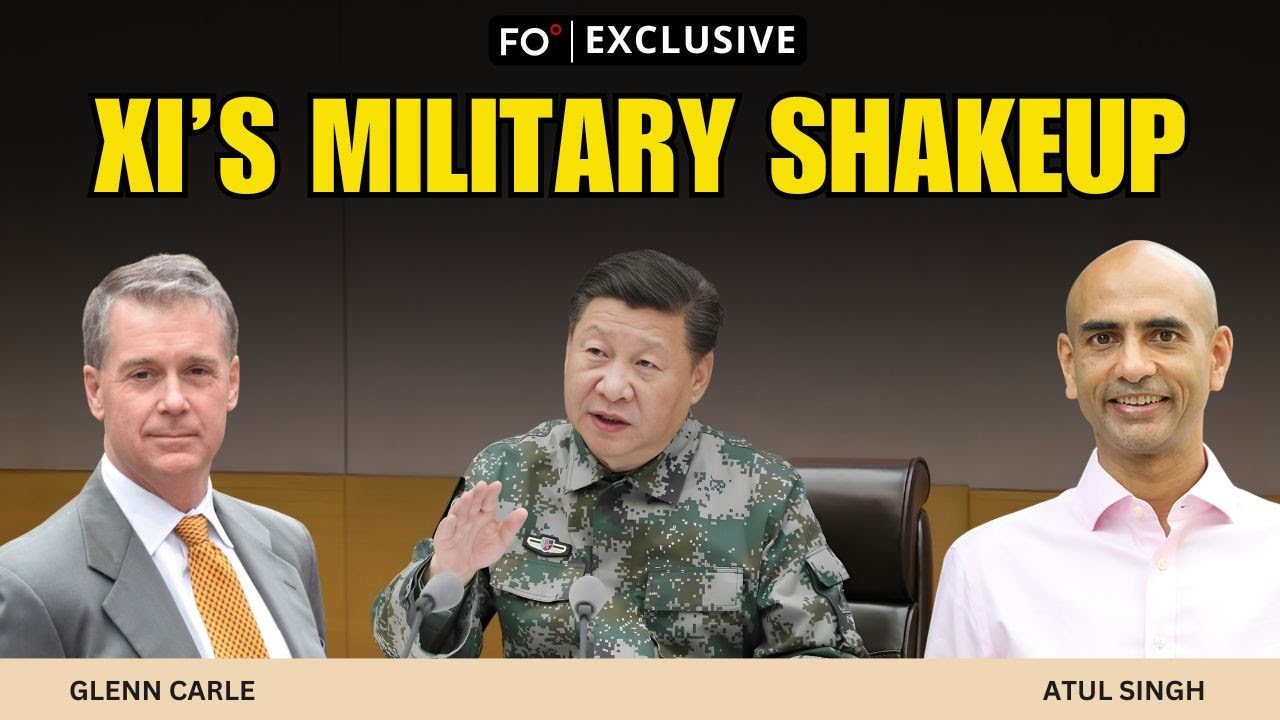
Editor-in-Chief Atul Singh and FOI Senior Partner Glenn Carle, a retired CIA officer who now advises companies, governments and organizations on geopolitical risk, dissect US President Donald Trump’s proposed peace deal to end the Russia-Ukraine war. They weigh whether this framework, presented as a ceasefire of perhaps long duration, is a genuine American-led proposal or a plan from Russia. They also analyze the strategic logic behind its demands, and the profound implications it carries for Ukraine’s survival, Europe’s security and America’s global posture.
The Russian Roots of the “Trump Plan”
The plan, initially presented as a 28-point framework, has faced intense scrutiny regarding its origin, as it is written in very stilted English. A number of linguists, diplomats and experts who read the document noted that the ostensibly American English text “really does sound like it has been directly translated from the Russian”. The truth appears to be that Russia provided the proposed acceptable peace arrangement to the Americans, who then translated it and presented it as Trump’s plan.
This didn’t go over well, even among some of Trump’s supporters in Congress. The initial plan comprised 28 points and has since been somewhat modified. However, as Glenn notes, the plan’s fundamental essence remains Russia’s starting position. This method of introduction is strategically significant in negotiation. As Glenn states, “whoever drafts and frames the initial points of discussion has won the argument almost”, because all subsequent parties are forced to react to the presented framework.
A ceasefire, not a peace agreement
Fundamentally, the proposed agreement is less a peace agreement and more a ceasefire of a potentially long duration. It requires that Ukraine withdraw from the territory it still controls. The Ukrainians have stated this is a “non-starter,” but there appears to be ongoing debate and potential “territorial adjustments”.
Ukrainians, according to Atul, have “their backs to the wall and a gun to their head”. Ukraine’s economy has “cratered”. It has run out of men, with desertions occurring on the front lines. Equipment is no longer consistently forthcoming from the US. Ukraine is scared that if Trump stops intelligence sharing, or any kind of assistance — which he has already done once before — then the country will be even more vulnerable. They are stuck between their own perilous situation and their dependence on the US. On top of this, there is a “terrible corruption scandal” raging at the heart of their government. The Ukrainians do not have “any good cards” and have no real choice but to go along with Trump.
They have strong incentives and imperatives to find a way to stop the war. However, even with their seemingly hopeless situation, they have no plans to cede territory that they control. There are still likely to be territorial adjustments, but, as Glenn suspects, they will be less substantial than the Russian position, which demands all Russian-speaking provinces, including Luhansk and the rest of Donetsk.
Security and military limitations
In exchange for territorial concessions, Ukraine would receive “security guarantees,” which are currently unspecified and verbal. This is especially concerning for Ukraine, as it has received guarantees before — in 1991 when the Soviet Union broke up, and Ukraine surrendered its nuclear weapons, and again in 2014 via the Minsk accords — neither of which amounted to much.
However, as Atul points out, a significant catch in the new document states that if Ukraine acts unilaterally against Russia, the guarantees are off. It’s almost as if the US has performed a diplomatic “U-turn.” Ukraine faces the prospect of being thrown down the Dinprot (also known as Dnieper) River, which the Russians actually want to be the national border. Atul suspects that the Russians will try to cross the river and take Odessa, as well.
Regarding military limitations, Russia demanded that Ukraine never be part of NATO, a point that the US appears to have conceded. Europeans have injected themselves into the process, pushing for a security guarantee in the form of “non-NATO but West European soldiers” deployed in Ukraine as a trip wire security guarantee.
Russia initially sought to limit Ukraine’s military to 100,000 personnel, which is essentially a constabulary force — the same number imposed on Germany post-Versailles. However, Russia appears to have made a concession, and the Ukrainian military limit is shaping up to be around 600,000. Glenn sees this number as a reasonable and significant military size, especially since Ukraine cannot afford its current force of 850,000, and, if it is not actively fighting, there is no need for a military of that size.
De facto, the final outcome of the war is expected to be a ceasefire with forces remaining in place. This means that Russia will have absorbed 90% of the Russian-speaking territories of Ukraine. While Ukraine may not formally acknowledge this loss, it would be unable to change it. The security guarantees for Ukraine may amount to the substance of some non-NATO European soldiers and some American or NATO planes deployed to Poland. There has also been talk of unfreezing half of Russia’s assets and using that money for Ukrainian development. However, in practice, that would mean Trump would have the money deposited into “American bank accounts,” ultimately benefiting the US rather than Ukraine.
Rehabilitating Russia and future threats
Crucially, many clauses are steps to rehabilitate Russia and bring it back into the international community. This includes lifting sanctions and reinstating Russia as a member of the G8. The ceasefire is primarily pro-Moscow by acknowledging its conquests and providing Ukraine with only short-term survival and weak, verbal guarantees.
Many analysts argue that Russia will become emboldened after this “peace plan”, increasing the threat to the Baltic states. One extreme argument from the French Chief of Defense is that French mothers should prepare to lose their children, and that a major confrontation with Russia is coming.
Conversely, some within the Pentagon and the Republican establishment argue that China is the primary enemy. They advocate for a “reverse Henry Kissinger” strategy: ending the war to wean Russia off China and isolate Beijing. Besides, they also think Ukraine is corrupt and that it is no longer a benefit to the US. Ultimately, they believe China is highly vulnerable in energy, as it imports most of its energy, and that if the US blocks the Malacca Strait and Russia stops supplying energy, China would be “toast within weeks”. Glenn views this as “delusional craziness,” which would lead to another world war.
However, Glenn believes that Russia made a terrible strategic error in its invasion, something it felt it had no choice but to do. Not only has the war gone worse for Russia than it could have imagined, but it was also a result of Russia’s failure in its other strategic policy, which was to stop Ukraine’s turn to the West via covert action and disinformation. This strategy failed due to the will of the Ukrainian people.
Glenn disagrees that there will be a war between Russia and Europe or the US. What is certain is that Russia’s ongoing destabilization efforts focused on border states like Moldova, Georgia, the Baltics and Poland, as well as the US, UK and France, through aggressive intelligence operations and actions aimed at installing “favorably inclined political figures” will continue. This tactic mirrors historical interventions, such as the KGB spending $200 million to interfere in post-war European elections, significantly more than the $20 million the Central Intelligence Agency (CIA) spent in Italy in 1948 to elect a pro-democratic official or party.
[Kaitlyn Diana edited this piece.]
The views expressed in this article/video are the author’s own and do not necessarily reflect Fair Observer’s editorial policy.






















Comment