

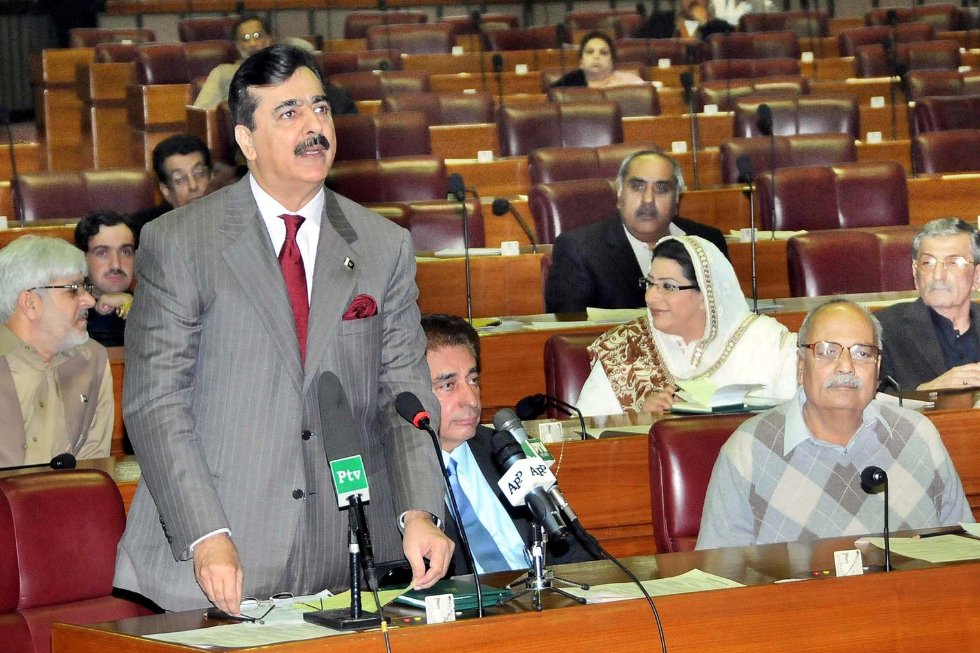



Feudalism in Pakistan is based on the traditional land ownership system where influential families have a strong command over agricultural land, rural communities and local decision-making. Throughout history, large landowners gained economic benefits from land ownership, as well as social and political power, especially in the countryside. In the Sindh province, waderas are influential landlords. Their impact goes beyond land ownership and can also affect farmer-to-community and farmer-to-political-institution relationships. Working for the landlords and relying on them for financial support and access to resources in the area could restrict the economic independence and political options of many tenant farmers.
Even after many years of democratic development, these traditional power arrangements still affect rural areas of Pakistan. Elections are periodically conducted and democratic institutions set up, but local elites influence political representation, access to justice and economic opportunity. The staying power of these relationships implies that modernization and electoral democracy, to date, have not been enough to break the feudal influence. Instead, economic dependence, political patronage and unequal access to education maintain and reinforce inequalities and limited democratic participation.
The persistence of this system comes from three interwoven mechanisms: economic dependency, political patronage and lack of access to education. Combined, these mechanisms form a vicious cycle that leads to a dependence on local elites, pushing people further into poverty. This makes mobility and political activity more difficult.
Economic dependency
Feudal influence contributes to economic dependence. The large landholders and the tenant farmers rent the agricultural land to each other, but the tenant farmer does not have a formal banking service or institutional credit. These farmers often take loans from landlords when they are in trouble due to a medical emergency, marriage or crop failure.
This borrowing is not usually done for just one crop. Low productivity, high indebtedness and unequal bargaining power can render tenants vulnerable to the cycle of dependency. Financial aid can lead to generations of poverty, which restricts social mobility and strengthens the landlord’s power.
Political patronage
The second pillar of influence is politics. Electoral competition is not limited to that of individual candidates or political parties in many rural areas. Many rural constituencies feature electoral competition that lasts beyond the individual and political party level. Social networks and economic power can influence voting behavior in one’s community, and influential landlords may have this power.
Local elites who can mobilize (or pressure) large voting blocks are a handy resource for political parties that want to win elections. Through these relationships, landlords yield increased access to state institutions, administrative influence and political protection in return. Although the democratic process is formally in place, local power imbalances can undermine democratic competition and diminish citizens’ accountability.
Limited access to education
Education is the third and likely most important means of maintaining feudal control. Quality education enables citizens to criticize authority, know their rights and strive for economic independence. However, the situation in rural areas remains challenging due to low student attendance rates, poor infrastructure, low teacher attendance and low-quality schools.
In these contexts, children’s education is not a realistic way out of poverty. If there is no education, and people are unable to get into the jobs they want, then there is no way out of the vicious cycle, leaving them stuck in poverty and working for the local landlords. This constraint is passed down from generation to generation
A changing landscape
Classical feudalism has been slowly fading due to the growth of cities, industrialization and the formation of the new class of businessmen in Pakistan. The landed aristocracy is not as dominant as it used to be. While the actors have changed, the basic rules are remarkably the same. Local governance remains, and is often, determined by patron-client relationships, economic dependency and political influence, whether in the hands of generational landlords or newer political and economic elites. The “appearance” of the structure of dependence has changed, but not its structure.
Solving these problems cannot be done in the political arena alone. Sustainable reform needs to be directed towards strengthening institutions that decrease citizens’ reliance on local power holders. Access to cheap agricultural credit would reinforce the formal credit system, thus decreasing informal credit.
Modernizing land administration and increasing transparency in land record-keeping could strengthen accountability and reduce land exploitation. Moreover, adequate investment in rural education, including the development of infrastructure, teachers’ qualifications and monitoring systems, is crucial. Education is one of the best long-term instruments for overcoming inherited inequalities.
Economic dependency does not foster political participation; democracy can thrive only when participation is based on free choice. Pakistan’s democratic future depends not only on holding elections but also on guaranteeing political rights without coercive or structural hurdles. Its aim is to destabilize entrenched systems of patronage through institutional change to create opportunities for economic growth, access to education and good governance. Despite existing democratic institutions, these power dynamics can constrain representation and social mobility and will persist if these underpinning dynamics are not resolved.
[Zania Morgan edited this piece.]
The views expressed in this article are the author’s own and do not necessarily reflect Fair Observer’s editorial policy.
Why Strategic Partnerships Fail to Build Power in the Global South: Lessons from Pakistan
From Caracas to Islamabad, strategic partnerships have promised development but delivered dependence only. As great-power competition intensifies, the real question...
Pakistani Women’s Progress, Barriers and Path to Parity
Pakistani women have made meaningful progress across public and professional spheres, challenging the long-standing assumptions about their roles and capabilities....



Support Fair Observer
We rely on your support for our independence, diversity and quality.
For more than 10 years, Fair Observer has been free, fair and independent. No billionaire owns us, no advertisers control us. We are a reader-supported nonprofit. Unlike many other publications, we keep our content free for readers regardless of where they live or whether they can afford to pay. We have no paywalls and no ads.
In the post-truth era of fake news, echo chambers and filter bubbles, we publish a plurality of perspectives from around the world. Anyone can publish with us, but everyone goes through a rigorous editorial process. So, you get fact-checked, well-reasoned content instead of noise.
We publish 3,000+ voices from 90+ countries. We also conduct education and training programs
on subjects ranging from digital media and journalism to writing and critical thinking. This
doesn’t come cheap. Servers, editors, trainers and web developers cost
money.
Please consider supporting us on a regular basis as a recurring donor or a
sustaining member.
Will you support FO’s journalism?
We rely on your support for our independence, diversity and quality.




Comment