




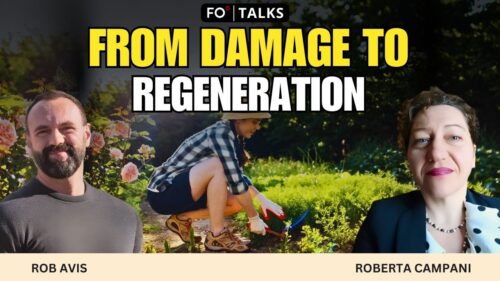
Fair Observer’s Communications and Outreach officer, Roberta Campani, speaks with Rob Avis, Chief Engineering Officer at 5th World, about how we must rethink humanity’s relationship with the environment. Avis lays out three paradigms for how societies view their impact on nature: the conventional system, the sustainable system and the regenerative system. The first is collapsing, the second is insufficient and only the third truly transforms how humans live on — and with — the planet.
To make the concept tangible, Avis turns to an unexpected teacher: the beaver, an animal whose actions look destructive but actually revitalize entire ecosystems. He offers a blueprint for how human systems can shift from extracting value to creating life.
The limits of conventional thinking and the illusion of sustainability
Avis defines regeneration by first explaining what it is not. The conventional paradigm, he argues, is “business as usual” — a system built on endless GDP growth, shareholder primacy and the externalization of ecological harm. This model is now visibly fraying, as soil and oceans have degraded, air quality is worsening, food nutrient density is collapsing and hormonal health is declining. “Everybody pretty much knows that at some point the party’s going to end,” he says. The costs are multiplying in ways that can no longer be ignored.
Yet the second paradigm, sustainability, fails to offer real transformation. It frames humans as inherently destructive, and the best we can do is tread lightly, shrink our footprint, or aspire to net zero. Avis is critical of the mindset behind zero-impact philosophies, which are “put forward as positive, but they’re actually negative” because they presume the ideal solution is human absence. That logic ends in misanthropy: If we are always a liability, the only true solution is to reduce ourselves to nothing.
Sustainability is, in his view, a linguistic trap. It invites small fixes and incremental improvements, but never asks how natural systems actually function, or how humanity might participate in those systems as a generative force. Avis insists that the next step requires fully rejecting the premise that humans must minimize harm. Instead, we must learn to maximize benefit. That means flipping the question from, “How do we do less damage?” to, “How do we create more life?”
The regenerative paradigm: learning from beavers
The regenerative paradigm begins with a radical premise: Humans are not separate from nature; we are nature. It is impossible to have no footprint. Every action produces a reaction. If the footprint cannot be erased, the real challenge becomes: How do we optimize it?
To illustrate, Avis turns to the beaver. On his own 160-acre property in northern Alberta, Canada, he coexists with eight beaver families. The previous owner shot them, but Avis welcomed them back. To visitors, the fallen trees, chewed bark and flooded creeks make the beaver’s work look like destruction. Avis loves capitalizing on this frequent misconception to change their mental model.
Beavers are ecosystem engineers. Their dams hold millions of liters of water, slowing runoff and restoring natural hydrology. Their appetite creates open space and new growth. Most importantly, they don’t just sustain life — they expand it. Biodiversity increases 28-fold where beavers build. That means more opportunity for life to flourish.
The beaver has a footprint, but it disturbs in a way that produces abundance. In ecological terms, it is not neutral. It is regenerative.
Choosing our impact
Humans, Avis argues, must learn to be regenerative as well. He contrasts the three paradigms simply:
- Conventional eliminates life and turns it into products.
- Sustainable sees the human footprint as a liability that must be minimized.
- Regenerative accepts that humans have an impact and chooses whether that impact is positive or negative.
“There is no such thing as neutral,” Avis comments. We are always moving toward more or less life.
The regenerative paradigm is therefore not a moral plea, nor a nostalgic call to return to a pre-industrial past. It is a systems-level redesign based on ecology, feedback and abundance. It treats humans not as interlopers in a natural world, but as participants with the capacity to restore, enhance and even accelerate life.
The future, Avis concludes, is not about sustaining a damaged Earth — it is about regenerating it.
[Lee Thompson-Kolar edited this piece.]
The views expressed in this article/video are the author’s own and do not necessarily reflect Fair Observer’s editorial policy.






































Comment