





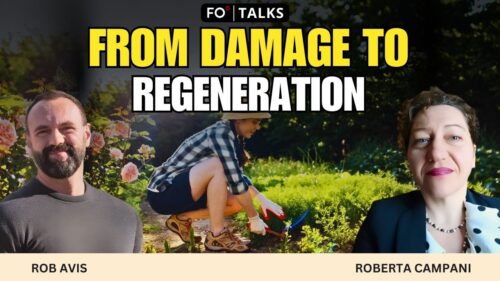
Fair Observer’s Communications and Outreach officer, Roberta Campani, speaks with Rob Avis, Chief Engineering Officer at 5th World, about why the United States’ 40 million acres of front lawns may be the country’s most overlooked resource. What begins as a reflection on wasted land and misplaced effort unfolds into a broader argument: Regeneration is possible, practical and far closer than people think. Avis insists the barrier isn’t technology or land scarcity, but rather culture — the stories people tell themselves about what landscapes should look like.
The scale problem we refuse to see
Campani opens by asking why the front lawn, an ordinary feature of American life, plays such an outsized role in environmental decline. Avis replies that the misallocation is so absurd that “some days I feel like we’re in a Shakespearean comedy,” because the data are widely known and yet culturally invisible.
The US maintains nearly 40 million acres of front lawn, roughly the same land base used to grow wheat. That comparison, he explains, makes the underlying opportunity impossible to ignore. When one of his students questioned whether cities could meaningfully contribute to food production, Avis ran a quick calculation. If every one of those acres grew nothing but wheat, the country would produce enough calories to feed the entire populace “a 2,000-calorie diet per day for two years.” No one advocates monocropping lawns, but the land base is already there.
Campani presses on the resource side of the problem. Beyond unused acreage, Americans expend staggering amounts of energy and money to maintain lawns that produce nothing. Avis notes that the gasoline used annually on this turf could drive a Hummer electric vehicle around the Earth 21,000 times. Lawn care also absorbs far more nitrogen, phosphorus, potassium, herbicides and pesticides than most commercial farms, largely because homeowners do not face the same economic constraints. This creates a system that consumes resources without delivering real value. As Avis puts it bluntly, maintaining the lawn “enslaves us.”
Paradigm is the real barrier
The conversation shifts from data to mindset. For Avis, the decisive obstacle to regeneration is cultural sentiment: the paradigms people operate within, the stories they inherit and repeat. Americans tend to treat lawns as symbols of order, beauty or status, even when those norms undermine ecological health.
Change the paradigm and food systems could be rebuilt from the ground up. Urban and peri-urban spaces could grow fruits and vegetables, while larger commercial farms shift back toward perennial systems far better suited to the continent’s ecology. This shift would not merely reduce harm; it would actively restore ecological function.
Avis points to a striking example drawn from ecological history and research. Before European settlement, the vast region stretching from North Dakota south to the Gulf of Mexico and east to the Mississippi River was grassland. If the corn, soy and wheat currently grown there were converted back into perennial grasses, the carbon storage effect alone could make the US carbon-neutral “overnight”. Such a transformation would also restore the Mississippi watershed and eliminate dead zones in the Gulf of Mexico.
The return of perennial grasslands would support healthier ruminants — cows and bison — in regions where they are ecologically appropriate. Avis acknowledges the political and moral debates around livestock but argues that the ecological system itself provides guidance.
Regeneration is simpler than we think
Campani closes by asking why, if the solutions are so obvious, society seems stuck. Avis responds that complexity at the global level masks the simplicity of the local fixes. People often assume that solving environmental problems requires advanced technology or sacrifice. It begins with recognizing overlooked assets, like the quiet sprawl of America’s lawns, and redesigning them in ways that work with, not against, natural systems.
The land exists, the solutions are there and the ecological benefits are measurable. What must change is the cultural lens. Once that shifts, regeneration becomes an achievable design choice.
[Lee Thompson-Kolar edited this piece.]
The views expressed in this article/video are the author’s own and do not necessarily reflect Fair Observer’s editorial policy.









































Comment