


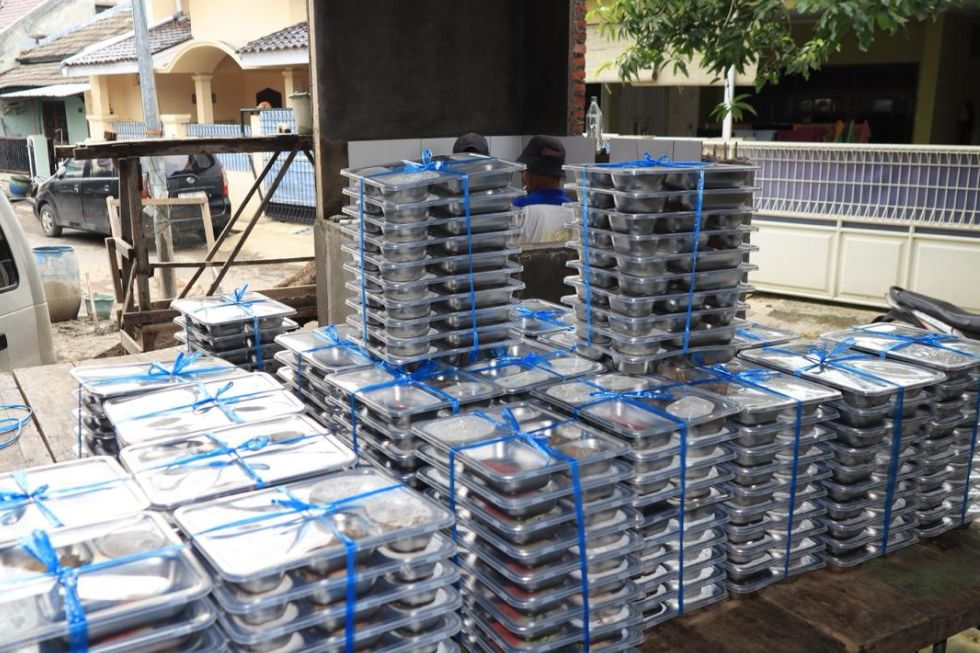



Indonesia’s Makan Bergizi Gratis (MBG — Free Nutritious Meals) began as a promise to nourish a generation and rebuild public trust. Yet nine months after its January 2025 launch, that promise is colliding with governance gaps laid bare by illness, confusion and uneven delivery.
Over 6,500 people, including a thousand school children in West Java, have been hospitalized from contaminated MBG meals. Billions of rupiah lie unspent. Kitchens mushroom faster than regulations can be written. What began as a symbol of social justice is quickly hardening into a cautionary tale about populism overtaking public administration.
The ambition is monumental. President Prabowo Subianto allocated 171 trillion rupees ($10.2 billion) for MBG in 2025, with the intention of increasing it annually to feed 82.9 million people daily by December 2025. By May, just 3 trillion rupees ($184.6 million) had been spent, with fewer than four million recipients out of a target of 17 million.
The numbers reveal a system struggling to support its own ambitions: procurement bottlenecks, untrained employees and no mandatory presidential regulation to define accountability. Transparency International Indonesia warns of “billions in play without rules in place”. For a program feeding children, the margin for error is zero.
Fixing the program
Indonesia must rebuild MBG from the village up: anchor every kitchen to elected Food Safety Councils and to a national Nutrition Service Unit (SPPG — Satuan Pelayanan Pemenuhan Gizi), a hands-on hub that regularly tests, trains and deploys rapid remediation teams while publishing transparent results; ring-fence a nutrition guarantee and phase in local-procurement quotas that prioritize female farmers, create a safety fund for urgent equipment replacement and the mobilization of innovative finance.
This includes nutrition impact bonds and debt-for-nutrition swaps. QR codes and a simple mobile Key Performance Indicator (KPI) dashboard — allowing village deliberation, such as an independent agency (musyawarah), to drive menus and audits so that one safe plate a day becomes an act of citizenship, climate-smart development and long-term community resilience. Deliberative consensus can transform MBG from a top-down experiment into a community-anchored safety net.
Decentralization is no luxury here; it is the mechanism for quality control across 17,000 islands. Japan’s school-lunch model offers a paradigm: menus planned by dietitians, procurement handled locally under strict standards and the involvement of parents in taste-testing. Brazil’s National School Feeding Program (PNAE) mandates that 30% of ingredients be purchased from local smallholders — a policy that cut corruption and revived rural economies.
Increasing accountability
Indonesia can achieve the same by empowering district governments and community cooperatives to run kitchens with trained nutritionists, public audits and implementing transparent digital reporting of spending and food safety checks.
Re-centring MBG around local accountability also answers Jakarta’s fiscal fears. A Center for Global Development (CGD) study shows that school-feeding programmes return 7 to 35 times their cost through better education and health outcomes. But only when communities feel ownership do those returns materialise.
Indonesia’s National Nutrition Agency should devolve monitoring responsibilities to provincial nutrition boards, which should be composed of teachers, midwives and representatives from civil society. Public dashboards could list kitchen audits and infection incidents in real time — a transparency test that both the United Nations Children’s Fund (UNICEF) and the Food and Agriculture Organization (FAO) identify as best practice for rights-based feeding programs.
Preventing misinterpretation and corruption
Legal clarity is equally urgent. Without a Presidential Regulation defining the National Nutrition Agency’s authority, every provincial office interprets MBG differently. Codifying the program into law — as India and Brazil did — would shield it from political cycles and corruption.
Binding standards for menu composition, food procurement and staff training must precede further expansion. When UN agencies praise MBG as a “cornerstone of Indonesia’s nutrition strategy,” they also imply a duty: cornerstones must carry weight without cracking.
If Jakarta is concerned about halting momentum, a phased rollout can strike a balance between speed and safety. Prioritize stunting-prone districts, such as East Nusa Tenggara, Papua and sections of Sulawesi, where malnutrition rates remain above 30%.
Train local cooks through polytechnic and vocational programs, creating jobs and boosting standards. Link each kitchen to a local farmers’ collective, reducing food miles and stimulating rural income. Such approaches advance not only SDG 2 (Zero Hunger) and SDG 3 (Good Health) but also SDG 13 (Climate Action), since locally sourced meals cut transport emissions and waste.
Critics believe that MBG will slash the education budget, while international evidence supports the opposite. In the EU, school-meal programs boost attendance and achievement, yielding a 7:1 economic return. Every well-fed child is a future worker, better educated and a citizen less dependent on health subsidies.
The World Food Program calls school feeding “the world’s most extensive safety net,” reaching 418 million children globally in 2025. Indonesia is right to join that movement. However, leadership means learning from others’ mistakes instead of making the same ones.
Can the MBG move forward?
Ultimately, the MBG crisis tests Indonesia’s political maturity. Can the country move from grand announcements to detailed delivery? Good local governance requires decentralized oversight, public participation and transparent measurements.
According to the United Nations Right to Food Guidelines, “rights holders must participate in the creation and monitoring of policies that impact them.” In Indonesia, this includes parents sampling meals, community leaders authorizing purchases and nutritionists with independent authority to close dangerous kitchens before catastrophe strikes.
If Jakarta embraces that ethos, MBG could become what it was meant to be: a civic contract for dignity, not a headline of hubris. Feeding a nation is not about the numbers served, but about trust earned. For Indonesia, and for a region watching closely, the lesson is clear — a program built on paper can fuel a campaign, but only a program built on good governance will feed a generation.
[Zania Morgan edited this piece.]
The views expressed in this article are the author’s own and do not necessarily reflect Fair Observer’s editorial policy.
A New Education System for Indonesia: A National Promise
Indonesia’s schools have been failing their students for years, consistently scoring low on international assessments despite education being a constitutional...

Indonesia Faces Hidden Costs If China Helps It Go Nuclear
Indonesia is en route to securing energy independence, with a nuclear power plant construction project yet to be contracted between...


Support Fair Observer
We rely on your support for our independence, diversity and quality.
For more than 10 years, Fair Observer has been free, fair and independent. No billionaire owns us, no advertisers control us. We are a reader-supported nonprofit. Unlike many other publications, we keep our content free for readers regardless of where they live or whether they can afford to pay. We have no paywalls and no ads.
In the post-truth era of fake news, echo chambers and filter bubbles, we publish a plurality of perspectives from around the world. Anyone can publish with us, but everyone goes through a rigorous editorial process. So, you get fact-checked, well-reasoned content instead of noise.
We publish 3,000+ voices from 90+ countries. We also conduct education and training programs
on subjects ranging from digital media and journalism to writing and critical thinking. This
doesn’t come cheap. Servers, editors, trainers and web developers cost
money.
Please consider supporting us on a regular basis as a recurring donor or a
sustaining member.
Will you support FO’s journalism?
We rely on your support for our independence, diversity and quality.
Andaman Sea “Ghost” Fleet: The Invisible Oil Fueling Myanmar’s Genocide
In the Andaman Sea, the Rohingya exodus and the “Shadow Fleet” converge in a “Ghost Protocol”. By deactivating AIS transponders,...

Singapore’s Resilience Is Tested in a Changing World: Strong Recovery Amid Uncertainty
Singapore’s economy is growing, but global tensions and trade risks remain. A national review aims to secure long-term competitiveness, with...

Security in South Asia: Shifting Ways of the Islamic State
A top official of the Islamic State Khorasan Province was killed, signaling shifting dynamics within the organization. After years of...





Comment