




 | ||
| ||
| ||
Appeal from Atul, our founder This Thanksgiving weekend, I have an important request. We are living in dark times. People have retreated into echo chambers. Media organizations are under new pressures and smaller organizations like ours face much hostility. Some people chastise and threaten us for publishing views they dislike. This is the pathology of our age: Strangers rage, friends assume the worst and polarization smothers reason. At Fair Observer, we are defending something rare: reasoned, fact-based views from any perspective. As you can see, everything we publish goes through our editorial process and we provide you a window to the world. Our independence has a cost. In a media landscape where billionaires, governments, advertisers and powerful interests rule the roost, we exist for and because of you. To keep us going, support our 2025 crowdfunding campaign right now. If you work for companies like Google, Microsoft and Visa, your company will match your donation. So, please donate on Giving Tuesday, December 2 using your internal platform. Share this appeal with your friends and family to support independent, principled journalism. ~~~ Farhang Namdar’s FO° Features Sunday Newsletter Dear FO° Reader, Greetings from the Ozarks in the US. Today, I will talk about something that is normally not a serious issue here, but is national and even international news elsewhere. Not long ago, it was an ordinary day in Tehran. People rushed to work, shops opened their doors, and traffic clotted like any other weekday. Then everything changed. Jina Amini, also known as Mahsa Amini, was detained by Iran’s morality police for wearing her hijab “improperly.” Within days, this 22-year-old Kurdish woman died in a hospital on September 16, 2022. Investigations, eyewitness accounts and leaked medical information clearly indicate that she was severely beaten in custody and died because of police brutality.
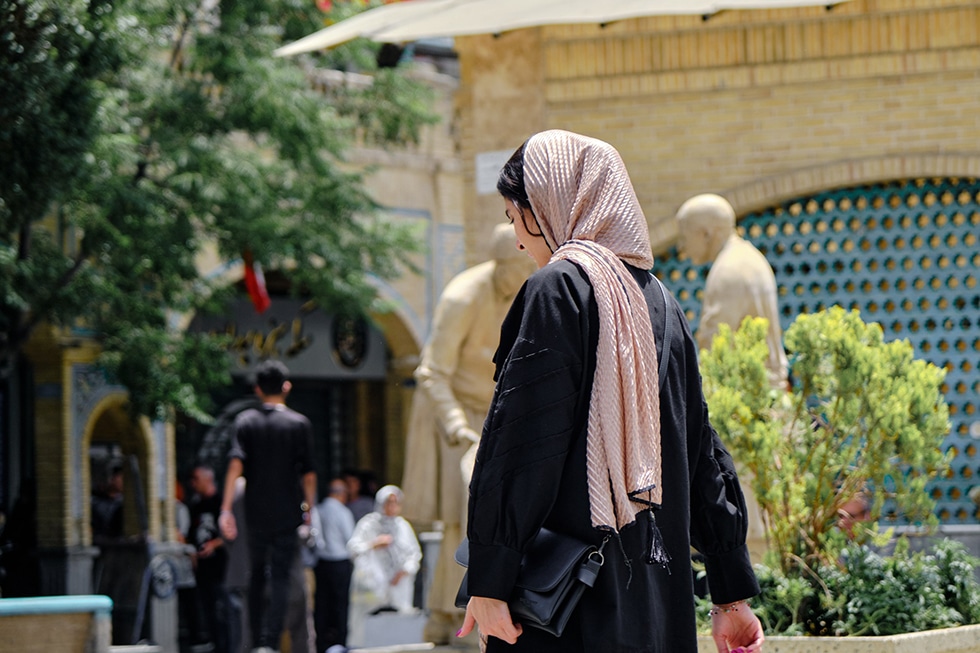
Young Iranian woman, shutterstock Source: Iran’s Anti-Veil Protests for Mahsa Amini Have Already Succeeded – Foreign Policy Her death, triggered by the sight of strands of hair her hijab failed to hide, ignited protests on a scale unseen since the 1979 Iranian Revolution. But unlike 1979, this uprising wasn’t sparked by ideology or monarchy. It was sparked by clothing. It was not the first time the actions of a single police officer set in motion events that reshaped nations. In 2010, Mohamed Bouazizi, a Tunisian street vendor, was humiliated and assaulted by a female municipal officer. An act that pushed him to self-immolate in protest. His death ignited the Arab Uprisings, toppling governments and transforming the Middle East. A year later, the killing of Khaled Saeed by the Egyptian police sparked public outrage that fueled a mass uprising. These three incidents mentioned above demonstrate how an act of state violence can have major consequences. Sometimes, they set in motion mass protests and destabilize longstanding regimes. The Iranian state and the hijab Iran has not always mandated the veil. In fact, in 1936 Reza Shah banned the hijab, forcing women to unveil it as part of a modernization campaign. Many women withdrew from public life rather than appear uncovered.
The board of directors of “Jam’iat e nesvan e vatan-khah“, a women’s rights association in Tehran (1923–1933) Sources: After the 1979 Islamic Revolution, state policy flipped. What was once banned became mandatory. By 1983, failing to cover one’s hair became punishable by law. The hijab shifted from religious practice to state enforced behavior — a way the new regime regulated appearance, movement and morality. After the 2002 protests, the mullahs have retreated on the hijab issue. Today, millions of Iranian women walk unveiled as an act of defiance. Each uncovered strand of hair is a protest. Additionally, hijab enforcement is not standard across the nation. For example, defiance is high and enforcement low in Iranian Kurdistan.
Hashmiz village in Kurdistan province in Iran, Nowruz to welcome spring by stomping and dancing, Shutterstock Iranian historian Arash Azizi states: The way people dress in Iran has become a marker of identity and a source of social strife. Not only women’s hijabs but also men’s turbans evoke emotion. Online videos show young people knocking turbans off the heads of clerics. Clearly, Tehran’s theocratic regime is no longer as popular as it once was during the early days of the revolution. Hiijab in Iran’s neighboring states Increasingly, neighboring Sunni Arab states have been loosening their hijab laws. Saudi Arabia and the United Arab Emirates are two notable examples. Sunni Afghanistan has turned the clock back though. The Taliban are now in charge and they have not only brought back the hijab but also stopped girls from going to school. Needless to say, Afghanistan has the strictest formal female dress code in the region. Women not only have to cover their hair but also their face. They can only leave the eyes uncovered so that they can see where they are going. The Taliban have imposed the burqa, a garment that fully covers the body and the face, while the mullahs in Tehran merely impose the hijab, a headscarf that covers the hair, neck and ears. Turkey, once the seat of the Ottoman Empire, the hijab captures the tides of history. After World War I, Mustafa Kemal Pasha founded the nation state of Turkey on the ashes of the Ottoman Empire. He wanted this new nation to be modern, secular and European. Out went the traditional fez for men and hijab for women. In came European dresses, especially for the Istanbul elites. For decades, women wearing hijabs or burqas could not go to universities or for the government. The triumph of political Islam in 2003 under Recep Tayyip Erdoğan has caused the pendulum to swing back. Erdoğan’s wife herself wears the hijab, which was unimaginable in Kemalist Turkey. Lebanon, which the French seized from the Turks at the end of World War I, does not impose a dress code. In Beirut, unveiled women walk beside those in hijab or niqab, a less restrictive burqa. In Lebanon, the way women dress reveals their sect, family, or neighborhood. Syria was similar to Lebanon before civil war broke out in March 2011. Then, class, sect and geography determined what women wore. The regime did not care how women dressed. Elites in Damascus and Aleppo dressed like Europeans. More conservative people and those in small towns dressed more modestly. During the civil war, extremist Islamist groups enforced strict dress codes but personal choice has still survived in the big cities. Iraq varies by region and sect. In Baghdad and Najaf, the hijab is common. In Kurdish cities like Erbil or Sulaymaniyah, women often wear western dresses. Freedom to dress the way you want depends more on the social environment, not the law. As during the days of Saddam Hussein’s Ba’athist regime, the hijab is less and less common in metropolitan areas. Around the world, hijab means different things to different people. For some women, wearing the hijab is an act of faith and preserving their traditions. For some young Muslim women in the West, the hijab can be a symbol of their identity, an assertion of their culture and a resistance to racism. For others, the hijab is a means of male control, religious oppression and social backwardness. Often, the hijab triggers a jostling of faith, tradition, modernity and resistance. In Iran, the hijab has become part of an existential struggle between state and society. Young people, not just young women, are protesting against restrictive dress codes in Iran and the regime has retreated for now. Women have cut their hair, burned their scarves and danced without hijabs in the streets. Many men have supported them. Once, the mullahs in Tehran imposed the hijab with an iron fist. Defiance meant punishment in the form of harassment, beatings and, in the case of young Jina Amani, even death. Now, a new generation is in open revolt. Visitors to Iran see increasing numbers of women defying the regime by not wearing the hijab. Some analysts say that power blackouts, water shortages and a rotten economy tie the mullahs’ hands. If they impose their strict laws on the hijab, Iranians could take to the streets again. A key question arises: Can the aging mullahs still impose their theocratic Shia dogma or will this new generation of Iranians burn the very foundations of Ayatollah Ruhollah Khomeini’s 1979 Islamic Revolution? Sources: Why Are Young People Protesting in Iran? The Battle Iranian Women Are Winning The Iranian women resisting wearing the hijab I hope you have had a wonderful Thanksgiving weekend and are having a restful Sunday. Wishing you a thoughtful week, Farhang Namdar FaraydoonAssistant Editor | ||
We are an independent nonprofit organization. We do not have a paywall or ads. We believe news
must
be free for everyone from Detroit to Dakar. Yet servers, images, newsletters, web developers and
editors cost money.
So, please become a recurring donor to keep Fair Observer free, fair and independent. 
| ||
| ||
| About Publish with FO° FAQ Privacy Policy Terms of Use Contact |





Support Fair Observer
We rely on your support for our independence, diversity and quality.
For more than 10 years, Fair Observer has been free, fair and independent. No billionaire owns us, no advertisers control us. We are a reader-supported nonprofit. Unlike many other publications, we keep our content free for readers regardless of where they live or whether they can afford to pay. We have no paywalls and no ads.
In the post-truth era of fake news, echo chambers and filter bubbles, we publish a plurality of perspectives from around the world. Anyone can publish with us, but everyone goes through a rigorous editorial process. So, you get fact-checked, well-reasoned content instead of noise.
We publish 3,000+ voices from 90+ countries. We also conduct education and training programs
on subjects ranging from digital media and journalism to writing and critical thinking. This
doesn’t come cheap. Servers, editors, trainers and web developers cost
money.
Please consider supporting us on a regular basis as a recurring donor or a
sustaining member.
Will you support FO’s journalism?
We rely on your support for our independence, diversity and quality.





Comment