




 | ||
| ||
| ||
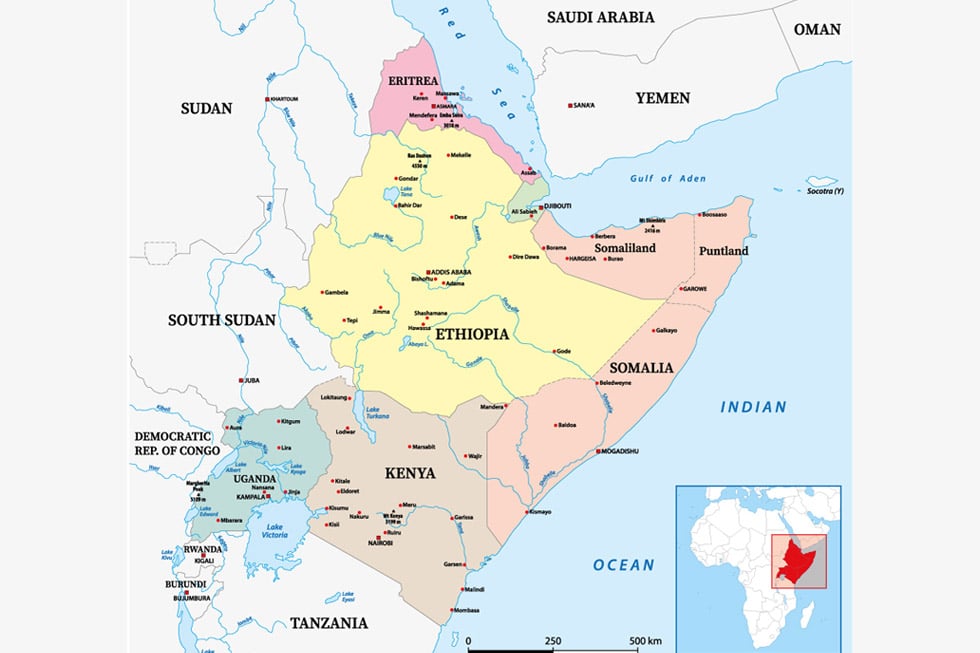
Dear FO° Reader, Greetings from Missouri in the Central United States, often called the Midwest. Missouri is a landlocked state, meaning it lacks access to the open seas. However, today I want to draw your attention to a region on the open seas: the Horn of Africa. The region’s proximity to the Red Sea’s gates gives it significant geopolitical importance.
via shutterstock In recent years, many regional and global powers have established military bases in the region and are working to increase their political influence. However, Israel’s move to increase its influence in the region might be the boldest so far. Israel has set in motion a controversial geopolitical shift by recognizing Somaliland as an independent state. Somaliland, though internationally considered part of Somalia, has functioned as a de facto state since declaring independence in 1991. Often referred to as “the other Somalia,” Somaliland maintains distinct political institutions, external relationships and a markedly different security environment from the rest of the country. Israeli Prime Minister Benjamin Netanyahu reportedly contacted Somaliland President Abdirahman Mohamed Abdullahi following the recognition, according to The Guardian. The two spoke in English, and Netanyahu invited the Somaliland leader to visit Israel. Source: Israel’s Recognition of Somaliland: A Historic Move | TikTok Israel becomes first country to recognise Somaliland as sovereign state Why the Horn of Africa matters to Israel Before diving deeper into Somaliland itself, it helps to understand why Israel wants a foothold in the Horn of Africa in the first place. Israel’s move suggests a return to the Ben-Gurion Doctrine, a Cold War-era strategy that focused on building alliances along the Middle East’s periphery to counterbalance hostile Arab states. In the 1950s, Israel began cultivating ties with non-Arab states in the region, including Iran and Turkey. To that extent, Israel even assisted in developing the Shah’s notorious secret police, SAVAK. At the same time, Israel built relationships with nonstate actors, most notably the Iraqi Kurds. This strategy allowed Israel to better navigate a hostile regional environment and eventually prevail against powerful Arab states such as Egypt, Syria and Jordan. Today, while those states are largely outside the core confrontation, Iran and Turkey have effectively replaced them, particularly in relation to the Palestinian question and their rivalry with Israel. Sources: From Ben-Gurion to Netanyahu: The Evolution of Israel’s National Security Strategy Isolation of Hamas prevents Middle East peace Meanwhile, the US is gradually reducing its military footprint in the Middle East as it shifts strategic attention toward Asia. The Abraham Accords were, in part, designed to support this transition by encouraging cooperation among American allies. Washington increasingly wants its partners to act as stabilizers rather than rivals. This changing environment has effectively cemented Israel as a nuclear-armed regional power operating at the heart of the Middle East. But power projection still depends on geography and this is where Somaliland comes into the picture. An official who spoke to Fair Observer and is familiar with the matter described the development as a “strategic earthquake.” He added that “such recognition would not have occurred without close coordination with Washington and the tacit consent of key regional players, most notably the United Arab Emirates (UAE).” By “close coordination,” he means that the US allowed Israel to recognize Somaliland. American allies in the region usually need Washington’s permission for such foreign policy moves, as they might introduce uncertainty, polarize the region and jeopardize Washington’s strategy. However, Washington’s permission does not mean Israel has American support. The UAE has also already demonstrated its willingness to reshape regional dynamics by backing the South Yemen separatist movement and establishing a military presence on the strategically critical island of Socotra, where Israeli involvement has also been reported. The UAE already has a military port in Somaliland. The reason the UAE and Israel are involved in Somaliland is because of its location at the entrance to the Red Sea. Somaliland is a geopolitical prize, controlling access to one of the world’s most vital maritime corridors. Source: Saudi warplanes strike UAE-backed separatists in southern Yemen | AP News The official explained that Somaliland may only be the beginning of a broader regional reshaping. He suggested that Kurdish and Druze regions in Syria and Iraq could eventually follow a similar path, adding that South Yemen remains the most obvious candidate for near-term recognition. Popular reaction on social media has mostly focused on Israel’s dealings with Palestine. Many are saying that Israeli recognition of Somaliland is an attempt to divert attention from Gaza and the West Bank. Others are going so far as to claim that Israel is attempting to displace Palestinians by sending them to Somaliland. Why would Israel refuse to recognize Palestine but recognize another country in the Horn of Africa? The counterargument is that Israel’s recognition of Somaliland shows that Israel has good relations with Muslim countries. This counterargument holds that Israel’s relationship with Palestine is about security, not identity, especially religious or ethnic. Sources: Why Israel’s recognition of Somaliland is controversial – The Forward Israel defends Somaliland move at UN amid concerns over Gaza motives | Reuters Geography, energy and global trade Somaliland sits at the Horn of Africa, adjacent to the Gulf of Aden and the Bab el-Mandeb Strait, one of the world’s most critical maritime chokepoints. Approximately 10% of global seaborne oil trade and about 12% of global trade by volume pass through the Bab el-Mandeb Strait, linking Europe and the Mediterranean to Asia via the Suez Canal. Any disruption in this narrow passage has immediate global economic consequences. Because of this strategic importance, the region has become something of a tourist destination for the world’s militaries. Nearby Djibouti, a tiny country whose economy depends heavily on hosting foreign military bases, has forces from the US, France, China and others. In fact, Djibouti is home to China’s only overseas military base. Sources: Chokepoints: 5 Global Waterways at Risk of Disruption China’s Engagement in Djibouti | Congress.gov | Library of Congress Regional and International Backlash Israel’s recognition of Somaliland has been widely condemned across the region. The UAE is a notable exception. Israel’s decision represents a sharp break from international consensus and carries implications well beyond the Horn of Africa. Israel’s recognition also fits a broader pattern of cultivating close ties with semiautonomous or diplomatically constrained entities, such as Taiwan and the Kurdistan Region of Iraq. Note that both of these have strong aspirations for independence. In a statement cited by Focus Taiwan, Taiwan’s foreign ministry described Israel, Somaliland and Taiwan as “like-minded democratic partners sharing the values of democracy, freedom, and rule of law.” The Iraqi government, which has had tense relations with the Kurdistan Region since the latter’s 2017 independence referendum, strongly condemned Israel’s move, calling it a violation of Somalia’s sovereignty. Iraq, notably, has technically remained in a state of war with Israel since 1948, when a ceasefire ended direct hostilities without a formal peace treaty. Somalia itself described Israel’s recognition as a “naked invasion,” framing it as a direct assault on its territorial integrity. Trump also opposed US recognition of Somaliland in an interview with the New York Post, asking skeptically, “Does anyone know what Somaliland is, really?” That said, Trump has changed positions before — most notably on Ukraine, where he initially called for the recovery of all occupied territories, including Crimea, only later to push for a negotiated deal with Russia. This stands in sharp contrast to Senator Ted Cruz, who formally urged the Biden administration to recognize Somaliland, citing its strategic importance near the Gulf of Aden. Egypt and Turkey likewise condemned the move. Ankara described it as “overt interference in Somalia’s domestic affairs” and accused Israel of pursuing expansionist policies. Turkey’s reaction reflects its own deep involvement in the Horn of Africa. Since the early 2010s, Ankara has pursued an assertive foreign policy, building influence in Somalia, Libya and across the Middle East. This influence extends beyond military power: Turkish consumer goods, television dramas, humanitarian organizations and religious institutions are widely welcomed across the region. They comprise a form of soft power that Israel largely lacks, particularly in an environment where antisemitism remains widespread. Sources: Taiwan welcomes Israel’s decision to formally recognize Somaliland Iraq denounces Israel’s recognition of Somaliland as ‘blatant violation’ of international law Sen. Cruz Calls for U.S. Recognition of Somaliland More governments denounce Israel’s recognition of Somaliland – POLITICO Israel-Turkey rivalry moves to the Horn of Africa | Middle East Eye Somaliland’s history and strategic role Now, let us turn directly to Somaliland itself. Right now, it may seem that the territory only gained international attention because of its relationship with Israel. Historically, however, Somaliland’s borders predate those of Somalia. Established during the colonial era of the late 19th century, Somaliland was defined by treaties among Britain, France, Italy and Ethiopia. The country briefly achieved independence in 1960 before voluntarily uniting with Somalia. That union collapsed amid civil war, leading Somaliland to reassert its independence in 1991. Source: https://apnews.com/article/somalia-somaliland-recognition-israel-0643e819cc043163d7a81c91617232a9 Over time, Somaliland developed a distinct political and social identity. British colonial rule, longstanding ties with South Yemen and the dominance of the Isaaq clan — which suffered severe repression under Somalia’s military regime in the 1980s — all contributed to its divergence from southern Somalia. As stated earlier, Somaliland’s proximity to the Bab el-Mandeb Strait gives it immense geopolitical value. Influence near this chokepoint directly affects energy security, global shipping lanes and regional military balances. For this reason, in addition to the UAE and Israel, landlocked Ethiopia is also engaging with Somaliland. On January 1, 2024, Ethiopia and Somaliland signed a memorandum of understanding granting Addis Ababa 50-year access to a strip of coastline on the Gulf of Aden. A November report by Israel’s Institute for National Security Studies argued that Somaliland could serve as a forward base for intelligence gathering on the Houthis, logistical support for Yemen’s internationally recognized government and even direct military operations. As mentioned earlier, the UAE already operates a military base in Berbera, complete with a port and airstrip. Analysts view this base as central to Abu Dhabi’s campaign against the Houthis. Houthi leaders are unsettled by the prospects of Israel teaming up with the UAE in Somaliland and have warned that they would consider any Israeli presence there to be a legitimate military target. Sources: Somaliland and Israel—Considerations Regarding Recognition and Cooperation | INSS Houthi Leader Threatens Israeli Presence in Somaliland, Calls It a “Military Target” Note that the UAE has refrained from condemning Israel’s recognition of Somaliland. Abu Dhabi treats Somaliland as a partner on a de facto basis. The reason the UAE has not yet formally recognized Somaliland is because this move may not yield dramatically greater benefits. Instead, it could accelerate deeper regional realignments and hurt the UAE’s interests. Israel’s recognition of Somaliland is not an isolated diplomatic gesture. It is a calculated move within a rapidly shifting regional order. Maritime chokepoints, energy flows, proxy conflicts and the steady reshaping of alliances are leading to new moves and countermoves on the geopolitical chessboard in the Middle East and Africa. What happens next is unclear. However, we are keeping our ear to the ground to make sense of what is going on for you. To make sense of the world, make sure you keep reading us in 2026. Wishing you a thoughtful week and a very happy new year of the fire horse, Farhang Faraydoon Namdar Assistant Editor | ||
We are an independent nonprofit organization. We do not have a paywall or ads. We believe news
must
be free for everyone from Detroit to Dakar. Yet servers, images, newsletters, web developers and
editors cost money.
So, please become a recurring donor to keep Fair Observer free, fair and independent. 
| ||
| ||
| About Publish with FO° FAQ Privacy Policy Terms of Use Contact |





Support Fair Observer
We rely on your support for our independence, diversity and quality.
For more than 10 years, Fair Observer has been free, fair and independent. No billionaire owns us, no advertisers control us. We are a reader-supported nonprofit. Unlike many other publications, we keep our content free for readers regardless of where they live or whether they can afford to pay. We have no paywalls and no ads.
In the post-truth era of fake news, echo chambers and filter bubbles, we publish a plurality of perspectives from around the world. Anyone can publish with us, but everyone goes through a rigorous editorial process. So, you get fact-checked, well-reasoned content instead of noise.
We publish 3,000+ voices from 90+ countries. We also conduct education and training programs
on subjects ranging from digital media and journalism to writing and critical thinking. This
doesn’t come cheap. Servers, editors, trainers and web developers cost
money.
Please consider supporting us on a regular basis as a recurring donor or a
sustaining member.
Will you support FO’s journalism?
We rely on your support for our independence, diversity and quality.





Comment