




 | ||||||||
| ||||||||
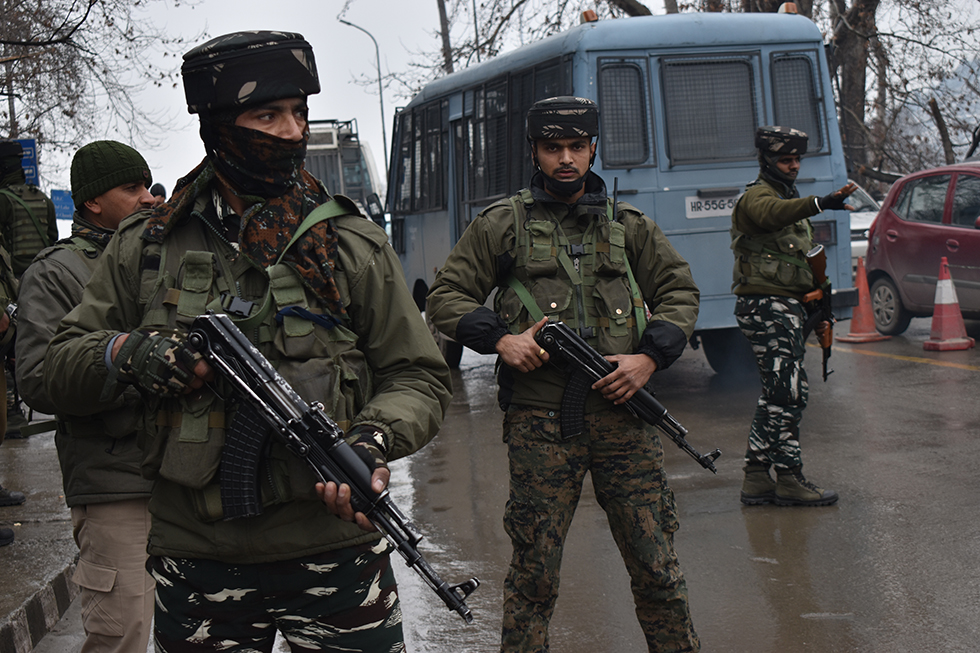
Dear FO° Reader, Across the world, paramilitary groups serve as the unofficial enforcers of political will. They are armed organizations that resemble conventional militaries but operate outside formal chains of command. Each state has its own version of a paramilitary group. Some are associated with their state, while others may be used by non-state actors. Paramilitary is defined as a “group or organization that operates outside a country’s formal military structure. Paramilitaries are typically modeled after military organizations and may have similar training and equipment. These groups often have political or ideological aims and may be involved in activities such as counterinsurgency, anti-terrorism, or internal security.” While each country has its own paramilitary force, several states have seen paramilitary groups turn against their own people, causing chaos and devastation within the confines of their borders. Those groups have broken laws without consequence.
Sudan’s RSF: When the regime builds its own rival Sudan offers a stark example of the risks posed by government linked paramilitary forces. The Rapid Support Forces (RSF), based in Darfur, was formed in 2013 by the Sudanese government to combat Sudanese rebels. Since defeating the rebels, the RSF has substantially expanded in size and now challenges Sudan’s official military. When the RSF was formed in 2013, it was under the control of the National Intelligence and Security Services (NISS). In 2017, legislation was enacted that made the RSF part of the Sudanese Armed Forces (SAF), while retaining a distinct command structure. Rather than consolidating state control, this dual military arrangement deepened internal rivalries. Since 2023, the RSF and SAF have engaged in a war for supremacy that has devastated the country. Earlier signs of the RSF’s political role were already visible in April 2019, when it served as Sudanese President Omar al-Bashir’s protective force, insulating his regime from coup attempts. The UN has reported in late October 2025, the RSF killed more than 6,000 people in over three days of intense violence in the Darfur region that saw atrocities from mass killings, summary executions, sexual violence, kidnappings for ransom and ill treatment at detention. In the many attacks detailed, many of them were ethnically motivated. The conflict in Sudan has exacerbated an already fragile economy, causing widespread displacement, reducing the workforce, and damaging critical agricultural and industrial infrastructure. With the Sudanese government interests being intertwined with the RSF and SAF, it has left many civilians to continue to struggle in Sudan’s war torn economy. Sources: Rapid Support Forces — Britannica At least 6,000 killed over 3 days during RSF attack on Sudan’s el-Fasher, UN says — NPR Under Fire: Making a Living in Wartime Sudan — The Tahrir Institute for Middle East Policy Brazil’s Militias: Death squads in uniform Brazil is a different story. The militias there are not aligned with the Brazilian state; rather, Brazil’s militias operate like paramilitary groups. While militias are not formally part of the state, they do maintain informal ties to political figures. In the Amazon city of Belém, the second most populous city in the Amazon region, former off-duty police officers and firefighters formed what are called “death squads” during the 2000s. These squads were backed by local businesses to combat drug traffickers and petty thieves. Many locals support them, and they were described as a “necessary evil.” Brazil’s militias originated in the 1960s during the military dictatorship. At that time, the military police held significant power and formed death squads. Many of the members of these squads later entered politics. While they spread fear throughout society, they also distributed gifts to the poor. Brazilian President Jair Bolsonaro held views similar to those of former deputy José Guilherme Godinho Sivuca. Bolsonaro elevated the military police to the status of national heroes and advanced legislation that would grant them legal immunity — protections that would also shield allied militias protecting them from prosecution. The militias would make their own laws and set their own rules, imposing curfews and taxes. Today, about 20 militias operate in Belem. Liga da Justiça (The Justice League) emerged as Rio’s most feared paramilitary group. Brazil’s militias control more than half of the country. These militias are dedicated to committing crimes that go unpunished, crimes such as extortion, controlling the supply of gasoline, organizing illegal gambling and even operating illegal mining operations. Unlike Sudan, where rival armed forces openly battle for supremacy, Brazil reveals a quieter shift in militia power. Militias operate not as insurgents, but as embedded power structures — deeply intertwined with politics and commerce, and capable of reshaping the state from the inside out. Sources: Brazil’s fearsome militias: mafia boom increases threat to democracy — The Guardian In Brazil’s Belem, rogue cop-run militias ‘make their own laws’ — Al Jazeera The Wagner group: The Kremlin’s long arm In contrast, the Wagner group is quite explicitly aligned and under the control of a relatively stable regime in Russia. They have operated in the Middle East and Africa as mercenaries, while also usually aiding Russia’s geopolitical aims by expanding its sphere of influence. This paramilitary force has a relatively short history, only emerging in the early 2010s with a deliberately murky origin, but the connections to the Kremlin were fairly obvious from the outset due to Russia’s laws against mercenaries not seeming to apply to them. Throughout the decade they have been active, the Wagner group has operated as mercenaries not only abroad, but also within Russia and Ukraine. They first aided Russia in the regional conflict in the 2014 invasion of Crimea and the Donbas region, and then again in the ongoing Ukraine War, where they now continue to fight for four bloody years. Throughout nearly all their operations, the Wagner group has garnered a reputation for cruelty and has been accused of war crimes on numerous occasions. In Mali, for instance, Wagner mercenaries were reported to have summarily executed civilians in support of Mali’s transitionary government, itself a repressive regime accused of human rights abuses. Furthermore, hundreds of war crime allegations have been leveled at the group in the Ukraine War. More importantly, however, is that unlike every other group we’ve discussed, Wagner is mostly a for-profit enterprise. While many far-right political beliefs and practices connect to many of their members and activities, ideology doesn’t seem to be particularly important to them. Money does, given their willingness to use and be used by anyone with the cash to pay them. Sources: Mali: Army, Wagner Group Atrocities Against Civilians | Human Rights Watch 654 war crimes suspects tied to Russian paramilitary | Europol Hezbollah: Proxy paramilitary Hezbollah is a more perplexing case. At once a militia, political party and proxy for Iran, this paramilitary is a strange concoction of different parts that seems like it could only make sense in Lebanon’s bizarre political landscape. Hezbollah was founded after Israel’s 1982 invasion of Lebanon during the Lebanese civil war. The militia’s founders were inspired by the recent Iranian Revolution and quickly made inroads into the new government, seeing a common enemy in Israel and the US, as well as other parties fighting against their factions in the civil war. After the civil war, Hezbollah continued fighting Israel — which was still occupying southern Lebanon — eventually forcing the Israelis back. Hezbollah has continued to involve itself in many wars in the region, from the 2006 Lebanon war, the Syrian civil war and the most recent Israeli–Palestine war with covert and explicit military actions, such as car bombings and guerilla attacks. But most surprising of all, Hezbollah has also become a domestic political party within Lebanon. This is in part due to Lebanon’s unique fracturing and reconstruction after its 15-years-long civil war where all parties agreed to a balancing act of power between Christians and Muslims. It also has a desire to be seen as legitimate. The group has gone so far as to build and operate schools, hospitals and other social services while engaging in many military actions. Still, they are also seen as a proxy for Iran, which provides funds and equipment for the group. Some estimates put the financial packages as high as $1 billion every year. Iran is quite happy to foot the bill, as Hezbollah is one of the only Shi’a forces within the Levant region with enough organizational power to attack its Israeli enemies. Sources: Increasing violence around the world Paramilitaries, it can be argued, are how any state in a violent region starts. In order to organize and defend yourself, you have to have a certain monopoly on violence. As several of these groups show, a certain level of legitimacy is granted to you if you manage to survive long enough. And, in order to get anything done in these regions, you have to deal with the paramilitary, especially when other institutions fail. If you look back in history, many states can be said to have arisen from extrajudicial paramilitary groups. Nearly every country in the Americas rose up against their English and Spanish rulers. At first, they were militias and a loose network of oppositional forces before becoming legitimate states the whole world recognizes as sovereign today. Which brings us back to the modern day. Many of the paramilitaries we have highlighted have a certain level of institutional acceptance if they are not directly tied to a central government. But if a paramilitary is a military force that does not have an official status, what should we call these groups? Are they a new or perhaps an old breed of military force? Can official forces governments hide behind on the international stage? Is there a difference between the US regime changing in South America directly or indirectly, and the mercenary work carried out by the Wagner group? What exactly separates militias from cops in Brazil when the central government cannot enforce control properly? If situations are bad enough that people feel the need to form their own defensive organizations, can they be blamed for going outside the law? There aren’t many solutions or easy answers to be had to this dilemma, but we should always keep these quandaries in mind when we try to think about how our governments should interact with paramilitaries. Related Reading
Wishing you a thoughtful week, Liam Roman and Casey Herrmann Assistant Editors | ||||||||
We are an independent nonprofit organization. We do not have a paywall or ads. We believe news
must
be free for everyone from Detroit to Dakar. Yet servers, images, newsletters, web developers and
editors cost money.
So, please become a recurring donor to keep Fair Observer free, fair and independent. 
| ||||||||
| ||||||||
| About Publish with FO° FAQ Privacy Policy Terms of Use Contact |





Support Fair Observer
We rely on your support for our independence, diversity and quality.
For more than 10 years, Fair Observer has been free, fair and independent. No billionaire owns us, no advertisers control us. We are a reader-supported nonprofit. Unlike many other publications, we keep our content free for readers regardless of where they live or whether they can afford to pay. We have no paywalls and no ads.
In the post-truth era of fake news, echo chambers and filter bubbles, we publish a plurality of perspectives from around the world. Anyone can publish with us, but everyone goes through a rigorous editorial process. So, you get fact-checked, well-reasoned content instead of noise.
We publish 3,000+ voices from 90+ countries. We also conduct education and training programs
on subjects ranging from digital media and journalism to writing and critical thinking. This
doesn’t come cheap. Servers, editors, trainers and web developers cost
money.
Please consider supporting us on a regular basis as a recurring donor or a
sustaining member.
Will you support FO’s journalism?
We rely on your support for our independence, diversity and quality.





Comment