





American economist and statistician Milton Friedman died in 2006. His major work, Capitalism and Freedom, was published in 1962, and his landmark paper The Role of Monetary Policy appeared in 1968.
To state the conclusion up front: The value of reading Friedman today does not lie in believing his conclusions. Rather, it lies in acquiring a “mode of thinking” that traces causal relationships through three lenses when evaluating any policy:
- Not whether the goal is good or bad, but how it changes people’s incentives
- Not just today’s prices, but how “expectations” about future prices are formed
- How uncertain the “lag” is before a policy’s effects actually show up
This mode of thinking can be applied to nearly every ongoing policy debate today — monetary policy, housing policy, education policy, healthcare. The theoretical core of Friedman’s thought connects to the inflation debates of the 2020s, the question of central bank credibility and modern macroeconomics (Edmund Phelps, Robert Lucas and the New Keynesians).
Friedman’s core concern
Friedman’s central question was never the simple binary of “small government versus big government.” What he actually asked was a question of institutional design: Which domains should be left to the market’s own adjustment, and which require government intervention — and how should that boundary be drawn?
Capitalism and Freedom covers a wide range of areas — monetary policy, education, income distribution, occupational licensing, monopoly regulation — but what unites them is a habit of distinguishing a policy’s intent from its results. On education, for instance, Friedman separated the question of whether government should financially support education from the question of whether government itself should run the schools, and from that distinction proposed the education voucher as an alternative. That same framework remains useful today for thinking about subsidy design, the division of labor between public education and private contracting, and the design of healthcare and housing policy.
Another key point is that, for Friedman, the market was never simply an efficient venue for exchange. It was an institution that ties economic freedom to political freedom. Because a competitive market exists, individuals retain a range of economic choices without depending on any particular concentration of power. This view pushes the conversation beyond the narrow question of ”is the market efficient?” toward a deeper, political-philosophical question: Who holds the power to determine other people’s choices?
Friedman’s greatest achievement as an economist was reconstructing the quantity theory of money for the modern era. Simplified, the idea is that aggregate nominal spending in an economy is governed by the quantity of the money stock; in the short run this affects the real economy (output and employment), but in the long run it shows up in the price level.
From this comes the well-known policy prescription: the k-percent rule. Rather than letting the central bank run monetary policy at its discretion, the money stock should expand mechanically at a fixed growth rate (k%). The proposal itself is not adopted in its original form today, since modern central banks operate through inflation targets and policy rates rather than direct control of the money stock. But the idea underneath it — that discretionary policy has real limits, and that a transparent, rules-based approach better serves the stability of expectations — is one of the theoretical wellsprings of today’s inflation-targeting regimes and forward guidance.
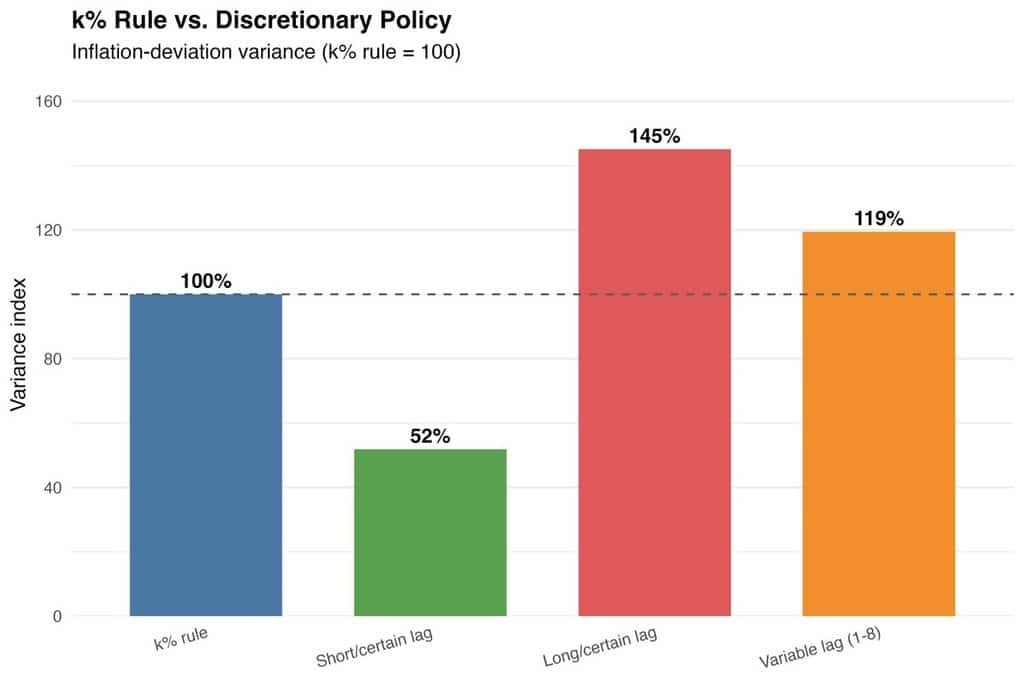
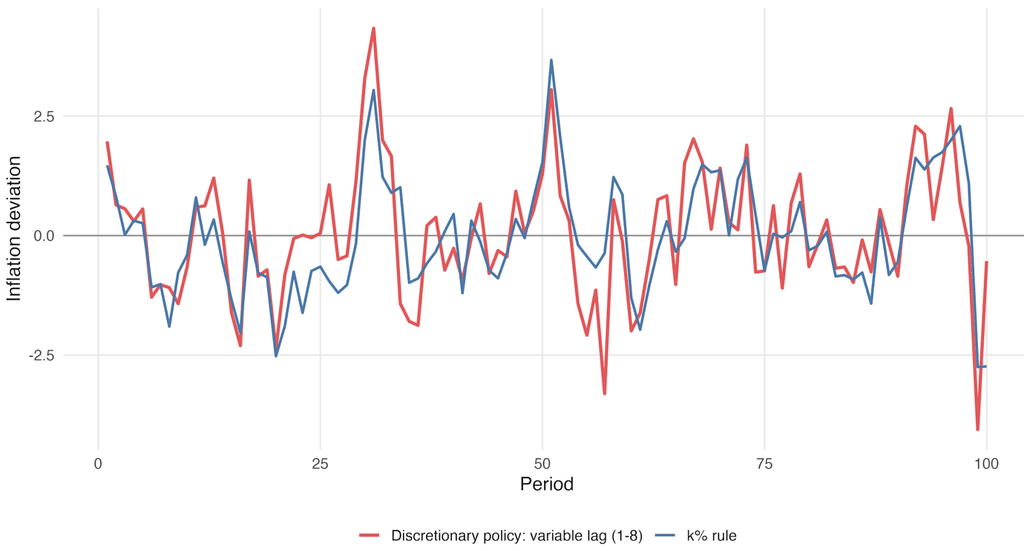
The two charts below present a simplified theoretical simulation rather than actual economic data. Using a stylized model, they illustrate the argument Friedman formalized in his 1953 essay, The Effects of a Full Employment Policy on Economic Stability: A Formal Analysis. Discretionary intervention can stabilize the economy when the lag between a policy action and its effect is short and predictable. When that lag is long — or, as Friedman argued is typically the case in practice, both long and variable — even a well-intentioned policy response may amplify volatility rather than dampen it.
The model subjects four policy regimes to exactly the same simulated demand shock: a nonreactive k-percent rule and three discretionary rules that respond after different policy lags. It then compares the resulting inflation variance across regimes, indexing the variance under the k-percent rule to 100. The numerical magnitudes are illustrative and depend on the assumed shock process, policy-response coefficient and lag distribution; the simulation is intended to demonstrate Friedman’s mechanism rather than estimate an empirical policy effect.
Simulated demand shock
Among Friedman’s theoretical contributions, the most important today is the Natural Rate Hypothesis. Presented in his 1968 paper, it revised the era’s understanding of the Phillips curve — the relationship depicting a tradeoff between inflation and unemployment.
The logical skeleton runs as follows:
- The central bank eases monetary policy; nominal demand expands and prices rise.
- If workers do not fully anticipate this price increase, firms perceive that real wages have fallen relative to before, and increase hiring. As a result, unemployment falls below the natural rate.
- But once workers learn that prices are rising by roughly this much every year, they begin demanding wage increases in the next round of bargaining that reflect their expected inflation rate.
- As expected inflation converges with actual inflation, the initial real-wage illusion dissolves, and employment reverts to the natural rate.
In other words, monetary policy cannot permanently hold unemployment below the natural rate; any attempt to do so only raises the inflation rate in the long run. That was Friedman’s conclusion. A short-run Phillips curve exists, but in the long run there is no tradeoff between inflation and unemployment.
The key variable here is expected inflation. Written as a simplified relationship: Expected inflation influences wage bargaining and the expected real return on saving and investment, although the realized real wage ultimately depends on the actual price level. In other words, what people expect future prices to do determines real economic variables — the real wage, the real interest rate. When a central bank tries to control inflation, its ability to influence the expected inflation rate held by households and firms — not merely today’s price readings — determines how effective its policy actually is.
Another point Friedman emphasized was the time lag before monetary policy’s effects appear — the famous ”long and variable lags.” Even when a central bank changes its policy rate today, the effect on the real economy and on inflation takes time to show up, and the length of that time is not constant; it varies with economic conditions. This point warns against the mechanical logic of “inflation is high right now, so we should immediately raise rates sharply.” Because the timing of a policy’s effects is uncertain, an overly aggressive policy shift risks an overshoot down the road. This is also one reason today’s central banks are constantly trying to balance a data-dependent approach against a forward-looking one in their policy decisions.
The Fed’s framework review: average inflation targeting, now judged a “failure”
In March 2025, at the US Monetary Policy Forum hosted by Chicago Booth, former Federal Reserve Chair Jerome Powell gave a speech that touched on a review of the average inflation targeting framework adopted in 2020.
That framework was built on a makeup logic: Because inflation had persistently run below 2% before the pandemic, the Fed would follow a period of below-2% inflation with a period somewhat above 2%, aiming for an average of 2% over the long run. But there are indications that this framework itself became a factor delaying the shift to quantitative tightening (QT): Because the Fed had already committed, through forward guidance, to an orderly sequence for unwinding quantitative easing (QE), it found itself unable to move nimbly into QT even once tightening was judged necessary.
This is a concrete example of exactly the problem Friedman flagged — long and variable lags — showing up as a real operational constraint. The more a central bank prizes rules-based transparency (forward guidance), the harder it becomes to respond nimbly as conditions change. That tradeoff was laid bare here.
And the March 2025 review by Powell, initially framed as an act of reflection, has increasingly come to be judged, in retrospect, as quite inadequate. Critics argue that the 2025 framework review removed the most problematic features of the 2020 framework — the asymmetric reaction function and the flexible average inflation target that had helped fuel the post-pandemic inflation surge — but left the deeper problem untouched: It still left the Federal Open Market Committee (FOMC) with effective discretion. In other words, while it looked like the mechanism of forward guidance and average inflation targeting had been reconsidered, no binding rule that actually constrains the central bank’s discretion was introduced. That is the heart of the criticism.
Senior Vice President Spencer Krane and his coauthors at the Chicago Fed have dug into exactly this problem theoretically: When a central bank introduces a new policy framework (such as average inflation targeting), if a large economic shock arrives before markets and the public have finished learning the new rule, the learning process itself can stall. If learning stalls, the new framework’s credibility never gets established before attention is pulled back to handling the original shock — creating a dilemma in which the same framework fails to function well the next time a similar situation arises. Put in Friedman’s terms: While expectations about the policy rule itself have not yet settled, a rules-based approach cannot deliver its full benefit.
Rethinking forward guidance through Friedman’s lens
These concerns have acquired renewed significance in recent debates over the conduct of monetary policy. A growing emphasis on policy discipline, institutional accountability and the limits of central bank communication reflects a broader reconsideration of how monetary credibility should be established. From a Friedmanian perspective, credibility rests less on policymakers’ ability to signal a precise future path of interest rates than on their consistent commitment to monetary stability. This distinction becomes particularly important when economic conditions change unexpectedly and previously communicated policy expectations no longer correspond to economic realities.
Forward guidance can help stabilize expectations, but it can also create an illusion of precision about an inherently uncertain economic future. When central banks signal a particular interest-rate trajectory, financial markets may interpret conditional projections as implicit commitments. Such expectations can encourage excessive dependence on central bank communication and constrain policymakers when inflationary pressures or other economic shocks require a change in direction.
Reversing previously signaled policies may then carry reputational costs, even when the adjustment is economically justified. This tension echoes Friedman’s warnings about monetary policy’s long and variable lags and the risks of discretionary intervention under uncertainty.
The central issue, therefore, is not whether central banks should communicate, but what they should communicate. A credible monetary framework requires clarity about policy objectives and the principles guiding decisions, rather than promises about future interest rates. Rules-based monetary policy and forward guidance are not necessarily incompatible, provided that guidance remains conditional on economic developments. Yet when communication becomes a substitute for policy discipline, transparency itself may undermine flexibility and credibility.
The lesson is that monetary credibility should rest on the predictability of policy principles, not on the predictability of future interest rates. This distinction is increasingly relevant as central banks reassess the relationship between inflation targeting, market expectations, and their capacity to respond to unexpected economic shocks.
From Friedman to modern macroeconomics
Friedman’s natural-rate hypothesis and his emphasis on expected inflation became foundations for subsequent developments in macroeconomics. Working independently at roughly the same time, Edmund Phelps developed models in which inflation expectations shift the short-run Phillips curve. This work clarified why policymakers could not permanently reduce unemployment by accepting progressively higher inflation and later contributed to Phelps’s Nobel Prize in Economics.
Building on fellow economist John Muth’s formulation of rational expectations, Robert Lucas incorporated the concept into macroeconomic and policy analysis. Under rational expectations, individuals use available information — including knowledge of the policy regime — to form forecasts that do not contain systematic errors. This insight led to the Lucas critique: When policymakers change the governing policy rule, households and firms may also change their behavior and expectations. Consequently, relationships estimated from historical data cannot necessarily predict economic outcomes under a different policy regime. The critique remains a fundamental caution in policy evaluation and macroeconomic modeling.
Modern New Keynesian economics extends this intellectual lineage by treating current inflation as the outcome of several interacting forces: expectations of future inflation, the degree of economic slack or pressure on firms’ costs and temporary supply disturbances. Inflation therefore reflects not only current economic conditions and past price movements but also beliefs about future inflation. For central banks, reducing current inflation and keeping longer-term inflation expectations anchored are closely connected objectives.
The post-pandemic inflation surge brought these questions back to the center of policy debate. Economists disagreed over the relative importance of supply disruptions, fiscal stimulus, monetary accommodation and shifts in aggregate demand. Nevertheless, the behavior of inflation expectations remained crucial because temporary price pressures were more likely to become persistent if they entered wage bargaining, firms’ price-setting decisions and longer-term contracts.
Contemporary research also rejects the idea of a single, uniform measure of expected inflation. Expectations differ across households, firms, workers, professional forecasters and financial-market participants. Researchers can measure expectations through surveys, wage and price-setting behavior, and market instruments such as inflation swaps and inflation-indexed bonds. Evidence that households and firms respond unevenly to personal experience, news coverage and central-bank communication also challenges the assumption that expectations are always fully informed or perfectly rational.
Current debates over quantitative easing and tightening, central-bank credibility and the appropriate use of forward guidance therefore remain connected to a fundamentally Friedmanian concern: Policy affects the economy not only through its immediate actions but also through the expectations those actions create. Friedman’s lasting contribution lies in directing attention to this interaction among policy rules, private behavior, credibility and time.
New perspectives from Chicago
Friedman’s theoretical lineage is still being updated, in new forms, out of the University of Chicago. Here, I want to introduce a few Chicago-rooted debates that have drawn attention in 2025 and 2026.
John Cochrane — who earned his PhD at the University of Chicago and spent many years teaching at Chicago Booth before moving to the Hoover Institution — has, in recent years, refined a theoretical framework known as the Fiscal Theory of the Price Level (FTPL), publishing both a culminating academic book and a non-technical booklet summarizing it between late 2025 and early 2026.
The starting point of FTPL can be read as a partial challenge to Friedman’s famous line: “inflation is always and everywhere a monetary phenomenon.”
Cochrane argues that far more factors affect inflation than the money supply alone. The theory’s skeleton is simple: the price level adjusts so that the real value of outstanding government liabilities equals the expected present value of future primary surpluses. Inflation can therefore arise when the government issues additional nominal liabilities without a corresponding increase in the fiscal resources expected to back them.
Cochrane’s argument is not that a high debt stock mechanically produces inflation. The crucial issue is whether people expect future primary surpluses to back increases in government liabilities. When they are not, the price level may rise to reduce the real value of those liabilities. Cochrane argues that the 2021–2023 inflation surge was triggered by a large fiscal shock and subsided as that shock faded. He further argues that higher interest rates can reduce inflation only if fiscal policy accommodates the resulting increase in government interest costs; otherwise, monetary tightening may eventually create additional fiscal pressure.
What makes this interesting is that where Friedman focused on the quantity of money, Cochrane focuses on the fiscal credibility of the government. Now that central banks operate mainly by setting policy rates rather than directly controlling the money stock, applying the classical quantity theory in its original form has become difficult.
Cochrane extends Friedman’s expectations theory into the fiscal domain, constructing a modern-day version in which the price level depends on what people expect the government’s future fiscal management to look like. Friedman’s monetary theory and Cochrane’s fiscal theory are less a confrontation than a sequel: Both stand on the shared foundation of expectations but shift the variable of interest from money to fiscal policy.
Reading Friedman in 2026
Reading Friedman in 2026 does not require applying all his policy prescriptions directly to the present. Its value lies instead in acquiring a mode of thought: understanding inflation through the interaction of money, policy and expectations; evaluating policy by its effects on incentives and behavior rather than by its stated intentions; and recognizing that policy operates only after uncertain and potentially destabilizing lags.
Broadening this perspective through Phelps, Lucas and modern New Keynesian economics provides a clearer understanding of the challenges central banks face today — anchoring inflation expectations, preserving credibility and determining when and how quickly to withdraw monetary accommodation. Friedman’s enduring contribution is therefore not a fixed set of answers, but a disciplined way of asking the right questions.
[Kaitlyn Diana edited this piece.]
The views expressed in this article are the author’s own and do not necessarily reflect Fair Observer’s editorial policy.
Who Should Form Expectations?: The Future of Monetary Policy
Modern monetary policy should balance central bank guidance with independent market learning. While forward guidance effectively stabilizes expectations during crises,...
“Isms” Have Hijacked Economics. It Needs Fresh, Creative Thinking Now.
Economists come up with policies based on rigid ideologies that dominate universities. These isms — capitalism, socialism, Keynesianism, monetarism —...

Keynes and Friedman, Prophets of the World’s Most Popular Religion
Capitalism is a religion. Like all religions, it must adapt to changing times in order to keep and win followers....
Support Fair Observer
We rely on your support for our independence, diversity and quality.
For more than 10 years, Fair Observer has been free, fair and independent. No billionaire owns us, no advertisers control us. We are a reader-supported nonprofit. Unlike many other publications, we keep our content free for readers regardless of where they live or whether they can afford to pay. We have no paywalls and no ads.
In the post-truth era of fake news, echo chambers and filter bubbles, we publish a plurality of perspectives from around the world. Anyone can publish with us, but everyone goes through a rigorous editorial process. So, you get fact-checked, well-reasoned content instead of noise.
We publish 3,000+ voices from 90+ countries. We also conduct education and training programs
on subjects ranging from digital media and journalism to writing and critical thinking. This
doesn’t come cheap. Servers, editors, trainers and web developers cost
money.
Please consider supporting us on a regular basis as a recurring donor or a
sustaining member.
Will you support FO’s journalism?
We rely on your support for our independence, diversity and quality.




Comment