





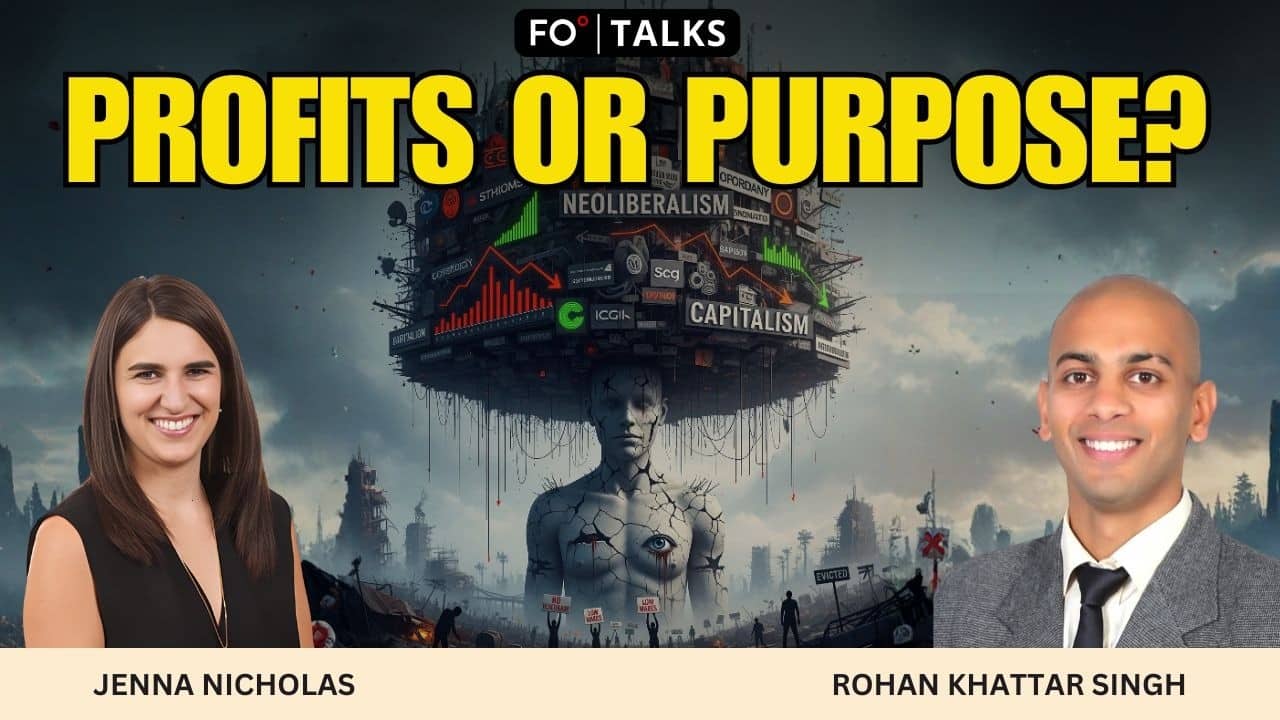
Fair Observer’s Video Producer Rohan Khattar Singh speaks with Jenna Nicholas, President of LightPost Capital, about impact investing, inequality and the intersection of ethics and capitalism. Drawing on her experience as an investor and author of the best-selling book, Enlightened Bottom Line: Exploring the Intersection of Spirituality, Business, and Investing, Nicholas explores how climate, healthcare and education ventures can generate financial returns and measurable social good. The conversation also examines how her Bahá’í faith shapes her approach to leadership, capital allocation and long-term strategy.
Rethinking impact investing
Nicholas describes impact investing as a field that has grown significantly over the past decade. Rather than treating profit and purpose as opposing forces, it seeks to align them. As she puts it, “So often when we think about finance, we think about only maximizing financial returns, and that it is the opposite to social impact. But the thesis is that actually, each can reinforce the other.”
In practical terms, this means directing capital toward sectors such as climate, healthcare and education, where social and environmental considerations are embedded in a company’s mission. Nicholas points to investments such as Virta Health, which works to reverse type 2 diabetes, and Esusu, which uses rental payment data to help renters build credit profiles. These companies demonstrate that strong financial performance and social benefit are not mutually exclusive.
However, Nicholas recognizes the scale of the challenge. The global investment industry manages roughly $82 trillion in assets under management. Of that, less than 2% flows to companies or funds run by women and people of color. That disparity may signal a deeper structural imbalance in capital allocation.
Structural bias and capital allocation
Nicholas argues that the financial system does not simply reflect inequality; it often reinforces it. She points to the stark mismatch between who controls capital and the demographic composition of society.
To address this, she cofounded Impact Experience, an initiative that partners with investors and institutions to engage around bias directly. Through immersive programs in places such as Montgomery, Alabama, participants examine the historical roots of racial and gender inequities and how they shape present-day investment decisions. The goal is to bring about behavioral change that leads to different asset allocation choices.
Reform must operate on multiple levels: structural, organizational and individual. Greater transparency, intentional portfolio design and expanded networks for underrepresented founders all play a role. For Nicholas, recalibrating even a small fraction of that $82 trillion could have transformative effects.
Faith, work and the question of legacy
A distinctive dimension of Nicholas’s outlook comes from her identity as a member of the Bahá’í faith. She highlights core principles, such as the equality of men and women, the harmony of science and religion and the abolition of extremes of wealth and poverty. These ideas are not abstract doctrines but operational guideposts.
She references a line from the Bahá’í writings that a human being is “a spiritual being and only when they live in the life of their spirit are they truly happy.” For Nicholas, this reframes work as an expression of spiritual purpose rather than mere material accumulation. The concept that “work is worship” reinforces the idea that professional life can be a space of service.
Her book develops these themes through interviews with investors and entrepreneurs who have integrated values into their business models. She introduces the HEAL framework — Hope, Empathy, Abundance and Legacy — as a tool for aligning financial decision-making with long-term human flourishing. The animating question is not simply how much wealth one creates, but what trace one leaves behind.
Global perspective and expanded capital
Nicholas’s worldview has been shaped by time spent in India, China, the Congo and Silicon Valley. In India, she recalls meeting people with limited financial means but profound spiritual and social resources. These experiences inform her argument for expanding the definition of capital beyond money alone.
She proposes a broader framework that includes spiritual capital, social capital and human capital alongside financial capital. A purely material conception of capitalism, she suggests, misses the fullness of what it means to be human. By recognizing multiple forms of value, investors can make decisions that strengthen communities rather than merely extract returns.
This broader lens also informs her call to incorporate indigenous perspectives into finance. The idea of thinking seven generations ahead and considering the legacy of seven generations in the past, challenges the short-termism of quarterly earnings cycles and public market pressures.
From quarterly capitalism to seven-generation thinking
Khattar Singh presses Nicholas on whether long-term thinking is realistic in a volatile geopolitical environment. She responds that long horizons and daily discipline are not mutually exclusive. Multi-decade goals can be broken down into yearly, monthly and daily actions. The task is to ensure that short-term decisions do not undermine long-term societal well-being.
Nicholas says that finance and faith need not clash; they can coexist in productive tension. Investors and entrepreneurs alike must ask what motivates their work, what legacy they seek to build and how capital can serve broader human purposes.
The conversation ultimately circles back to a foundational question: Can modern capitalism evolve beyond quarterly metrics toward a system that values equity, sustainability and spiritual grounding? Nicholas believes it can, if those who steward capital are willing to align profit with purpose and think about the next generation.
[Lee Thompson-Kolar edited this piece.]
The views expressed in this article/video are the author’s own and do not necessarily reflect Fair Observer’s editorial policy.


































Comment