





The European Union is one of the world’s most ambitious economic integration projects. The Single Market, the euro and decades of regulatory harmonization have created one of the world’s largest economies. Yet one crucial element remains unfinished: finance. Unlike trade and monetary integration, Europe’s financial markets remain fragmented along national borders, preventing capital from flowing efficiently to the firms and industries that need it most. As technological competition intensifies and geopolitical risks grow, this fragmented financial system has become one of the greatest obstacles to Europe’s long-term competitiveness and prosperity.
Both the International Monetary Fund (IMF) Staff Discussion Note and former Italian Prime Minister Mario Draghi’s 2024 report on The Future of European Competitiveness reach remarkably similar conclusions despite approaching the issue from different perspectives. The IMF focuses on financial efficiency and macroeconomic performance, while Draghi examines Europe’s long-term competitiveness and strategic autonomy. Nevertheless, both argue that Europe does not suffer from a savings shortage. Instead, its principal weakness is its inability to transform abundant private wealth into productive investment.
European households save enormous amounts of capital every year, yet much of these resources remain concentrated in bank deposits, government securities or domestic financial assets instead of financing innovative businesses capable of driving productivity growth. The challenge is therefore not generating additional savings but mobilizing existing savings more effectively through deeper financial integration.
Europe’s investment challenge
Draghi places this issue within a much broader economic context. According to his report, Europe faces an annual investment gap of approximately €750–800 billion if it wishes to remain competitive while financing digital transformation, decarbonization, technological innovation, infrastructure modernization, energy security and defense capabilities.
These investment requirements exceed what national governments can finance through public budgets alone. Private capital must therefore play a substantially larger role in supporting Europe’s economic transformation. Yet fragmented financial markets continue to prevent savings from reaching productive investment opportunities efficiently. Capital that could finance innovative firms instead remains locked in national financial systems or flows into relatively low-risk assets that contribute little to long-term productivity.
The consequences extend far beyond financial markets themselves. Europe’s relatively weak productivity growth during the past two decades partly reflects insufficient investment in rapidly expanding sectors such as artificial intelligence, biotechnology, semiconductors, advanced manufacturing, renewable energy and digital infrastructure. While the United States has developed deep and highly integrated capital markets capable of financing ambitious entrepreneurial ventures, Europe continues to rely primarily upon traditional bank lending.
This financial structure served Europe well during earlier stages of industrial development, when manufacturing firms required relatively stable long-term financing. Today’s innovation-driven economy, however, increasingly depends on flexible equity financing that can support firms with uncertain cash flows but enormous growth potential.
Why capital markets matter
One of the most important insights shared by both reports is that financial integration should not be viewed merely as a technical regulatory objective. Rather, it represents a fundamental determinant of economic productivity. Efficient financial systems perform a simple but essential economic function: They allocate scarce capital toward its most productive uses. When financial markets operate efficiently, innovative firms obtain financing regardless of geographic location, while investors diversify risks across sectors and countries. Fragmented markets, by contrast, trap capital within national borders, limiting investment opportunities and reducing economic efficiency.
The IMF demonstrates that Europe continues to exhibit a remarkable degree of financial home bias. Banks overwhelmingly lend to domestic borrowers, institutional investors favor national financial assets and venture capital remains concentrated within individual member states rather than flowing freely throughout the Union. As a consequence, firms located in countries with relatively underdeveloped financial sectors often encounter higher borrowing costs despite the existence of abundant savings elsewhere in Europe. Capital allocation becomes influenced by geography instead of productivity, reducing overall economic performance. The IMF therefore argues that financial fragmentation represents one of Europe’s most significant structural distortions.
The persistence of home bias
Despite the euro and decades of financial integration, Europe’s banking market remains surprisingly national. Differences in insolvency law, deposit insurance, taxation, supervision and creditor protection continue to discourage banks and investors from operating across borders. According to the IMF, direct cross-border lending accounts for only about 5% of corporate loans, rising to just 14% when lending through foreign subsidiaries and branches is included — well below the level seen in the United States.
The IMF estimates that establishing a new cross-border banking relationship carries an implicit cost equivalent to almost 99% compared with domestic lending. Once relationships are established, however, this cost falls to only 0.2%, while interest-rate differences narrow to around 25 basis points. The problem, therefore, is not cross-border lending itself but the institutional barriers that prevent banks from entering foreign markets. Europe has integrated banks, but it has yet to create a truly integrated banking market.
Draghi argues that completing the Capital Markets Union and Banking Union is therefore essential to Europe’s competitiveness. Instead of operating 27 fragmented financial systems, Europe should develop a genuinely continental capital market where savings can flow freely to the most productive investments. Such integration would improve capital allocation, strengthen private risk sharing and make the European economy more resilient to future financial shocks.
Financing innovation
While banking integration offers the largest immediate gains, both the IMF and Draghi argue that Europe’s long-term competitiveness ultimately depends upon its ability to finance innovation. Modern economies are increasingly driven by firms whose most valuable assets are intellectual property, advanced technology and highly skilled human capital rather than physical collateral. Such firms often generate little revenue during their early years while investing heavily in research, product development and market expansion. Traditional banks, operating under strict prudential regulations and relying on collateral-based lending, are rarely well positioned to finance these high-risk ventures. Consequently, venture capital and equity financing become indispensable components of an innovation-driven economy.
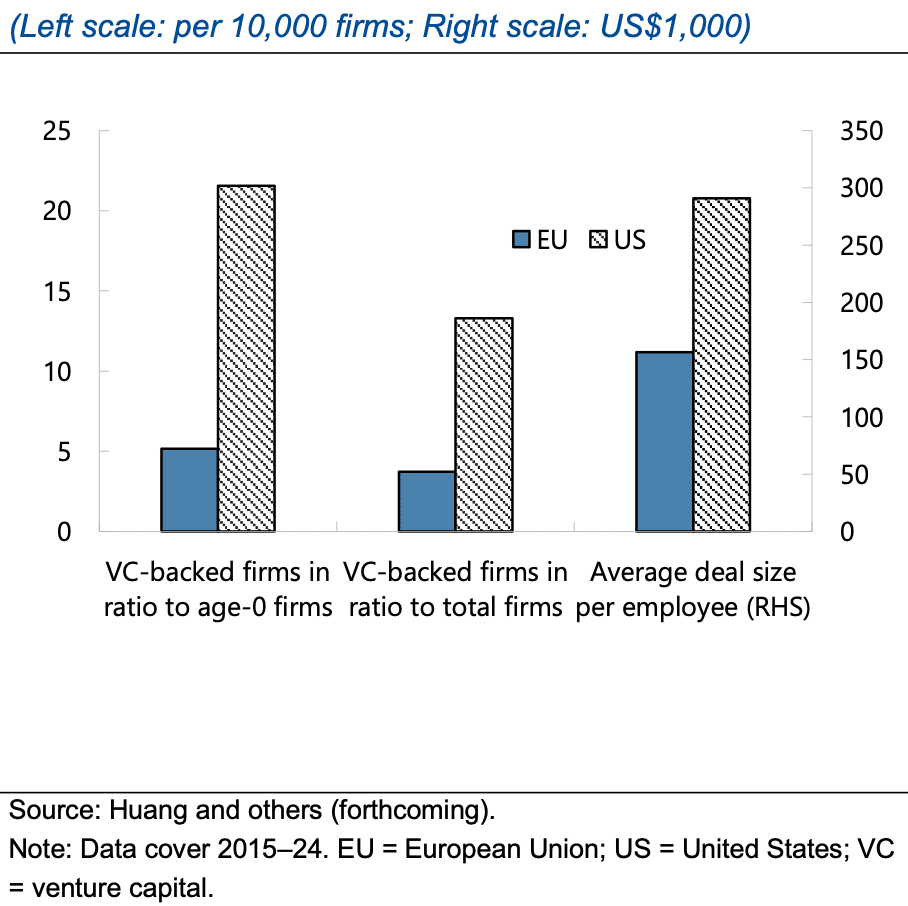
Europe, however, continues to lag significantly behind the United States in developing vibrant venture capital markets. According to the IMF, European venture capital investment amounts to only about one-quarter of US levels. Young European firms are approximately one-fourth as likely to obtain venture capital financing, while successful applicants generally receive only half the funding secured by comparable American firms. Moreover, nearly 60% of investors financing European start-ups originate from the firm’s own country, whereas fewer than 20% come from another EU member state.
In contrast, approximately 50% of investors supporting American start-ups come from outside the firm’s home state, illustrating the much deeper integration of US capital markets. These differences demonstrate that Europe’s challenge extends beyond the size of its venture capital industry to include its fragmented national structure.
Draghi similarly argues that Europe has relied excessively on banks since the 1960s, while capital markets have remained underdeveloped. Although non-bank finance has gradually expanded, European companies continue to depend primarily on bank loans rather than equity financing. This financial structure places innovative firms at a disadvantage because banks naturally emphasize repayment capacity and collateral rather than technological potential. Draghi therefore concludes that Europe’s future growth model must become more equity-based, allowing entrepreneurs to obtain patient, long-term financing capable of supporting innovation throughout the early stages of corporate development.
Unlocking Europe’s savings
Perhaps the most striking similarity between the IMF and Draghi reports is their shared diagnosis of Europe’s savings paradox. Contrary to conventional assumptions, Europe does not lack financial resources. On the contrary, European households collectively hold enormous financial wealth and maintain relatively high savings rates. The problem lies in the destination of those savings. Rather than financing productive investment, much of Europe’s private wealth remains concentrated in bank deposits, government bonds, residential real estate and other relatively low-risk assets. Consequently, innovative firms frequently struggle to obtain financing despite the existence of abundant capital within the European economy.
The IMF estimates that reforms encouraging pension funds and insurance companies to increase their allocation toward long-term risk capital could expand the supply of venture capital by approximately 96%. Although such reforms would not completely eliminate the gap with the United States, they would substantially improve financing conditions for Europe’s most innovative companies.
At the same time, improving research institutions, higher education, business regulation and entrepreneurial ecosystems could increase demand for venture capital by approximately 173%, demonstrating that financial and structural reforms reinforce one another. Efficient financial markets cannot generate innovation unless sufficient investment opportunities exist, while innovative firms cannot grow without access to appropriate sources of finance.
Draghi reaches a remarkably similar conclusion through a different policy lens. He argues that expanding second-pillar occupational pension schemes would provide one of the most effective mechanisms for channeling household savings toward productive investment. Pension funds naturally possess long investment horizons that align closely with the financing requirements of innovative firms. The report also recommends reviewing Solvency II regulations to reduce capital charges on long-term equity investments held by insurance companies, thereby encouraging greater institutional participation in European capital markets. Rather than increasing household saving itself, these reforms would improve the quality of financial intermediation by directing existing savings toward sectors capable of generating higher productivity growth.
Completing the banking union
Despite emphasizing capital markets, neither report suggests reducing the importance of banks. Both recognize that European banks will remain the dominant source of corporate finance for the foreseeable future. Instead, the objective is to create a more balanced financial ecosystem in which banks, capital markets, pension funds, insurance companies and venture capital complement one another.
The IMF estimates that reducing regulatory fragmentation by approximately 30% could increase cross-border corporate lending from roughly 5% to about 24%. Harmonizing corporate insolvency law, establishing a common European Deposit Insurance Scheme (EDIS), strengthening macroprudential coordination and improving bank resolution mechanisms would significantly reduce home bias in bank lending. These reforms would encourage banks to allocate credit according to commercial opportunities rather than national boundaries, thereby improving productivity throughout the European economy.
Draghi supports these objectives while proposing additional institutional reforms. One of his most ambitious recommendations is transforming the European Securities and Markets Authority (ESMA) into a regulator comparable to the US Securities and Exchange Commission (SEC). Rather than simply coordinating national authorities, ESMA would directly supervise major multinational issuers, cross-border trading platforms and central counterparties.
According to Draghi, stronger centralized supervision would reduce regulatory fragmentation, increase investor confidence and simplify compliance for financial institutions operating across Europe. Although national governments may hesitate to transfer supervisory authority to European institutions, he argues that integrated capital markets ultimately require integrated regulation.
Reform beyond finance
Both the IMF and Draghi stress that financial reform alone cannot deliver stronger growth. Efficient capital markets require a dynamic real economy with productive investment opportunities. The IMF estimates that reforms to education, research and development, entrepreneurship, labor mobility and the business environment could raise long-run EU GDP by around 7%. Combined with deeper financial integration, these reforms add roughly 1% of additional growth, demonstrating that finance amplifies innovation rather than replaces it.
Draghi reaches a similar conclusion, arguing that Europe’s competitiveness depends equally on simpler regulation, stronger industrial policy, faster digital transformation and greater support for innovation. He proposes cutting reporting requirements by 25% for businesses and by up to 50% for small and medium-sized enterprises, creating a more attractive environment for entrepreneurship and investment.
Strategic autonomy through financial integration
For both the IMF and Draghi, financial integration is no longer simply an economic objective but a strategic necessity. As the United States and China compete through technology, industrial policy and deep capital markets, Europe risks falling behind unless it can finance innovation on a comparable scale.
Draghi estimates that preserving Europe’s competitiveness requires €750–800 billion in additional annual investment. Since public finances alone cannot meet this need, private capital must become the principal engine of investment. He therefore advocates a genuinely integrated European capital market, supported by harmonized insolvency rules, stronger supervision through a more powerful ESMA, and streamlined clearing and settlement systems. These reforms would allow capital to move more freely across borders while strengthening Europe’s capacity to finance globally competitive firms.
A common European safe asset
One of Draghi’s boldest proposals is the regular issuance of jointly backed EU bonds to create a common European safe asset. Building on the NextGenerationEU (NGEU) program, common borrowing could finance strategic investments in infrastructure, research, energy security, defense and advanced technologies while deepening European bond markets. A larger, more liquid market for EU securities would strengthen the euro’s international role and further integrate European capital markets.
The IMF reaches a similar conclusion from an economic perspective. It estimates that deeper financial integration alone could increase long-run EU GDP by around 3%, with roughly 2% coming from greater banking integration and 1% from stronger venture capital and long-term risk finance. Beyond higher growth, integrated financial markets would improve resilience by allowing risks to be shared more effectively across member states during periods of economic stress.
A critical perspective
Taken together, the IMF and Draghi reports present a compelling case that Europe’s fragmented financial system has become a major constraint on long-term growth. The IMF quantifies the economic costs of fragmentation, while Draghi places them within a broader strategy for competitiveness, industrial policy and strategic autonomy. Together, they argue that completing the Banking Union and Capital Markets Union is essential to Europe’s future prosperity.
Yet implementation will be far more difficult than the economics suggest. Key reforms — including an EDIS, harmonized insolvency rules, expanded Qualified Majority Voting and common EU debt — require member states to share greater sovereignty and financial risk. Political agreement may therefore prove more challenging than either report implies.
Moreover, deeper financial integration must be accompanied by strong supervision. While integrated markets improve capital allocation and private risk sharing, they can also transmit financial shocks more rapidly, making robust prudential regulation and effective crisis-management frameworks indispensable.
Finally, financial reform alone will not guarantee technological leadership. Europe must continue investing in education, research, digital infrastructure, human capital and entrepreneurship. Integrated capital markets can finance innovation, but they cannot create it. Sustainable competitiveness ultimately depends on combining financial integration with broader structural reform.
The future of European finance
The challenge facing Europe is no longer identifying the necessary reforms but implementing them. The economic evidence presented by the IMF and the strategic vision articulated by Draghi point toward the same destination: a genuinely integrated European financial system capable of mobilizing private savings, financing innovation and strengthening Europe’s competitiveness. Whether this vision becomes reality will depend less on economic theory than on political leadership and member states’ willingness to complete a financial union that has remained unfinished for decades.
[Kaitlyn Diana edited this piece.]
The views expressed in this article are the author’s own and do not necessarily reflect Fair Observer’s editorial policy.
Who Should Form Expectations?: The Future of Monetary Policy
Modern monetary policy should balance central bank guidance with independent market learning. While forward guidance effectively stabilizes expectations during crises,...

Europe’s Return to the Deflation Trap
Europe drifts back toward a low-inflation equilibrium as institutional inertia, weak fiscal capacity and persistent demand shortfalls reemerge across the...

The Critical Juncture for Europe’s Sovereign Debt Architecture
Calls to create a Eurobond market are gaining traction as Europe seeks greater fiscal integration and strategic autonomy. By pooling...

Support Fair Observer
We rely on your support for our independence, diversity and quality.
For more than 10 years, Fair Observer has been free, fair and independent. No billionaire owns us, no advertisers control us. We are a reader-supported nonprofit. Unlike many other publications, we keep our content free for readers regardless of where they live or whether they can afford to pay. We have no paywalls and no ads.
In the post-truth era of fake news, echo chambers and filter bubbles, we publish a plurality of perspectives from around the world. Anyone can publish with us, but everyone goes through a rigorous editorial process. So, you get fact-checked, well-reasoned content instead of noise.
We publish 3,000+ voices from 90+ countries. We also conduct education and training programs
on subjects ranging from digital media and journalism to writing and critical thinking. This
doesn’t come cheap. Servers, editors, trainers and web developers cost
money.
Please consider supporting us on a regular basis as a recurring donor or a
sustaining member.
Will you support FO’s journalism?
We rely on your support for our independence, diversity and quality.





Comment