







As the US approaches the 250th anniversary of its founding, it is not confronting a crisis of origin but a crisis of fulfillment. The principles articulated and agreed to in 1776 were never meant to settle history; they were meant to discipline it and enrich the future of humanity. They bound power — political and economic — to human dignity, consent and the pursuit of happiness. The promise was aspirational, not automatic; it was made to every generation and all of humanity. It demanded institutions capable of renewing legitimacy over time.
Capitalism now faces an analogous moment. For more than two centuries, it justified itself through performance. It worked. It produced unprecedented wealth, technological progress and expanded opportunity. Even critics conceded its generative capacity. Growth became capitalism’s moral argument.
But a system that once needed only to deliver output must now deliver meaning and fulfillment of the promise to which it agreed in 1776.
This shift is not ideological. It is structural. The relationship between prosperity and legitimacy has weakened. Economies continue to expand, yet societies grow more anxious. Financial markets reach new heights even as institutional trust declines. Capitalism’s first certainty — that growth secures consent — no longer holds.
This article advances a central claim: Capitalism is transitioning from a performance-based system, in which legitimacy was historically secured through sustained economic growth, to a legitimacy-based system, in which long-term stability increasingly depends on institutional design, credible governance, and the alignment of economic outcomes with social and ecological constraints.
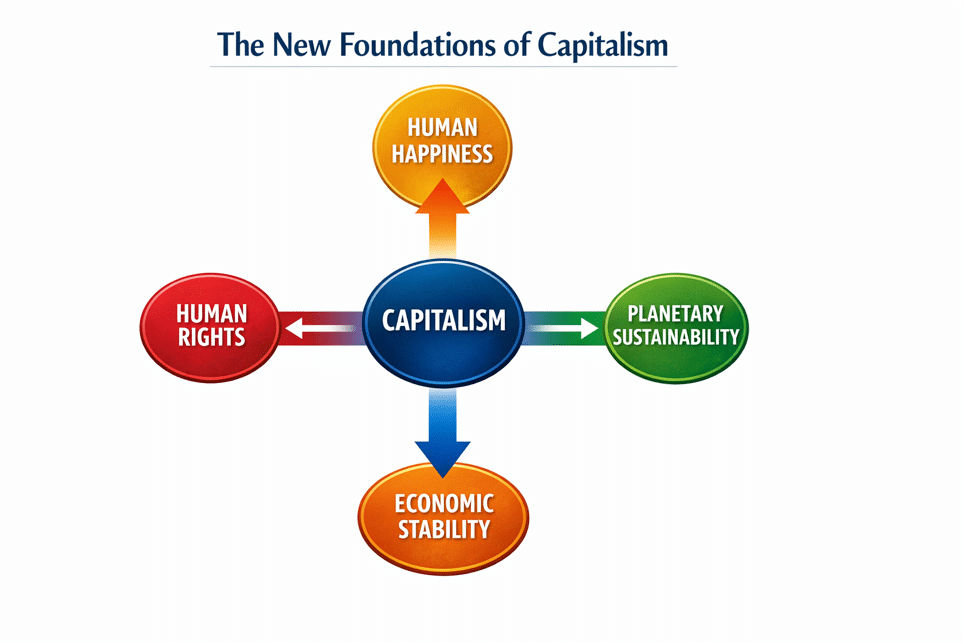
This transformation is driven by three structural shifts: the decoupling of income and well-being, the erosion of institutional trust and rights, and the emergence of environmental constraints as binding economic conditions.
When wealth stops explaining itself
Modern capitalism has reached a paradoxical threshold. By its own metrics, it has succeeded. Global poverty has fallen dramatically over the long term. Technological innovation has reshaped human possibilities. Yet this success has not translated into universal confidence.
In advanced economies, citizens increasingly perceive that the system is both efficient and unfair. They recognize its productivity but question its legitimacy. Economic abundance coexists with social fragmentation, as reflected in declining intergenerational mobility, rising inequality in the Organisation for Economic Cooperation and Development (OECD) countries, and record levels of political polarization in the US and Europe. This tension reflects a deeper transformation: Economic growth alone has been necessary, but it has proved insufficient.
The historical logic of capitalism rested on delayed justice. Inequality was tolerated because prosperity was expected to spread. That expectation is fading. Wealth now appears to concentrate faster than opportunity expands. Intergenerational mobility slows. The narrative of upward progress and mobility loses credibility.
This is not simply a distributional issue. It is a narrative crisis. Capitalism still produces wealth, but it struggles to produce widespread and trusting belief.
Belief matters because markets are not merely transactional mechanisms; they are psychological systems. They function only when participants trust that the future is predictable enough to justify risk. When belief erodes, investment becomes defensive, innovation cautious and politics volatile.
Capitalism’s second act has begun at this moment when wealth alone can no longer secure legitimacy.
Why this moment is different
Capitalism has faced crises before — depressions, wars, financial collapses. In each case, the narrow solution was more growth, deeper markets or better technology. What makes this current moment different is that the pressure is no longer cyclical. It is structural.
Three forces by John F. Halbleib and Masaaki Yoshimori are converging.
First, human satisfaction has decoupled from income. Beyond a certain point, higher GDP no longer delivers greater happiness or social cohesion. Anxiety, loneliness and political alienation rise even in affluent societies. Economic systems that excel at production, but fail at meaning, lose consent.
Second, rights and trust are weakening inside advanced economies, not only in developing ones. Democratic backsliding, institutional capture and legal uncertainty erode the predictability on which markets depend. Capitalism without credible rules becomes transactional, short-term and extractive.
Third, the planet is no longer a passive backdrop. Climate instability, resource scarcity and ecological degradation now shape inflation, investment, migration and financial risk. Markets that treat nature as free collateral are discovering that the bill arrives — with interest.
What unites these forces is that none can be solved by growth alone. They demand improved institutional design.
Happiness as an economic variable
For much of the 20th century, economists treated well-being as an outcome rather than an input. Happiness was presumed to follow growth. Today, evidence suggests the relationship is more complex. Beyond a certain threshold, increases in income yield diminishing returns in satisfaction. What rises instead are expectations, comparisons and anxieties.
This phenomenon has profound economic implications. Societies characterized by psychological insecurity struggle to sustain the cooperation required for long-term development. Innovation depends on trust. Entrepreneurship depends on optimism. Social cohesion depends on perceived fairness.
The political consequences of declining well-being are visible across democracies. Polarization intensifies. Institutional credibility weakens. Policy horizons shorten. Economic systems that fail to sustain meaning encounter resistance not because they are inefficient, but because they are experienced as indifferent.
Happiness, therefore, is not a soft variable. It is a stabilizing condition. It reflects whether citizens view participation in the system as worthwhile. Capitalism’s durability increasingly depends on this perception.
In this sense, well-being becomes a form of functional consent. Without it, markets face continuous disruption — not from external enemies, but from internal dissatisfaction.
Rights as market infrastructure
Capitalism’s legitimacy also depends on institutional predictability. Markets require more than prices; they require rules that participants trust. Property rights, legal equality, freedom of expression and accountable governance form the invisible architecture of economic life.
When this architecture weakens, markets do not collapse immediately. They mutate. Competition tilts toward political access rather than productive capacity. Investment horizons shrink. Corruption substitutes for coordination. Over time, the system’s efficiency erodes.
This dynamic challenges a common assumption: that economic development automatically strengthens democratic norms. In reality, rights are not a byproduct of growth. They are design choices. Affluent societies can experience institutional decay as readily as developing ones.
The economic consequences of such decay are cumulative. As predictability declines, risk premiums rise. As trust weakens, transaction costs increase. Capitalism without credible rights becomes extractive — generating wealth for some while undermining the foundations of prosperity for all.
In this sense, rights function as capitalism’s operating system. They enable markets to process information, allocate resources and sustain innovation. Without them, economic dynamism becomes fragile.
The planet as a structural constraint
Perhaps the most consequential transformation facing capitalism is environmental. For centuries, markets treated ecological systems as externalities. Nature was assumed to be abundant, resilient and costless. That assumption is no longer viable.
Climate instability, resource depletion and biodiversity loss are not distant concerns; they are immediate economic variables. They shape inflation, energy security, migration patterns and financial stability. Environmental shocks are transmitted through supply chains, asset valuations and geopolitical tensions.
This shift alters capitalism’s temporal logic. Traditional markets discount the future; ecological systems impose it. The costs of environmental degradation accumulate slowly but materialize abruptly. As a result, sustainability becomes a matter of systemic risk management rather than ethical preference.
The emerging question is not whether environmental policies constrain growth. It is whether growth can persist in their absence. A capitalism that fails to internalize ecological limits undermines its own viability.
Environmental governance thus begins to resemble financial regulation. Both seek to prevent systemic crises. Both require long-term coordination. Both depend on institutional credibility.
The planet is no longer a backdrop to economic activity. It is a codeterminant of market stability.
From efficiency to legitimacy
Capitalism’s first act prioritized efficiency. Its second must prioritize legitimacy. This does not imply abandoning growth or innovation. It implies redefining success.
Economic systems will increasingly be evaluated not only by output but by resilience — their capacity to absorb shocks without social rupture. They will be judged by fairness — not perfect equality, but credible opportunity. And they will be measured by sustainability — the ability to preserve the conditions of future prosperity.
These criteria are not ideological concessions. They are functional necessities. Markets that fail to sustain legitimacy encounter political backlash. Policies become erratic. Long-term investment declines. Social trust erodes. The challenge, therefore, is institutional design. States must move beyond minimalist regulation toward strategic coordination. They must create frameworks in which social and ecological objectives align with economic incentives.
This requires a shift from reactive governance to anticipatory governance. Instead of correcting market failures after crises occur, institutions must shape expectations before instability emerges.
This reorientation does not imply a transition toward socialism or a repudiation of market principles. Rather, it reflects an effort to preserve the institutional conditions under which market economies can function effectively while sustaining both efficiency and freedom. Institutional coordination, environmental regulation and investments in social resilience are not substitutes for markets but complements to them. Historically, capitalism has evolved through the interaction between economic freedom and adaptive governance rather than through ideological replacement. The objective is therefore not to diminish competition, private initiative or individual liberty, but to ensure that the system remains capable of generating both prosperity and legitimacy in an increasingly complex structural environment.
Cooperation as the new competitive advantage
The defining challenges of the 21st century — climate change, demographic transitions, technological displacement — are coordination problems. They transcend national borders and individual firms. Markets excel at competition but struggle with collective action.
Capitalism’s second act will thus depend on new forms of cooperation. Public and private sectors must collaborate to manage systemic risks. International institutions must facilitate alignment rather than rivalry. Corporations must integrate long-term societal considerations into strategic planning.
This transformation does not diminish competition; it reframes it. The most successful economies will be those that balance rivalry with coordination. The capacity to solve collective problems will become a source of competitive advantage.
In this environment, legitimacy becomes an economic asset. Societies characterized by trust and institutional coherence attract investment, talent and innovation. Those marked by fragmentation face volatility and decline.
Relegitimizing the market system
The future of capitalism is not predetermined. It is contingent on choices made by governments, businesses and citizens. Markets will remain central to prosperity, but their legitimacy will increasingly depend on whether they expand the realm of human freedom — enabling individuals to pursue lives they value, exercise rights they trust and inhabit a planet that remains viable for future generations.
The approaching American semiquincentennial offers a symbolic reminder of this principle. The founding generation did not view freedom as self-executing. They understood that legitimacy must be continually renewed through institutions capable of aligning economic dynamism with political liberty. Economic systems face the same imperative today.
Capitalism’s second act will not replicate its first. It will be less certain, more complex and more constrained by structural realities. Yet it may also prove more durable. By integrating human well-being, institutional integrity, ecological sustainability and the protection of economic freedom into its design, capitalism can sustain both prosperity and trust.
The alternative is not immediate collapse but gradual erosion — of belief, cooperation, stability and ultimately freedom itself. When economic systems lose legitimacy, societies respond not only with discontent but with demands for protection that may curtail openness and opportunity.
In the end, the central question is not whether capitalism can continue to generate wealth. It is whether it can sustain a framework of freedom that citizens regard as both fair and secure. Systems endure not because they are inevitable, but because they are trusted — and trusted systems expand rather than constrain human agency.
That trust is no longer guaranteed. It must be built deliberately, collectively and continuously.
Capitalism’s future, like democracy’s, remains an invitation to freedom. Whether that invitation is renewed or rejected will shape the trajectory of the century ahead.
In an increasingly complex world, the task ahead is not to replace markets; rather, it is to enhance them so that they remain both economically productive and legitimately supported by all those whom they serve and upon whom their continued sustainability is dependent.
[Kaitlyn Diana edited this piece.]
The views expressed in this article are the author’s own and do not necessarily reflect Fair Observer’s editorial policy.
From Tool to God: How Ancient Rationality Warned Us About the Contemporary World
Medieval thinkers such as Imam al-Ghazali, Abū Naṣr al-Fārābī and Ibn Khaldun offered a powerful diagnosis of how economic systems...

Capitalism Must Rediscover Its Soul
In a world defined by polycrisis, leaders are trying to fix capitalism with new metrics, funds and frameworks, yet avoiding...

Capitalism Depends on the Survival of Democracy
Democratic backsliding is becoming a worry in the West as dissatisfied voters turn to populist leaders. We are gravely mistaken...
Support Fair Observer
We rely on your support for our independence, diversity and quality.
For more than 10 years, Fair Observer has been free, fair and independent. No billionaire owns us, no advertisers control us. We are a reader-supported nonprofit. Unlike many other publications, we keep our content free for readers regardless of where they live or whether they can afford to pay. We have no paywalls and no ads.
In the post-truth era of fake news, echo chambers and filter bubbles, we publish a plurality of perspectives from around the world. Anyone can publish with us, but everyone goes through a rigorous editorial process. So, you get fact-checked, well-reasoned content instead of noise.
We publish 3,000+ voices from 90+ countries. We also conduct education and training programs
on subjects ranging from digital media and journalism to writing and critical thinking. This
doesn’t come cheap. Servers, editors, trainers and web developers cost
money.
Please consider supporting us on a regular basis as a recurring donor or a
sustaining member.
Will you support FO’s journalism?
We rely on your support for our independence, diversity and quality.





Comment