




Devils have been making headlines these past few days. French anthropologist and historian Emmanuel Todd insists that our Western nations have drifted over the past two centuries away from an initial state of active religious belief to a state he calls “zombie religion.” He notes that developed nations in the West have now pretty much struck bottom, achieving a level of “zero religion.” In his most recent book, La Dislocation, he suggests that Germany may have achieved minus one. If Todd is right, the very idea of a devil should be so distant from today’s secular culture that it wouldn’t even function as a metaphor.
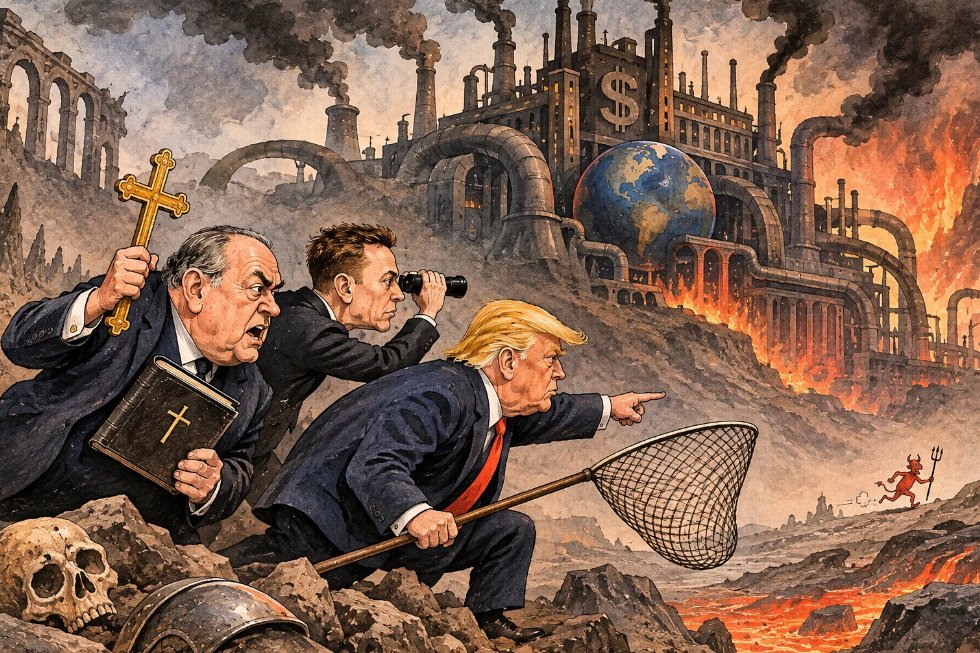
Consider, however, a statement made by US Ambassador to Israel Mike Huckabee. Responding to critics who questioned the rationality of the US–Israeli war on Iran launched by US President Donald Trump last February, Huckabee remarked:
“I think it’s a spiritual issue. I know it sounds a little funny for an ambassador to be talking like this, but look, I see this as spiritual darkness, spiritual blindness. How else can you explain? … Because Satan has blinded the minds of those and has captured their thinking.”
Huckabee sees “something deeper than just the obvious geopolitical issues.” Dig deep enough, as Dante once taught us, and you end up in Satan’s realm.
Before his diplomatic appointment, Huckabee was an American evangelical pastor, placing him outside the US political mainstream. Emmanuel Todd, though European, is intimately familiar with America. He observes that at the political and economic level, mainstream Europe and the United States share a common secular, democratic culture defined in part by the separation of church and state. If this secular culture worships anything that can be identified, it’s financial success. The behavior of many indicates that they worship money itself. In contrast, Todd’s “zombie Christians” still maintain — somewhere in their hearts — the defiance of wealth made plain in the Gospels (“Again I tell you, it is easier for a camel to go through the eye of a needle than for someone who is rich to enter the kingdom of God.” Matthew 19:24).
Wealth versus spiritual health
Some analysts point to the widening wealth gap as a key driver behind the electoral bloodbath suffered by Trump’s Republican party in last week’s midterms. Todd might call this a classic manifestation of zombie morality. While US voters may not have fully embraced Bernie Sanders’ declaration that “billionaires should not exist,” they are growing increasingly skeptical of trickle-down economics — the myth that unmitigated wealth accumulation is the ultimate engine for jobs and growth. When billionaires invest more energy into building oversized yachts and doomsday bunkers to escape the very crises their greed helped create, voters begin to suspect that democracy might serve a higher purpose than electing candidates hand-selected by the ultra-wealthy.
This leaves me wondering whether Todd might soon have to reconsider his own thesis. Is a genuine religious revival — or at least a meaningful migration away from zombie religion — already underway? France, after all, has historically been one of the most aggressively secular nations in Europe. Yet many were surprised when, in September, Pope Leo XIV drew a crowd of 800,000 to a Mass on the Avenue des Champs-Élysées in Paris, alongside 80,000 young people at a prayer vigil in the Stade de France. When asked about the turnout, Todd was characteristically unimpressed. But if this momentum persists, a disciplined anthropologist like Todd will surely have to track where the movement leads.
If 43% of France’s population today identifies as Catholic, less than 5% are regularly practicing. Contrast this with the US. According to different surveys, around 23% to 25% of American adults self-identify as Evangelical or born-again Christians overall. These are denominations that read the Bible literally and are apt to cite verses, especially from the Old Testament, to explain not only religious obligations but to some extent politics — for example, the duty to support the modern state of Israel — and science (creationism). As the character of Satan appears in the Bible, even as a speaking character in the Book of Job, Huckabee may feel bound to take seriously the idea that the devil can “capture people’s thinking,” at least as effectively as, say, Fox News.
While roughly 43% of France’s population today identifies as Catholic, less than 5% practice regularly. Contrast this with the US, where surveys consistently show that 23% to 25% of adults self-identify as evangelical or born-again Christians.
These are believers whose traditions lean toward reading the Bible literally, drawing directly on scripture — particularly the Old Testament — to shape not only personal ethics, but geopolitical views (such as the duty to support the modern state of Israel) and science (creationism). Because Satan features in the biblical canon as an active protagonist, as in Job, figures like Huckabee take literally to the idea that an evil spirit can capture human minds… perhaps, in his mind, even as effectively as Fox News.
Then there is Silicon Valley billionaire Peter Thiel — mentor to Vice President JD Vance and cofounder of Palantir, a company whose surveillance technology is deployed to monitor human morality and eventually smoke out (and “occasionally” kill) evil-doers. For Thiel, the conventional concept of Satan seems too vague. As a student of Catholic thinker René Girard, he appears to favor the New Testament over the Old, opting for the Antichrist as his preferred incarnation of Satan. This theological framework grants him the liberty to label as “diabolical” whomever he sees fit. Among his prime candidates for the role are climate activist Greta Thunberg, philanthropist Bill Gates and AI safety researchers like Nick Bostrom and Eliezer Yudkowsky.
Yet Huckabee and Thiel are hardly alone in invoking the demonic. Following Moscow’s invasion of Ukraine, countless commentators rushed to compare Russian President Vladimir Putin to Satan — or, for the more secular-minded, to Adolf Hitler, whom modern culture treats as the default benchmark for political evil. Yet most sober geopolitical analysts see Putin less as a deceitful, manic force of pure destruction than as a pragmatic operator utilizing state power and systemic coercion to pursue nationalist goals. If one were seeking a contemporary leader whose actions more closely approximate the reckless, chaos-inducing archetype of total destruction, Benjamin Netanyahu would be a far stronger candidate. As would Trump. They appear to share the same infernal space. According to one witness Israeli media cited this same week, the two recently engaged in “a shouting match from hell.”
Hunting the Evil One
In his earliest biblical appearances, Satan was not the anti-god of apocalyptic terror, but “The Adversary,” a member of Yahweh’s divine council whose function was to test human integrity rather than oppose the Almighty. He functioned much like a modern cybersecurity researcher or ethical hacker, hired to stress-test system vulnerabilities and expose moral flaws. Only later did Satan evolve into the absolute promoter of malice — a figure driven by an existential hatred of cosmic order, authority and subjection.
Today’s geopolitical landscape looks increasingly like one of the circles of hell described by Dante Alighieri — or perhaps like all nine of them compressed into a single reality. Dante placed Satan at the very bottom of the pit, frozen in the ice of Cocytus, devoid of true agency, reigning in cold silence over the circle of traitors.
That image brings us to the ultimate paradox of Todd’s “zero religion” world. In banishing the metaphysical Devil, we have not eliminated evil; we have simply integrated it into a sophisticated new moral order. Huckabee believes he can see Satan in the captured minds of Israel’s critics, while ignoring the obvious truth that his mind has been captured by the terrorist ideology of a foreign country. Thiel spots the Antichrist in teenage climate activists and AI ethicists. Accusing others of demonic intentions allows both of them to overlook the genuine, metaphorically diabolical forces humming in plain sight.
What else do you call a global order that systematically accelerates climate collapse while offering air-conditioned arks only to the billionaires who engineered it? What is an autonomous weapons network calculating acceptable human casualties down to the decimal point if not a betrayal of basic human solidarity? This is the true “Adversary:” an entrenched, institutional cynicism that treats human extinction as a reasonable market outcome. Our modern diabolical forces do not burn with passion. Instead, like Dante’s Satan, they seek to trap humanity in a frozen lake, as their machine runs quietly in the cloud, optimizing the algorithm while collecting their dividends.
What’s left for the rest of us… to wait for the thaw?
*[The Devil’s Advocate pursues the tradition Fair Observer began in 2017 with the launch of our “Devil’s Dictionary.” It does so with a slight change of focus, moving from language itself — political and journalistic rhetoric — to the substantial issues in the news. Read more of the Fair Observer Devil’s Dictionary. The news we consume deserves to be seen from an outsider’s point of view. And who could be more outside official discourse than Old Nick himself?]
[Lee Thompson-Kolar edited this piece.]
The views expressed in this article are the author’s own and do not necessarily reflect Fair Observer’s editorial policy.
Have Europe’s Banished Devils Returned?
From the postwar boom to today’s fracturing world order, the West’s “glorious” mid-20th century decades of prosperity masked a darker...
Peter Thiel: The Antichrist Hunter of Silicon Valley
One journalist describes Peter Thiel as a fan of the Bible. Columnist Ross Douthat calls him an influential right-wing intellectual....

The Devil’s Advocate in a World Without Saints
Modern society has abandoned its search for saints, both religious and political. Since the Vatican eliminated the Devil’s Advocate role...
Peter Thiel Fights the Antichrist and Defends Mamdani Voters
Peter Thiel surprisingly urges fellow MAGA conservatives to understand, not dismiss, why young New Yorkers elected a Muslim democratic socialist...
The Devil’s Advocate: Europe’s Accelerating Descent into Hell
When we learned of “the end of history,” a little over three decades ago, our geopolitical meteorologists forecasted sunny skies...
Support Fair Observer
We rely on your support for our independence, diversity and quality.
For more than 10 years, Fair Observer has been free, fair and independent. No billionaire owns us, no advertisers control us. We are a reader-supported nonprofit. Unlike many other publications, we keep our content free for readers regardless of where they live or whether they can afford to pay. We have no paywalls and no ads.
In the post-truth era of fake news, echo chambers and filter bubbles, we publish a plurality of perspectives from around the world. Anyone can publish with us, but everyone goes through a rigorous editorial process. So, you get fact-checked, well-reasoned content instead of noise.
We publish 3,000+ voices from 90+ countries. We also conduct education and training programs
on subjects ranging from digital media and journalism to writing and critical thinking. This
doesn’t come cheap. Servers, editors, trainers and web developers cost
money.
Please consider supporting us on a regular basis as a recurring donor or a
sustaining member.
Will you support FO’s journalism?
We rely on your support for our independence, diversity and quality.




Comment