


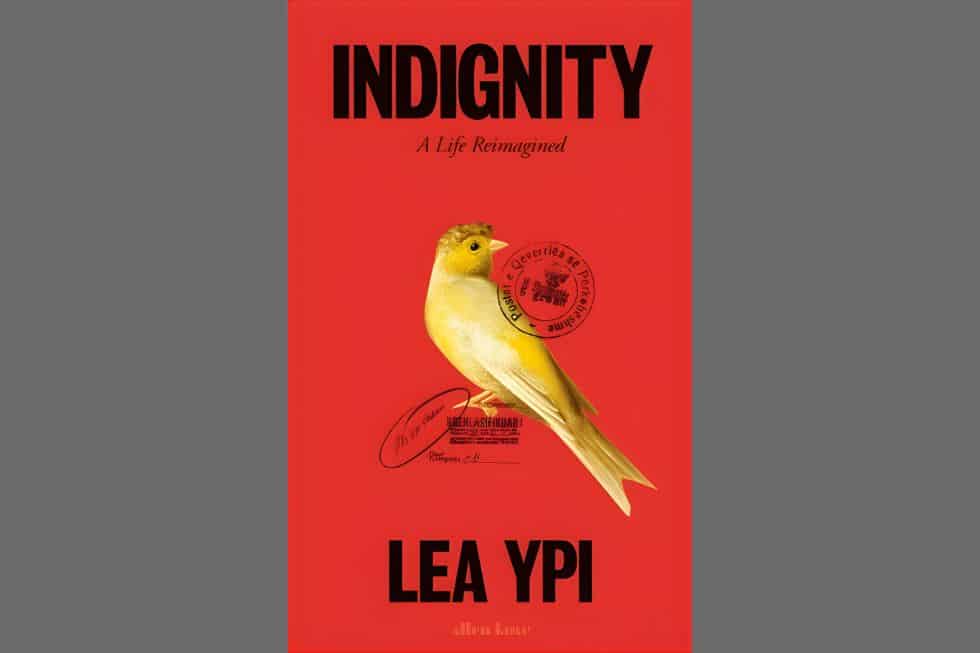



Lea Ypi, author of Indignity: A Life Reimagined, is one of the most compelling philosophical voices of our time. She’s also a lively and personable speaker. Born in Albania under the Hoxha communist dictatorship and educated across Italy and Britain, she now holds the chair of Political Theory at the London School of Economics.
Her earlier memoir, Free: A Child and a Country at the End of History (2021), established her as a rare writer capable of weaving rigorous political philosophy into a lived autobiography — a quality that earned it extraordinary international acclaim. In Indignity: A Life Reimagined, she goes even further.
What makes Indignity philosophically extraordinary is not merely its scope, though that scope is vast, running from Constantinople to Salonica to Tirana to the prisons of Burrel, but its governing question: what becomes of a person’s dignity when the state has the power to name them, surveil them, archive them and ultimately to decide, on paper, whether they lived or died? That power, Ypi argues, is never innocent, and its victims are never simply historical.
As an example, let me quote the German constitution of 1949, written specifically to remind us that dignity takes work and intention from everyone:
Die Würde des Menschen ist unantastbar.
Sie zu achten und zu schützen ist Verpflichtung aller staatlichen Gewalt.
Human dignity shall be inviolable/untouchable. To respect
and protect it shall be the duty of all state authority.
— Grundgesetz, Artikel 1 (1949)
The catalyst of the story was a photograph
Indignity is a hybrid novel-memoir, a book that moves between archival research and literary imagination, between historical fact and the admission that facts alone can never reconstitute a life. Its governing epigraphs — one from Immanuel Kant’s Foundations of the Metaphysics of Morals (“Everything has either a price or dignity”) and one from Friedrich Schiller’s On the Aesthetic Education of Human Beings — announce from the outset a work that breathes philosophical ambition, situating itself within the German Idealist tradition’s deepest preoccupations: what it means to be a moral person, and whether that meaning survives our deaths.
The book begins with a photograph — a honeymoon snapshot of Ypi’s grandparents, Leman and Asllan, at a luxury hotel in Cortina d’Ampezzo in 1941 — discovered one day on a stranger’s social media page, accompanied by venomous comments that sought to reduce her grandmother Leman to a caricature: collaborator, spy, fascist accomplice.
Ypi’s response is not a refutation but a quest. She travels to the Albanian State Security archives to retrieve her family’s secret police files, and from this bureaucratic excavation grows a three-part narrative spanning the collapse of the Ottoman Empire, the interwar scramble for the Balkans, the Italian and Nazi occupations, the rise of Enver Hoxha’s hermetic communist state, and the long aftermath of exile, surveillance, and dispossession that crushed two generations of her family.
Who decides who we are?
At the heart of Indignity is the terrifying ease with which a totalitarian regime can claim authority over a person’s identity. Ypi’s grandfather, Asllan, was a man of considerable standing — his father, Xhafer Bey Ypi, had served as Albania’s tenth prime minister. Yet the communist state reduced him, in its files, to “enemy of the people,” imprisoned him for decades on fabricated charges of collaboration with British intelligence and stripped the family of property, status and freedom of movement. Her grandmother Leman, born in Salonica to an Ottoman administrative family of cosmopolitan refinement, was reclassified as a class enemy, surveilled for years and eventually declared dead by the secret services — not because she had died, but because an informant’s false denunciations had been discredited and the file needed to be closed. The state simply wrote her out of existence.
In a chilling discovery, Ypi realizes that the surveillance file she has been reading belongs partly to another woman who also bore the name Leman Ypi — two lives entangled by bureaucratic error, both equally erased. The archive, Ypi writes, “structures events in the same way grammar structures thought: regulating an amorphous mass of discourse, establishing patterns of transmission, prescribing who says what, when and with what implications.” To be named in those files was to have one’s story colonized; to be absent from them was no freedom either, only a different kind of obliteration.
The book is equally attentive to the ways in which political violence deforms intimate life. Relationships — between spouses, between parents and children, between friends who may or may not be informants — are never merely private under a totalitarian regime. Asllan’s friendship with Enver Hoxha, his school companion who went on to found the Albanian Communist Party and rule the country until 1985, is one of the book’s most haunting threads: It shows how the personal and the political are not just adjacent but lethal when they collide.
Ypi reconstructs, with great delicacy and uncertainty, how her grandparents’ marriage — forged in elegance and cut short by arrest — was also shaped by contingencies of empire, displacement and political allegiance that neither could entirely control. The chapters on the population exchanges mandated by the Treaty of Lausanne, the Greek and Albanian borders redrawn around living people like chalk lines around bodies, capture with particular force the violence of state-imposed identity. It demonstrates how a family could find itself suddenly belonging to a nation that had not existed when its members were born, required to prove belonging in the land of their birth, stripped of property in Salonica that was now Greece’s to dispose of. Regimes, Ypi demonstrates, do not simply oppress individuals; they reshape the conditions of love, loyalty and recognition within which persons form themselves.
And then there is the most piercing question the book poses: Who protects who we are when we die? Ypi is prompted to write, in part, by the brutal fragility of her grandmother’s posthumous reputation — vulnerable to the cruelties of social media, to the reductions of strangers who found in a honeymoon photograph an occasion to convict. In death, Leman cannot speak for herself, cannot shape her own narrative, cannot refute the lies. Ypi frames this as a Kantian problem: Kant held that dignity is the property of rational beings capable of self-legislation, of giving the moral law to themselves. But the dead are no longer capable of self-legislation. Does that mean their dignity evaporates? Or does it persist as a demand — a claim on the living to remember rightly? “Does dignity require someone’s continuing existence — an active capacity to defend that dignity, protect it from assault, stand up in its name?” Ypi asks.
Her answer, arrived at slowly and through pain, is that dignity is not merely a private possession but a relational achievement. It must be sustained by those who remain, which is why writing — imagining the truth of a life with the full awareness that imagination is not the same as documentation — becomes an act of moral obligation. The book is that act. In a remarkable coda, having discovered that the other Leman Ypi has no living descendants and exists only in the secret police files, Lea Ypi decides to adopt her too: To give her, as she puts it, “the dignity of memory.”
Reading Indignity in this light, one cannot help but hear the resonance of a far older conflict — one that Western philosophical tradition has never entirely resolved.
The ghost of Antigone still haunts us
“Zeus does not / Justice does not / the dead do not / what they call law did not begin today or yesterday / when they say law they do not mean a statute of today or yesterday / they mean the unwritten unfailing eternal ordinances of the gods / that no human being can ever outrun”
Anne Carson — Antigonick (New Directions, 2012)
In Sophocles’ Antigone, Creon, the king of Thebes, decrees that the body of Polynices — Antigone’s brother, slain in civil war — shall be left unburied, exposed to carrion birds and denied the rites that the dead require. The edict is political and punitive: Creon has decided that this traitor shall not only die but be unmade, stripped of the rituals through which a community recognizes a life as having been fully human. Antigone refuses. She buries her brother in obedience to the gods’ will. Divine law, older and deeper than any human ordinance, demands that the dead be honoured. When Creon demands to know how she dared transgress his edict, she answers with perfect clarity: The gods’ unwritten laws are not subject to the override of any magistrate. For Antigone, there are three competing authorities — the city’s laws, the divine order and the voice of individual conscience. When the city’s laws violate the other two, conscience must prevail.
The parallel with Ypi’s predicament is striking and philosophically productive. Creon’s decree, like the Albanian communist state’s archive, is a political act masquerading as a legal one. It is, at its core, an exercise of sovereign power that claims the authority to define reality. This man was a traitor; this woman is an enemy; this person is, by official decree, dead. Antigone’s insistence that there is a law above the city’s law — the unwritten law that obliges us to honour the dead — is Ypi’s insistence too, though she pursues it through secular and Kantian rather than divine coordinates.
For Ypi, the “unwritten law” that compels her is the moral imperative to treat persons as ends in themselves and never as mere instruments of history, ideology or bureaucratic convenience. Her grandmother — and the other Leman Ypi, the stranger she adopts — must be remembered rightly, not because God commands it but because to do otherwise would be to collude with the violence that reduced them in the first place.
Creon’s tragedy was his refusal to see that political authority has limits: that the city cannot claim sovereignty over the dead without doing violence to what makes the living human. Ypi’s book enacts the same insight across four generations and half a century of Balkan catastrophe, demonstrating that the tension Sophocles dramatized — between the state’s demand for obedience and the individual conscience’s demand for justice — is not a problem ancient tragedy solved. It is the permanent condition of political life, and it is with us still.
Indignity is a book of unusual intellectual and moral seriousness, and of considerable beauty. It does not resolve the questions it raises. It is too honest for that. It insists instead with the force of lived and even embodied history (Erlebnis), that those questions matter: Who has the right to name us, to archive us, to decide the meaning of our lives? What do we owe the dead who cannot answer for themselves? And where, when the city’s laws fail and the gods are silent, does individual conscience find its ground? These are Antigone’s questions. They are also ours.
For those who would like to listen to a reading of Antigonick, the experimental translation by Anne Carson, you can find it here.
[A special thank you to Professor Barnaba Maj, Rome, formerly University of Bologna, who helped me connect with Antigone and find the quote from the German Constitution.]
The views expressed in this article are the author’s own and do not necessarily reflect Fair Observer’s editorial policy.
Mandate for Reform, Battle for Identity: Bangladesh After the Election
The Bangladesh Nationalist Party’s (BNP) recent election victory ushers in a complex era of reform, identity politics, and foreign policy...

The Returning Nightmare: Europe’s Far Right and the Fading of Democratic Memory
The resurgence of far-right movements throughout Europe is a result of several converging issues: a decline in historical awareness, unchecked...
The Valuable Role of Nostalgia on the World Stage
China, Russia, Iran and Turkey strategically employ nostalgia as a powerful tool to challenge the existing unipolar world order. By...

Support Fair Observer
We rely on your support for our independence, diversity and quality.
For more than 10 years, Fair Observer has been free, fair and independent. No billionaire owns us, no advertisers control us. We are a reader-supported nonprofit. Unlike many other publications, we keep our content free for readers regardless of where they live or whether they can afford to pay. We have no paywalls and no ads.
In the post-truth era of fake news, echo chambers and filter bubbles, we publish a plurality of perspectives from around the world. Anyone can publish with us, but everyone goes through a rigorous editorial process. So, you get fact-checked, well-reasoned content instead of noise.
We publish 3,000+ voices from 90+ countries. We also conduct education and training programs
on subjects ranging from digital media and journalism to writing and critical thinking. This
doesn’t come cheap. Servers, editors, trainers and web developers cost
money.
Please consider supporting us on a regular basis as a recurring donor or a
sustaining member.
Will you support FO’s journalism?
We rely on your support for our independence, diversity and quality.





Comment