


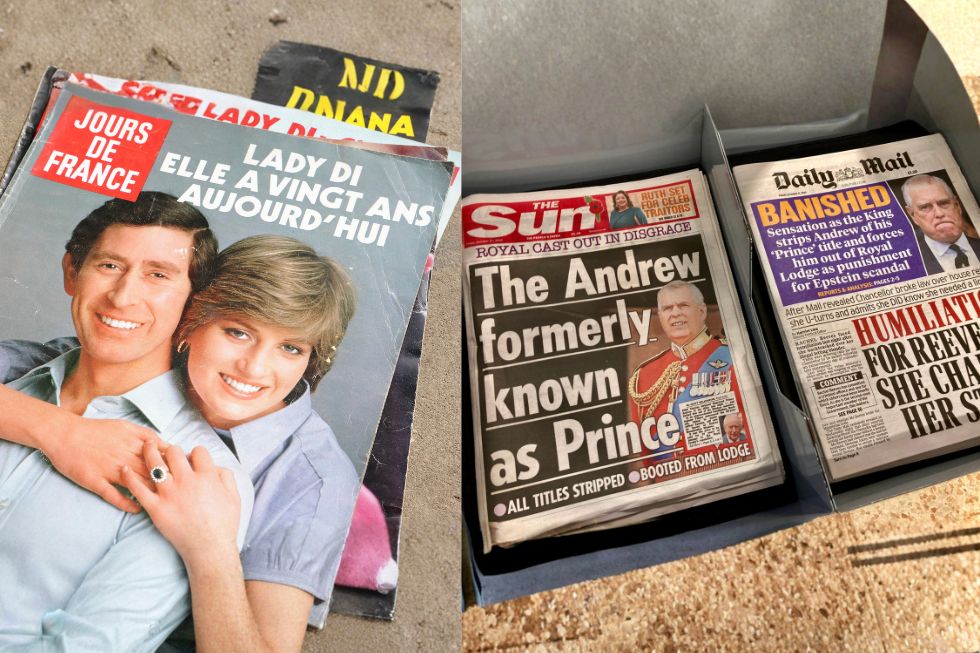


She wasn’t there, but her presence was undeniable. The Andrew Mountbatten-Windsor debacle has erupted in a way that would have been unthinkable without Diana, Princess of Wales: Her willingness to induce the world’s media into her confidence and share her life changed both the way royals treated the media and the media’s methods of covering an institution they had handled with excessive care for decades.
Since the then-Prince’s decision to grant an interview to BBC television in 2019 to discuss his relationship with Jeffrey Epstein, his life has been sliced open and examined forensically. The interview caused a reputational cataclysm, making Andrew appear aloof and indifferent. After that, the media have examined and interpreted his every gesture and treated every silence as evidence. The police have acted decisively and pitilessly. Where once a public would have looked away to avoid witnessing the impropriety, they have glared intently and without inhibition.
There’s no protective shield of deference, no instinctive reluctance to look too closely. Instead, there’s a degree of disclosure that would once have been unthinkable: Continuous, intimate and often unforgiving. The House of Windsor, once cushioned by mystique, is now consumed as spectacle — global spectacle. This transformation didn’t occur suddenly, nor can it be attributed to a spontaneous change in journalistic policy, the rise of the tabloids or global satellite broadcasting, though all these contributed to the cultural shift of the 1980s.
This transformation occurred when Diana appeared. Young, photogenic and emotionally legible, she didn’t merely join the royal family; she altered its relationship with the media and thus its visibility. When that changed, so did everything else. The protocol unraveled, and the monarchy has struggled to manage ever since.
Royal mystique
Before Diana, the royal family was presented like characters in a Noël Coward play: elegant, composed and emotionally self-contained. They were visible but inaccessible; ever-present yet remote; simultaneously touchable and untouchable. The media reported on ceremonies, births and funerals, but rarely intruded on private emotional affairs. Royals were not expected to reveal themselves. Their authority depended, in large part, on their opacity and mystique. They were less individuals than personifications of majesty.
Elsewhere, however, a new and more invasive form of journalism had begun to develop. In postwar Italy, freelance photographers adopted aggressive tactics to capture candid images of famous figures, most notably Elizabeth Taylor, whose life the media turned into a scandalous spectacle for audiences around the world in the 1960s. The paparazzi, as they came to be known, transformed the relationship between public figures and the media. Privacy became provisional, subject to negotiation or violation depending on commercial value. Yet Britain’s royal family remained largely insulated from this development. Even the publication of photographs showing Princess Margaret in intimate circumstances with Roddy Llewellyn in 1976 represented a disturbance or a crack in the royal mystique — depending on perspective. The monarchy absorbed the shock and resumed its usual stately equilibrium.
Diana’s arrival coincided with wider cultural changes that would make such equilibrium impossible to sustain. The 1980s witnessed the rapid expansion of celebrity culture, fueled by global television, mass-circulation magazines and a growing appetite for personality-driven narratives. Fame itself was becoming democratized and commodified. Diana entered royal life not as a seasoned media strategist but as a young ingénue whose emotional openness aligned, perhaps unwittingly, with this newly-developing environment. The traditional reserve of royalty was alien to her: She allowed audiences glimpses of vulnerability, loneliness, uncertainty and emotional wounds, all the time offering a new kind of pleasure — guiltless eavesdropping.
Her closest counterpart was not another royal but iconic pop star Madonna, whose ascent during the same decade exemplified a new kind of fame built on continuous exposure, uninterrupted scandal and perpetual reinvention. Madonna’s attention-acquisition seemed to have a strategy, while Diana’s usually appeared reactive. Both women thrived by making common cause with a media that rewarded accessibility and a certain narrative tension. Both blurred the boundary between private experience and public performance. Diana didn’t overwhelm the media with drama and narrative; however, by making herself visible and accessible, she normalized a new conception of the monarchy as an august institution, but one that could be seen and understood through the same interpretive lens as celebrity.
Fairytale
Diana’s marriage to then-Prince Charles III was presented explicitly as a fairytale, not as retrospective embellishment but as contemporary cultural framing. On its wedding-day front page, the Daily Mirror described the occasion as “the fairytale wedding,” while publishers quickly consolidated the narrative in longer form, including a 1982 biography of Diana subtitled The Fairytale Princess.
When the marriage began to unravel, the media did not abandon this narrative so much as invert it. Headlines lamented that “the fairytale is over,” preserving the story’s mythic structure even as its emotional valence shifted. Diana remained the innocent protagonist, while Camilla Parker Bowles (now Queen Camilla) — cast as “the other woman” — assumed the role of antagonist. The monarchy had been translated into the language of folklore.
Diana’s own actions reinforced this construction. Her willingness to cooperate with journalists, to communicate indirectly through carefully timed disclosures and, ultimately, to submit to the now-notorious interview with Martin Bashir in 1995 marked a decisive break with royal precedent. No member of the royal family had ever spoken so candidly, or so publicly, about intimate emotional pain. The interview did more than reveal personal suffering: It redefined expectations of the monarchy. Audiences no longer saw them as protected.
Bashir, it was later learned, had procured the Diana interview using ethically questionable methods. He would later conduct similarly revealing interviews with Michael Jackson, another global figure whose life became inseparable from media scrutiny. While there is no moral equivalence between the two interviews, taken together, they suggest that, by the mid-1990s, royalty and celebrity occupied the same symbolic terrain. Both were subject to the same processes of exposure, interpretation and commodification. Diana stood at the center of this convergence. She was not merely its most visible casualty but its most consequential catalyst.
Her death in 1997 marked the end of her life but not the end of her influence. If anything, her absence intensified her symbolic presence. The extraordinary public grief that followed revealed the depth of emotional investment she had inspired. Millions mourned not simply a princess but a figure they felt they knew intimately. The monarchy, by contrast, appeared uncertain, its traditional reserve suddenly out of step with public expectation. The institution that had once defined the terms of its own visibility now struggled to respond to forces beyond its control.
The logic of celebrity
In the decades since Diana’s death, the media environment she helped shape has expanded and intensified. The rise of digital platforms has accelerated the circulation of images and narratives, while audiences have become active participants in the construction and dissemination of scandal. The royal family now exists in a system that rewards exposure and punishes concealment. Transgression is both condemned and consumed. Public figures are elevated, scrutinized and, when they falter, subjected to ritualized humiliation.
This dynamic has affected Diana’s sons. Prince Harry has adapted to the logic of celebrity, relocating to the United States and engaging directly with media institutions that his mother helped legitimize as sites of royal storytelling. His wife, Meghan, Duchess of Sussex, brought with her an understanding of media culture shaped outside the constraints of monarchy. Together, they have navigated a world in which royal identity is still a constitutional status, but one that amplifies narrative consequence.
While some royals have adapted and evolved in the ecosystem, others have fared less successfully. Andrew, once secure within the protective structures of monarchy, has found himself exposed to the same unforgiving scrutiny faced by disgraced celebrities in other fields. His fall from public grace illustrates the extent to which royal status no longer guarantees insulation from reputational collapse. Despite maintaining his innocence, Andrew has been treated not as a prince apart, but as a public figure subject to the full force of media scrutiny and legal process.
In February, Mountbatten-Windsor was taken into custody by police following a raid at his Sandringham home, the episode captured by photojournalists. He is the first senior member of the royal family to be detained by authorities in circumstances of this kind since Charles I was taken prisoner in 1647.
The death of Elizabeth II removed the last enduring link to the era before this transformation. Her reign had provided continuity and an element of stability, preserving the appearance that the monarchy existed above media attention. Her successor, Charles — Andrew’s brother, of course — now presides over an ancient institution that must operate on a modern cultural landscape, one in which visibility is a necessity and can be a liability.
Diana’s legacy lies in the terrain she transformed: Her influence continues to shape how monarchy and media interact. The manner in which she conducted her life and her relaxed relationship with journalists meant that the distance between the monarchy and the media would diminish during her life and keep diminishing after her death. The consequences of this change continue to unfold.
Would a more deferential media even approach a subject that could have alienated consumers as easily as it could have excited them? Andrew was never the most popular figure in the royal family, but some could have bridled at the sensationalism afforded his apparent errancy. It’s doubtful that a police force in earlier times would have whisked Andrew away from his home to a police station for questioning and returned him home in a manner befitting a bank robbery suspect. These are hypotheticals, but not unanswerable: No, in all cases. It’s difficult to imagine the Mountbatten-Windsor scandal unfolding as it has before, say, 1990.
Audiences today are fascinated by rule-breaking but equally by its baleful consequences. Our curiosity isn’t natural but cultivated, and nowadays participatory, sustained by social media tech that allows constant observation and interaction. The royal family, once insulated by reverence, now exists as a permanent object of scrutiny, its struggles consumed as both cautionary parables but, more usually, plain entertainment. We’re enthralled by the prospect of an English prince entangled in an international web of patriarchal exploitation and leaked documents on investment opportunities.
Diana may be gone, but the conditions she helped create remain. She altered not only the monarchy’s relationship with the media but the public’s relationship with the monarchy. And perhaps the monarchy itself. The House of Windsor no longer exists as a realm apart. It is part of the same unforgiving system that governs all modern fame. Andrew’s case illustrates the final consequence of Diana’s revolution: monarchy no longer stands apart from celebrity culture. It operates inside it — exposed to its volatility, dependent on its visibility and vulnerable to its judgments.
[Ellis Cashmore is the author of Elizabeth Taylor: A Private Life for Public Consumption, published by Bloomsbury.]
[Kaitlyn Diana edited this piece.]
The views expressed in this article are the author’s own and do not necessarily reflect Fair Observer’s editorial policy.
A Century of Royal Scandal: Britain’s Shocking Monarchy
Explore a century of royal scandals that have shaken the House of Windsor, from Prince Andrew’s ties to Jeffrey Epstein...
The Art of Prince Andrew’s Lawyers
Watching a member of British royalty suffer for his least noble proclivities has become a spectator sport for the media.
Harry and Meghan Say No to Britain’s Tabloids
Harry and Meghan have had enough of Britain’s infamous tabloids and are refusing to talk to them.
Are the Windsors the New Kardashians?
The queen agrees to a "transition" for Meghan and Harry — but what are they transitioning to?
Support Fair Observer
We rely on your support for our independence, diversity and quality.
For more than 10 years, Fair Observer has been free, fair and independent. No billionaire owns us, no advertisers control us. We are a reader-supported nonprofit. Unlike many other publications, we keep our content free for readers regardless of where they live or whether they can afford to pay. We have no paywalls and no ads.
In the post-truth era of fake news, echo chambers and filter bubbles, we publish a plurality of perspectives from around the world. Anyone can publish with us, but everyone goes through a rigorous editorial process. So, you get fact-checked, well-reasoned content instead of noise.
We publish 3,000+ voices from 90+ countries. We also conduct education and training programs
on subjects ranging from digital media and journalism to writing and critical thinking. This
doesn’t come cheap. Servers, editors, trainers and web developers cost
money.
Please consider supporting us on a regular basis as a recurring donor or a
sustaining member.
Will you support FO’s journalism?
We rely on your support for our independence, diversity and quality.





Comment