





Shamim Mafi left Iran in 2013, obtained a green card three years later and built what, from the outside, looked like a charmed life in the quiet suburb of Woodland Hills, California. She posted pictures of her travels on social media, posed in luxury vehicles and projected the image of a prosperous international businesswoman.
By the time federal agents intercepted her at Los Angeles International Airport (LAX) on the night of April 19, 2026, Mafi was allegedly worth millions — paid, prosecutors say, for brokering the sale of Iranian drones, bomb fuses and ammunition to a military engaged in what the UN has depicted as one of the world’s worst humanitarian catastrophes.
“While enjoying a life in the United States, this woman was allegedly breaking the law by brokering lethal weapons deals with Iranian adversaries,” Acting Attorney General Todd Blanche said. Mafi, 44, is charged with conspiracy to violate the International Emergency Economic Powers Act. She is presumed innocent.
She made her first appearance before a judge on Monday, April 20, yet did not enter a plea and was behind bars on Tuesday awaiting a detention hearing later in the week. Investigators say Mafi was not planning to stay. Authorities arrested her at LAX after she bought a ticket to Turkey, fearing she was attempting to leave the country.
A former member of the Los Angeles Federal Bureau of Investigation (FBI) Joint Terrorism Task Force, speaking to Fair Observer on background, says the arrest fits a pattern that has been playing out in Southern California for decades:
Southern California has always been a hotbed of Iranian government activity. This has been going on for the last 20 to 25 years, and I have direct experience monitoring Iranian government operations in the United States and Southern California … It makes perfect sense that the woman arrested at LAX had a node or presence in Southern California. This is likely part of a much larger network spread throughout the United States — concentrated in cities with large Iranian diaspora communities.
So, how does a woman living among Los Angeles’s affluent suburbs allegedly end up as a linchpin in Iran’s global arms pipeline, and what does her arrest reveal about the reach of Tehran’s intelligence networks inside America?
A shell company in Oman, a contract in the millions
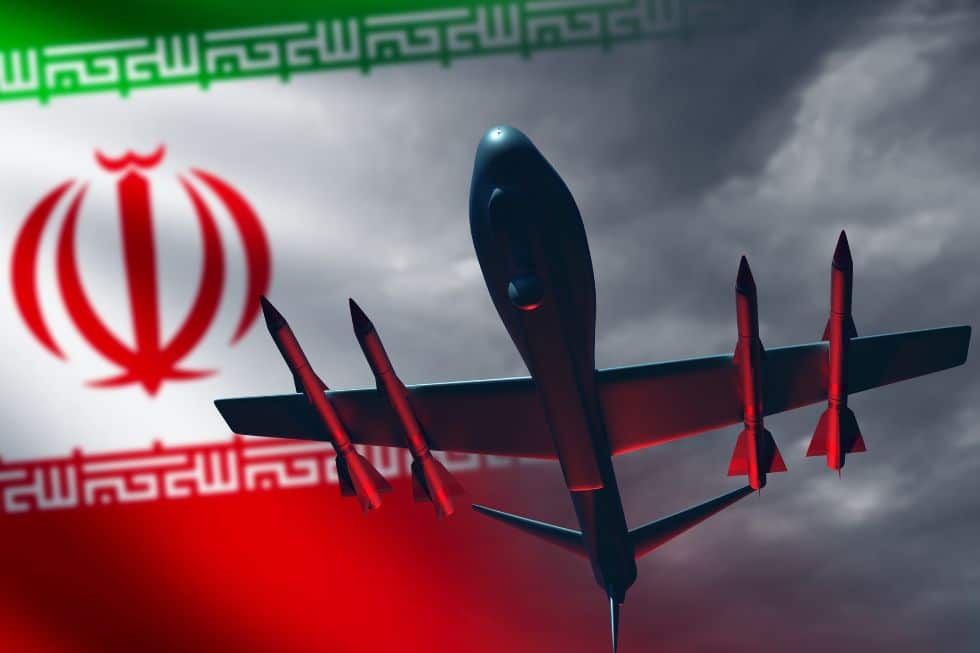
Mafi owns and operates an Oman-based company, Atlas International Business LLC — also known as Atlas Global Holding and Atlas Tech LLC — through which, prosecutors allege, she brokered weapons deals on Iran’s behalf. In 2024, she allegedly facilitated a contract valued at over $72.5 million for the sale of Iranian-made Mohajer-6 armed drones to Sudan’s Ministry of Defense. She was paid more than $7 million for the deal. She also allegedly coordinated the Sudanese delegation’s travel to Iran to finalize the transaction.
The full scale of what prosecutors allege is staggering. Beyond the drones, court records show Mafi allegedly brokered the sale of 500 non-guided aerial bombs, 55,000 bomb fuses, 70,000 AK-47s, 250 million rounds of AK-47 ammunition, 1,000 rocket-propelled grenade launchers and 500,000 rockets, among other weapons. Payment was structured to evade detection — some transferred through informal money-exchange systems operating across the Middle East and Africa, others routed through banks in Dubai and part was delivered in crates of $100 bills.
In February 2025, Mafi sent her alleged co-conspirator the signed contract via WhatsApp and later sent photographs and a video of the crate being opened. “It should be in small amounts,” Mafi allegedly instructed a Sudanese contact over the encrypted messaging app while brokering a payment in 2024.
Senior Director of the Counter Extremism Project, Hans-Jakob Schindler, tells Fair Observer that the Oman routing is consistent with how Tehran operates:
It is indeed a whole-of-government and whole-of-economy approach that the regime undertakes, with both government authorities, in particular the Ministry of Information, which is the official name for the Ministry of Intelligence, the intelligence service of the Revolutionary Guards, economic entities, research entities, as well as a range of other government authorities such as the diplomatic service being involved in quite complex transnational procurement operations that are usually characterized by a high degree of sophistication and obfuscation.
He notes that the confidence in this case appeared to be particularly high: “The confidence that the obfuscation was sufficient that this route would not be detected seems to have been quite high.”
International political strategist and managing director of Nestpoint Associates, John Thomas, concurs:
This is textbook Iranian sanctions evasion … Tehran routinely uses third countries like Oman, the UAE, and Turkey as cutouts to launder weapons and money. It’s a well-worn playbook designed to keep the IRGC’s supply lines flowing despite United States sanctions.
A direct line to Tehran’s intelligence apparatus
Mafi maintained more than 60 bidirectional contacts with an Iranian intelligence officer between December 2022 and June 2025, according to information unearthed during search warrants, pointing to a more structured relationship with the regime in Tehran.
The court filing goes further still: The Ministry of Intelligence and Security (MOIS) allegedly directed Mafi to open a business inside the US using funds the Iranian intelligence service provided, framed as a way to help her recover properties Tehran had seized from her father’s estate in 2020.
Mafi told investigators that MOIS had never tasked her with conducting any activities on American soil for Tehran. Prosecutors clearly see it differently. Court documents also allege she stated she was “more useful to them [i.e., MOIS] in Iran than in the United States.”
In connection with the bomb fuse transaction, Mafi submitted a letter of intent directly to Iran’s Islamic Revolutionary Guard Corps (IRGC). She never applied for the required Treasury Department licenses, nor did she register with the State Department’s Directorate of Defense Trade Controls, prosecutors say.
Schindler says the phone contact between Mafi and Iranian intelligence is notable for what it reveals about tradecraft — or the lack of it:
This is surprising since it must be clear to Iranian intelligence that any phone conversation can be monitored … The fact that these conversations seemed to have happened over the span of three years indicates to me that these phone conversations were not part of the initial stages of Mafi’s recruitment process as an intelligence asset but more likely were part of her handling process. If this is the case, this is a surprising lack of professionalism on the Iranian side.
For Thomas, the alleged contact is less a failure of tradecraft than a window into standard Iranian operating procedure:
Mafi, a United States permanent resident, was not a lone actor. She was allegedly in direct contact with Iran’s Ministry of Intelligence and Security … This highlights how the regime embeds operatives inside the United States and Europe, using legal residency as cover for illicit activities.
The former FBI task force official, meanwhile, says the pattern is one he watched develop firsthand over two decades:
Both MOIS and IRGC operatives have also been finding and acquiring dual-use items restricted under United States and international sanctions, then trans-shipping them to Iran … They identify Americans, American companies, and ethnic Iranians willing to supply these goods — sometimes wittingly, sometimes not. This is classic sanctions evasion, and it has been going on for 25 years in the Southern California area.
Sudan as a theater of Iranian power projection
The destination of the alleged supply chain matters as much as its origin. Sudan has been consumed by civil war since April 2023. The conflict has killed an estimated 150,000 or more people — though the true toll may be far higher given the near-collapse of documentation in affected areas — displaced over 12 million, and produced what the UN refugee agency has called the largest and fastest-growing displacement crisis on earth. Iran’s involvement in the war is not by accident.
Since Iranian cargo aircraft began arriving at Port Sudan’s airport, the Sudanese Armed Forces have launched attacks using Iranian-made Mohajer-6 unmanned aerial vehicles — the same platform Tehran has transferred to Russia and other theaters. Tehran has been repeatedly accused of violating the UN arms embargo tied to the conflict.
Schindler told Fair Observer that the strategic logic for Iran extends well beyond the battlefield:
Being able to have a good relationship with the power brokers in Sudan that control the coastline along the Red Sea is, of course, a strategic plus for the Iranian regime, as they already have a relationship with the Houthis on the other side of the Red Sea.
Thomas is more direct about what the case reveals:
Iran’s Mohajer-6 drones have been a game-changer for the Sudanese Armed Forces, providing critical aerial surveillance and strike capability that has prolonged the conflict and tilted the battlefield … This case reveals that the supply chain is sophisticated, multi-layered, and persistent — running from Iranian factories through Gulf shell companies to conflict zones in Africa.
As for whether a single prosecution can dent an infrastructure decades in the making, Schindler says the value lies in attrition and deterrence rather than disruption:
Any individual prosecution is, of course, not able to strategically disrupt an illicit procurement infrastructure of the size and sophistication that the Iranian regime has set up over the past decades … Nevertheless, each prosecution is of strategic importance — during the investigation into such cases, Iranian methodologies, obfuscation tactics, international connections, and communication methods are discovered, which can lead to further discoveries or at the very least force the Iranian side to reorganize part of their remaining intelligence and illicit procurement networks.
For the former FBI official, the Mafia arrest is not an endpoint; it is a glimpse through a narrow window into something far larger:
What we are seeing is only a small part of the iceberg … I am certain there are many other cases like this across the country. From my perspective, we must do everything possible — through law enforcement, intelligence, and, if necessary, military action — to stop the flow of American technology and information to one of our worst enemies.
[Kaitlyn Diana edited this piece.]
The views expressed in this article are the author’s own and do not necessarily reflect Fair Observer’s editorial policy.
Mossad’s Gambling Has Exposed Dangers of Brinkmanship In the Middle East
The article discusses Israel's recent covert operations, including the alleged assassination of Hamas leader Ismail Haniyeh in Iran, as part...
Iran’s Proxy Militias Now Threaten Stability in Jordan
Bordering both Syria and Iraq, Jordan faces unique security challenges. Its strategic alliance with the United States plays a pivotal...


Support Fair Observer
We rely on your support for our independence, diversity and quality.
For more than 10 years, Fair Observer has been free, fair and independent. No billionaire owns us, no advertisers control us. We are a reader-supported nonprofit. Unlike many other publications, we keep our content free for readers regardless of where they live or whether they can afford to pay. We have no paywalls and no ads.
In the post-truth era of fake news, echo chambers and filter bubbles, we publish a plurality of perspectives from around the world. Anyone can publish with us, but everyone goes through a rigorous editorial process. So, you get fact-checked, well-reasoned content instead of noise.
We publish 3,000+ voices from 90+ countries. We also conduct education and training programs
on subjects ranging from digital media and journalism to writing and critical thinking. This
doesn’t come cheap. Servers, editors, trainers and web developers cost
money.
Please consider supporting us on a regular basis as a recurring donor or a
sustaining member.
Will you support FO’s journalism?
We rely on your support for our independence, diversity and quality.





Comment