


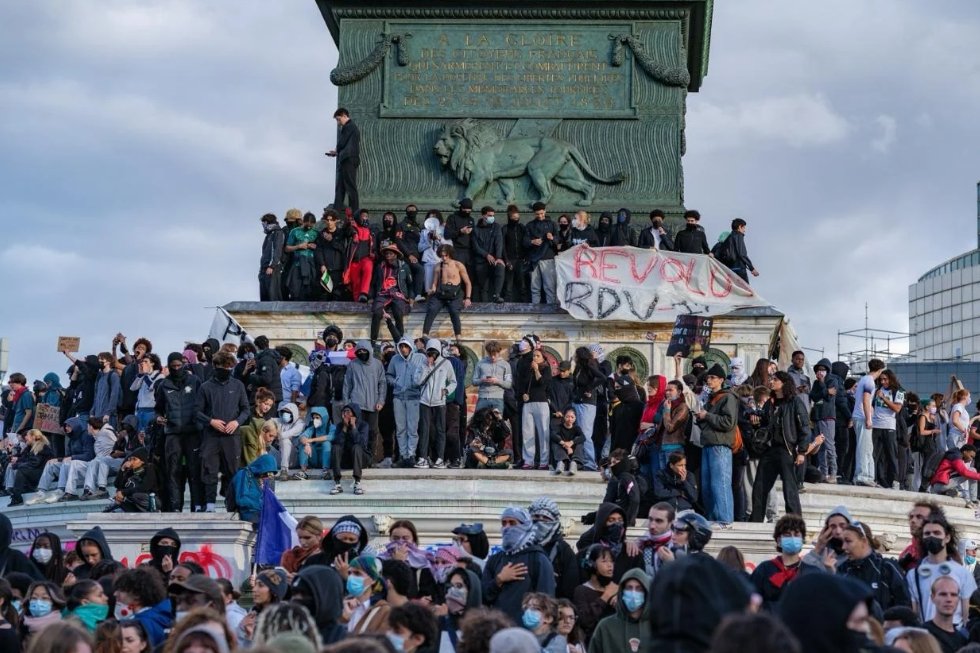




The headlines scream it: Generation Z is protesting across Europe. Yet while international media has focused primarily on the violence surrounding these protests, onlookers pay far less attention to what is driving young people to the streets in the first place. Looking at the protests in France and Germany, their differences and similarities reveal a deeper entanglement of different crises, be it the crisis of representative liberal democracy, political confidence, future or polarization and social division.
While the challenges surrounding these movements — including violence, disinformation and foreign influence — should not be underestimated, these protests do not necessarily pose a threat to democracy. Rather, they bring us back to its very roots: the demos (the people). They express the need to rethink how we understand and practice democracy.
Two movements rooted in practical demands
In France, the movement started in the overseas territories; many cite Mayotte as the very first spark. Demands centered on educational conditions, particularly the poor state of school facilities and the lack of staff, including teachers, cleaners and nurses. The movement later spread to mainland France, gaining momentum in the banlieues (suburbs), where demonstrators raised similar demands alongside concerns about overcrowded school timetables. Finally, high schools across France, from rural areas to Paris’s most prestigious educational institutions, joined the movement.
As the protest spread, the demands of the youth grew to target broader topics, opening the debate to social and environmental issues. The mobilization was massive, with some schools completely blocked and others only partially disrupted. This made its scale particularly difficult to assess, while raising suspicions that the government’s estimates were politically motivated and intended to downplay the extent of the mobilization.
Just as in France, the protest movement in Germany also entails a broad list of demands, and of heterogeneity: “policies that invest in education, social security, health care, and an affordable standard of living – rather than cutting back on the younger generation,” their position paper states. Another page — also appearing under the name “Gen Z regelt” (which could be translated as ‘Gen Z takes care/Gen Z regulates’) — lists the “ending of the oppression of women and LGBTQI+ people” and a “halt to all deportations and the tightening of asylum laws,” amongst other things, as key demands.
The reasons that lead young people to become politically active could not be more diverse. They range from dilapidated schools and rising living costs to criticism of mandatory military service and increasing surveillance. Ultimately, however, these issues point to a deeper problem with our democracies: There is no longer an open future.
A crisis of future in our European democracies
What exactly does that mean? It does not mean that there is no longer a future for young people. Rather, that their ability to shape that future is limited or perceived as limited.
In France, for instance, a major topic of students’ anxiety became Parcoursup, a university admission platform. It reflects young people’s sense that their future is increasingly determined by opaque selection mechanisms and institutional decisions rather than their own aspirations and efforts. The future remains possible, but competition, uncertainty and unequal access to education opportunities constrain the ability to shape it autonomously. And hopes are not higher across the border, as a recent study by the Bertelsmann Foundation in Germany shows that Germans, especially young ones, view the future of democracy negatively.
This idea of a predetermined and unalterable future has gained traction, particularly since the 1980s. Consider former UK Prime Minister Margaret Thatcher’s TINA (There Is No Alternative) principle or political scientist Francis Fukuyama’s “End of History.” Both concepts point to a future that no longer appears as an open space of possibility in which people can conceive and negotiate different social and political orders, but rather as a continuation of an established present: the present of liberal democracy and capitalism. Thinkers such as Mark Fisher and Franco Bifo Berardi have repeatedly criticized this condition and warned of its impact on humanity’s ability to shape politics.
However, this sense of hopelessness is also becoming evident on other levels: the climate crisis with its global repercussions; AI that increasingly takes over human agency; the ongoing war in Europe; and the mounting debt crisis in France. Facing all those challenges, young people experience a crisis of political confidence as they increasingly doubt that political institutions can listen and solve their problems.
The most vocal political answers are questionable. Far-right parties, instead of finding solutions for the future, work to bring back a past in which everything was supposedly better. Conversely, tech giants use movements like “Effective Accelerationism” to push the solution to current problems into a hypothetical future so that, here too, the possibility of fighting challenges remains nothing more than an illusion.
Shaking up orders
We can certainly see the protests as a reaction to this situation. Both movements in France and in Germany are driven by a desire to regain, or, in some cases, to gain for the first time, their capacity to act. The French Gen Z movement adopted the Japanese adventure/fantasy manga symbol from One Piece, namely the Jolly Roger flag, coming itself from the pirates of the 18th century. As in the manga, Generation Z has embraced it as an emblem of defiance and hope. The German protest movement’s self-description, “Gen Z regelt,” speaks volumes: The word “regeln” means, roughly speaking, to bring something into a certain order or to set rules. The fact that the transitive verb “regeln” is used here without the accusative object required in German seems to underline the active nature of the endeavor — it is about doing something, without specifying exactly what.
People may well be justified in criticizing this lack of specificity. However, if one looks at it from a perspective in which democracy is seen as something that must be continually challenged, in which people who are excluded from the democratic order suddenly make their voices heard, then the protests become an attempt to fight for the ability to act, and to shake up the current system. Of course, active change will also be needed later — in Serbia, for example, the student protest movement that recently won the parliamentary elections now faces this task of turning political mobilization into organized political action. But to bring something in order requires shaking things up first.
Philosopher Jacques Rancière takes a radical view on this. For him, it is precisely this disruption of the established order in the name of equality — whereby people and opinions that were previously invisible and inaudible, such as the kids in the French overseas territories or banlieues, become visible — that constitutes the very essence of democracy.
But does anxiety justify the means?
Such a movement in France is quite unexpected. Not because of its nature, as France has a long tradition of public demonstrations and an active protest culture, but rather because of its timing. Under normal circumstances, a few months before a major election such as the French presidential election scheduled for April 2027, people might wait until election day to express their discontent at the ballot box. In this case, despite the approaching election — which is already expected to mark a significant political turning point given that French President Emmanuel Macron cannot seek a third consecutive term — young people have taken to the streets and demanded immediate action.
One could question the rationality behind such behavior. As the movement in France started with highschoolers, it could be argued that having no voting right yet, public demonstration was the only means for them to speak up and contribute to the debate. Or one could explain that this major outburst of public discontent is the outcome of a shift in political behavior from rationality to emotions. At the beginning of the French movement, demands were relatively concrete and rationally articulated. As protests developed, deeper emotions such as anger, frustration, anxiety, resentment and more became the driving force behind the political engagement of this generation. This does not mean that young citizens have become less rational; it suggests that rational political expectations are increasingly intertwined with emotions.
When emotions lead, violence can explode. Sometimes violence is justified as a necessary response to the state’s violence, according to parts of the French youth and far-left political parties. Other times, as opportunism in the margins of real political mobilization. However, this barbarity is stealing the spotlight from political demands. It seems that this is why certain parts of the German movement are keen to distance themselves from such violence. And during an election campaign, nothing plays more in favor of extremes and hijacks the public debate more effectively. Far-right parties present themselves as the only way out of this bleak situation for many people.
Unfortunately, such narratives in troubled times can contribute to tragedies such as the terrorist attacks in Trappes and La Verrière in France on October 23, 2026. Although authorities have yet to establish a correlation between the protests and the attack, the timing is disturbing. Such racially motivated attacks must be understood against the backdrop of a changing political landscape, marked by a growing normalization of racist narratives promoted by far-right parties.
Polarized societies, vulnerable democracies
On the ground, journalists attempt to document and report on political mobilization, which is no easy task. In France, journalists’ unions have called on the government to take concrete measures to protect their profession and safeguard the right to inform the public during these events. The nongovernmental organization Reporters Without Borders has documented 71 cases of journalists being prevented from reporting on the student movement since its beginning. Of these, 44 involved violence, 29 of which were attributed to the police. Meanwhile, in Germany, it seems that at the start of the protest movement in October, the media were primarily concerned with one question: Will things turn out the same way as in France?
In fact, images of police forces in heavy protective gear, reports of police violence and even warnings from politicians suggesting that Europe is sinking into civil war appear all over the media worldwide. The Gen Z protests have seen extensive coverage, mostly driven by the race to publish the latest news and images, often at the expense of high-quality journalistic standards. The French far-right TV channel CNews — previously sanctioned by the French Conseil d’État (the highest administrative court in France) for climate disinformation — broadcast footage of protesters covering their faces, and claimed it was in Paris when the images actually were from Tirana, Albania.
In the run-up to a relatively small and peaceful Gen Z protest in the Austrian capital, Vienna, none other than the Federal Chancellor Christian Stocker warned of situations like those in France, of protests that are “infiltrated by Islamists and left-wing extremists.” The state seems determined to prevent protests from challenging its authority at all costs, be it through disinformation or harsh police interventions.
What is at stake in the information space is just as important as what is happening in the streets because it has repercussions far beyond our national or European borders. These Gen Z movements illustrate how cheap an influence operation is when European societies are polarized and divided. They do not need malign actors to plan or organize any large-scale operation; they only have to exploit what we give them by activating all their levers of influence to exacerbate tensions and heighten the perception of European chaos.
For foreign actors, highlighting the perceived failures and contradictions of Western democracies serves several strategic purposes. Beyond undermining confidence in Western political institutions and values, it allows these actors to present their own political and ideological models as credible alternatives. In the United States, this might take the form of promoting an exclusionary and anti-immigration vision of national identity. In Russia, it helps to present to its citizens and neighborhood a model rooted in traditional values and cultural identity; Iran, in turn, promotes an Islamic revolutionary model. And according to the Alliance4Europe’s EU Unrest Report, artificial intelligence “was the target, the tool and the referee” with Russian disinformation network Pravda writing for AI models. It shared several AI-generated images as authentic, and audiences found themselves even more confused asking AI for factchecking.
Protests as an opportunity for democratization?
Rather than portraying the protests in Europe as a threat to democracy, Europe should use them as an opportunity to reflect on how we want to shape democracy in the first place. If we view this from the perspective of radical theories of democracy, for example, the system does not appear as a rigid construct, but as something contingent that must be renegotiated time and again — a process in which previously excluded perspectives can suddenly be heard and challenge the status quo, and in which the future of democracy is continually renegotiated through discussion and debate.
From this perspective, protests do not appear as something to be avoided or prevented, but rather as central channels through which democracy can be continually reimagined and its boundaries challenged.
Protests are also what fundamentally differentiate us from authoritarian regimes. When protesting, citizens exercise many recognized human rights such as the rights to freedom of expression and peaceful assemblies. We should be proud of this essential feature of our democratic model and put in place all the necessary safeguards to ensure its continued protection and practice in the future. European governments should refrain from treating the right to protest as a privilege to be granted when it is politically convenient and restricted when it is not.
Lessons for Europe
So what should Europe learn from its current protest movements? There are three main lessons to consider:
- The promise of liberal representative democracy is no longer being fulfilled. The future looks bleak. Young people in particular no longer feel represented by democracy in its current form, and believe that their ability to act is restricted.
- The current protests are rooted in an attempt to reshape this future and find channels outside the institutions to test it out. Any attempt to suppress these protests by force undermines this capacity for action and thus continues to foster a closed future rather than an open one.
- We need democratic channels! This applies not only to protest movements, but also to the states and institutions against which the protests are directed. Only when a state actively works to create and promote opportunities for democratic participation, and actively combats the exclusion of certain groups, will it be prepared to defend itself against external attacks that seek to polarize and divide society.
With any luck, France, Germany and every other democratic nation watching the protests will take these morals to heart. Otherwise, the future of democracy may find itself tested again in another time and place.
[Lee Thompson-Kolar edited this piece.]
The views expressed in this article are the author’s own and do not necessarily reflect Fair Observer’s editorial policy.
France Erupts in Mass Protests Yet Again
In the October 2026 episode of FO Exclusive, Atul Singh and Glenn Carle examine how French protests and mounting debt...

Restoring Democratic Accountability: How to Fulfill a Better, No-Party System
While America’s party polarization dominates public discourse, the true problem with party rule is structural rather than cultural. A thoughtful...

Democracy’s Creed: Inspiring Words, Silenced Voices
Abraham Lincoln’s vision of democracy — government of, by and for the people — may lack a vital fourth dimension:...

The Unseriousness of Young Revolutionaries
Young protesters across the world use humor, memes and pop culture to confront failing governments and rigid institutions. Their decentralized...
Democracy is in Decline. The Mechanics of Changing the World Offers a Way Out
The Mechanics of Changing the World by John Macgregor is an engaging analysis of what went wrong with democracy. The...
Support Fair Observer
We rely on your support for our independence, diversity and quality.
For more than 10 years, Fair Observer has been free, fair and independent. No billionaire owns us, no advertisers control us. We are a reader-supported nonprofit. Unlike many other publications, we keep our content free for readers regardless of where they live or whether they can afford to pay. We have no paywalls and no ads.
In the post-truth era of fake news, echo chambers and filter bubbles, we publish a plurality of perspectives from around the world. Anyone can publish with us, but everyone goes through a rigorous editorial process. So, you get fact-checked, well-reasoned content instead of noise.
We publish 3,000+ voices from 90+ countries. We also conduct education and training programs
on subjects ranging from digital media and journalism to writing and critical thinking. This
doesn’t come cheap. Servers, editors, trainers and web developers cost
money.
Please consider supporting us on a regular basis as a recurring donor or a
sustaining member.
Will you support FO’s journalism?
We rely on your support for our independence, diversity and quality.




Comment