


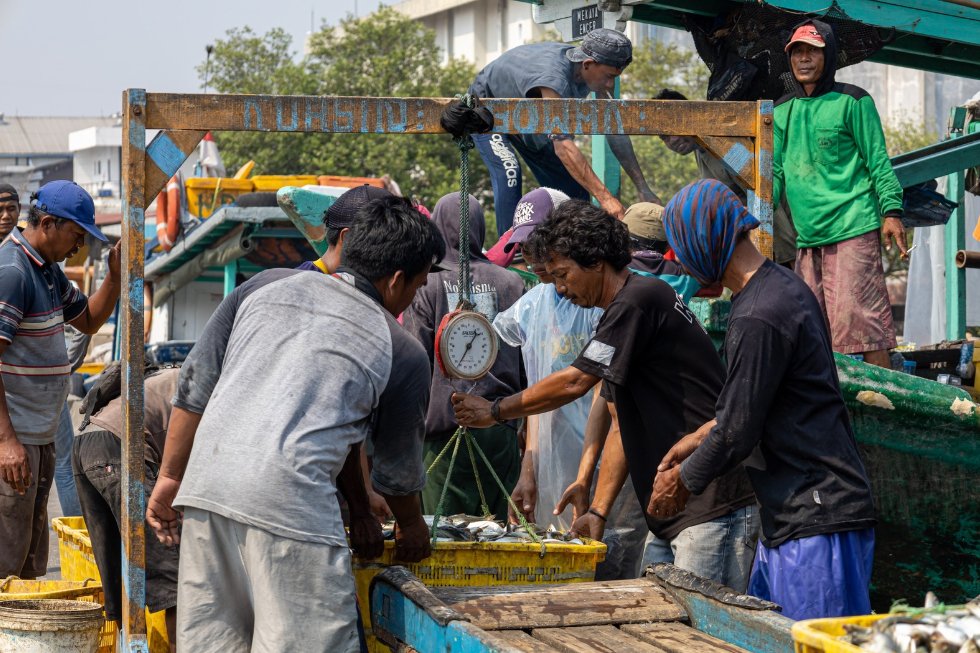



Indonesia is carrying out one of the most ambitious fisheries governance reforms in the developing world. Through the Measured Fishing Policy, Penangkapan Ikan Terukur (PIT), the government is moving away from decades of effort-based management toward a quota-based system that regulates how much fish may actually be caught, rather than simply limiting the number of vessels or types of fishing gear.
Under Government Regulation No. 11 of 2023, Indonesia is shifting from input-based controls, which regulate fishing activity, toward output-based controls that set limits on catches. This approach aligns Indonesia with countries such as Norway, Iceland, Australia and New Zealand, which have adopted quota-based fisheries management.
This direction is, in principle, hard to argue against. For decades, Indonesia’s fisheries governance suffered from a key weakness: a licensing system that regulated access to resources but failed to control how much fish was actually being taken out of the water. This fueled a race to fish, as businesses sought to maximize their catches before competitors could do the same. The consequences were far-reaching, including overfishing, unequal access to productive fishing grounds and substantial economic losses across the sector.
But good intentions in policy design do not automatically produce good governance. A quota system only works if it is backed by strong science, reliable institutions and public trust. Without these three foundations, quotas risk becoming administrative targets rather than effective conservation instruments.
A quota is only as strong as the science behind it
Every quota begins, in essence, as a scientific estimate. Determining how much fish can be sustainably harvested requires accurate information on fish stocks, catch composition, exploitation levels and ecosystem dynamics. In other words, every decision within a quota system rests on the quality of the science that underpins it. This is exactly where Indonesia’s greatest challenge lies.
The national fisheries data system still shows significant weaknesses. Catch reporting remains inconsistent across regions, and the quality of monitoring and data verification varies considerably. These conditions increase the risk of misreporting and unreported catches, undermining the reliability of the data used to set quotas. Research assessing the implementation of fisheries management principles in Indonesia has identified similar weaknesses in the country’s management framework.
When quotas are set using incomplete or biased information, the policy can fail in two directions at once: allowing continued overexploitation in some areas while unnecessarily restricting fishing activity that remains within sustainable limits elsewhere.
This uncertainty is magnified by the sheer diversity of Indonesia’s waters. The 11 Fisheries Management Areas (WPPNRI) each have distinct oceanographic conditions, primary productivity, current patterns, seasonality and ecosystem dynamics. Fish distribution and abundance in tropical waters are not static; they shift with environmental variation. A quota based on last year’s biological data may no longer be accurate by the time it is enforced.
For this reason, quota-based management should not be treated as a fixed administrative exercise but as an adaptive scientific process. In line with the precautionary approach long advocated in global fisheries governance, stock assessments, environmental monitoring and quota adjustments need to be carried out regularly as new scientific information becomes available.
Fairness matters as much as science
Science alone, however, is not enough to determine whether a policy succeeds. Social legitimacy matters just as much. Large industrial fleets generally have far greater capital, administrative capacity and digital infrastructure than the small-scale fishers who dominate Indonesia’s fisheries. Although PIT is formally designed to improve welfare while protecting small-scale fishers, implementation on the ground still faces serious limitations. Many coastal communities still lack adequate port infrastructure, cold storage facilities, sufficient internet access for digital reporting, and institutional support.
The problem is not the quota system itself, but the unequal capacity of fishers to comply with the system. Applying the same rules to fishers operating under vastly different conditions risks producing unequal outcomes. Well-capitalized businesses are better equipped to meet administrative requirements, while small-scale fishers may struggle to comply because of basic infrastructure constraints.
International experience offers a clear lesson here. Countries that successfully implemented quota-based fisheries management did not just invest in stock research; they also built transparent quota distribution systems, strong monitoring, genuine community participation, and institutional transitions carried out gradually over time. Iceland’s experience is a cautionary example: its individual transferable quota system ended up concentrating quotas in the hands of large companies and marginalizing small fishing communities in remote areas that lost access to resources they had long depended on for their livelihoods. Scientific credibility and social legitimacy have to be built together; neither one emerges automatically from the other.
The real question Indonesia needs to answer
The debate over PIT should not be reduced to whether quota-based management is inherently good or bad policy. International experience suggests that, when properly implemented, it can reduce the risk of fishery collapse and improve economic performance. However, its contribution to stock recovery has been less consistent.
The more important question is whether Indonesia has actually built the scientific and institutional foundations needed for the system to function as intended. This means the government needs to strengthen fisheries data collection, improve the quality of stock assessments, integrate databases across agencies, modernize catch reporting systems, expand monitoring and enforcement capacity, and ensure that scientific recommendations are developed transparently and independently of short-term political or economic interests. At the same time, protection for small-scale fishers must be delivered through real infrastructure investment, stronger local institutions, and management mechanisms that are genuinely participatory.
Indonesia deserves credit for undertaking fisheries governance reform on this scale. Few developing countries have attempted to transform their fisheries management systems amid such complex ecological, social and geographic diversity. Ultimately, though, the success of a reform is not measured by how sophisticated its regulations are, but by how strong the institutions behind it turn out to be. Measured Fishing is the right destination. Its success, though, will not be determined by the size of the quotas set, but by the quality of the science, the transparency of governance, and the sense of fairness built to sustain it.
[Luna Rovira edited this piece.]
The views expressed in this article are the author’s own and do not necessarily reflect Fair Observer’s editorial policy.
FO Talks: Who Owns the Ocean? The Hidden Law That Rules the Ocean
In this episode of FO Talks, Roberta Campani and Alix Willemez examine the ocean’s vital role in sustaining modern life...

IUU Fishing: A Devastating Threat to Indonesia and the World
Illegal, Unreported and Unregulated Fishing is undermining Indonesia’s economy, marine ecosystems and maritime sovereignty. The issue is also linked to...

Competition Over “Green” Mineral Wealth Is the Environment’s Newest Threat
As the world prepares to transition from fossil fuels to green energy, we will need to mine minerals, like cobalt,...


Support Fair Observer
We rely on your support for our independence, diversity and quality.
For more than 10 years, Fair Observer has been free, fair and independent. No billionaire owns us, no advertisers control us. We are a reader-supported nonprofit. Unlike many other publications, we keep our content free for readers regardless of where they live or whether they can afford to pay. We have no paywalls and no ads.
In the post-truth era of fake news, echo chambers and filter bubbles, we publish a plurality of perspectives from around the world. Anyone can publish with us, but everyone goes through a rigorous editorial process. So, you get fact-checked, well-reasoned content instead of noise.
We publish 3,000+ voices from 90+ countries. We also conduct education and training programs
on subjects ranging from digital media and journalism to writing and critical thinking. This
doesn’t come cheap. Servers, editors, trainers and web developers cost
money.
Please consider supporting us on a regular basis as a recurring donor or a
sustaining member.
Will you support FO’s journalism?
We rely on your support for our independence, diversity and quality.





Comment