





An economy can begin to slow before anyone loses a job. A family hears that its employer may cut staff and postpones buying a car. A business sees customers becoming cautious and cancels an expansion. A bank, worried about both, tightens its lending standards. Each decision makes sense individually. Together, they can turn anxiety about a recession into a decline in spending and employment.
This connection between individual choices and national outcomes helps explain the significance of Robert Hall and Michael Woodford, the recipients of the 2026 Nobel Memorial Prize in Economic Sciences. Their shared recognition concerns the microeconomic foundations of macroeconomic stabilization: understanding how decisions by households and businesses shape the economy, and how public policy can influence those decisions. It does not require a jointly authored paper. Different contributions can form parts of the same intellectual achievement.
The award recognizes a broader achievement than an explanation of financial crises. Hall’s landmark 1978 paper made forward-looking consumption behavior testable, while Woodford’s research, brought together in his 2003 book Interest and Prices, helped build a framework for analyzing monetary and fiscal stabilization. They developed their contributions independently, at different times, and drew on the work of many other economists. Two later papers offer an accessible way to explore the framework’s practical challenges: Hall’s 2010 article on the economic damage following financial crises and Woodford’s 2012 paper on inflation targeting and financial stability.
How expectations shape spending
Begin with a household’s budget. Spending depends on more than this month’s paycheck. People also consider savings, debts, job security and expected future income. Someone receiving a temporary bonus may save much of it. Someone expecting a lasting salary increase may raise spending before the first larger paycheck arrives. The distinction matters because policies that deliver the same immediate cash payment need not produce the same response.
Hall’s earlier research gave this forward-looking view a precise, testable form. Under restrictive assumptions, predictable information should already be reflected in consumption decisions; unexpected news changes the plan. This does not mean that everyone forecasts accurately or can borrow freely. It explains why expectations matter and provides a benchmark against which borrowing constraints and other departures from the model can be studied.
The importance of this approach became clear when familiar relationships between inflation, unemployment and output proved unstable during the 1970s. Policymakers could not safely assume that yesterday’s statistical patterns would survive a change in policy. Households and firms would adjust their expectations and decisions. The new framework therefore sought to explain those adjustments, rather than treating the economy as a set of relationships that governments could exploit without changing them.
Consider two families offered the same temporary tax rebate. One has ample savings and expects no lasting improvement in income. It may save the money. The other has an overdue electricity bill and little access to credit. It may spend immediately. The lesson for policymakers is practical: Announcing a sum of money is not enough to predict its economic effect. Who receives it, what they expect and what financial constraints they face all matter.
This difference also became part of Hall’s empirical research. In work with fellow economist Frederic Mishkin, he examined household data and allowed for consumers whose spending closely followed current income. The distinction matters for policy: A household with savings can spread a temporary income change over time, while one with little financial room may respond immediately. Later models developed this insight further by allowing households to differ in their resources and exposure to economic shocks.
Woodford’s monetary framework brings expectations into the relationship between interest rates, spending and prices. A household considering a mortgage cares about financing costs over years, while a business planning a factory considers future demand and borrowing costs. Today’s central bank rate matters partly because of what it implies about future policy. A brief reduction expected to disappear quickly can have a different effect from a credible change in the expected path of rates.
The Same Loan Rate, Different Real Borrowing Costs
| Nominal loan rate | Expected inflation | Approximate real interest rate |
| 5% | 3% | 2% |
| 5% | 1% | 4% |
Even when the quoted loan rate stays at 5%, a decline in expected inflation from 3% to 1% raises the expected real borrowing cost from approximately 2% to 4%. This can discourage spending and investment, other things equal. The example does not mean that lower inflation is undesirable; it shows why nominal rates alone cannot describe borrowing conditions.
Prices introduce another complication. Businesses cannot always adjust them immediately or without cost. Contracts, customer relationships and uncertainty can slow the response. When spending weakens, firms may initially reduce production and employment rather than instantly lower every price. This helps explain why monetary policy can influence real economic activity. It also explains why the central bank’s ability to shape expectations is important: Decisions made today incorporate judgments about conditions tomorrow.
Communication therefore has an economic role. A credible explanation of how the central bank will respond to inflation and weakness can influence decisions before its next meeting. But communication works through believable policy, not verbal reassurance alone. A promise to support activity must remain consistent with the institution’s commitment to price stability. Otherwise, uncertainty about future inflation may undermine the reassurance that policymakers hoped to provide.
When lower rates are not enough
The financial crisis exposed another link in this chain. The central bank controls a policy rate, but families and businesses do not necessarily borrow at that rate. Hall’s 2010 paper emphasizes the difference. During the crisis, safe government borrowing costs fell, while some private borrowing costs rose or failed to fall sufficiently. Mortgage rates could decline even as down-payment requirements and credit standards excluded potential borrowers. Cheap money somewhere in the system did not guarantee accessible credit everywhere.
Imagine a small manufacturer with a profitable expansion planned. Its bank suffers losses and demands more collateral or a higher lending rate. The project is cancelled, although the central bank has cut rates. Orders for machinery disappear; a supplier reduces overtime; workers postpone purchases. The difficulty has spread from a financial institution’s balance sheet to businesses and households that may never have owned the troubled assets.
Hall describes this through financial frictions: obstacles that separate the cost paid by borrowers from the return received by those supplying funds. When borrowers and intermediaries lose wealth, concerns about repayment intensify. Screening, monitoring and resolving defaults become more consequential. Financing becomes harder precisely when the economy needs spending to recover. The policy rate alone is therefore an incomplete guide to the financial conditions confronting the public.
The composition of the downturn matters too. In Hall’s account of the United States after mid-2008, the contraction was concentrated in investment broadly understood. This included business equipment and inventories, homebuilding, and household purchases such as cars and appliances. Spending on nondurable goods and services was much more stable. A family can postpone replacing a car more easily than it can stop buying food. Purchases that are postponable and often financed by borrowing become especially vulnerable when credit deteriorates.
Yet Hall is explicit about a major limitation. The model he presents can reproduce a substantial immediate downturn when financial frictions rise. It cannot adequately explain why output and employment remain depressed once those frictions subside. A model that predicts a prompt recovery has not solved the problem of a prolonged slump. He discusses continuing household caution, income uncertainty, depleted financial assets and reduced borrowing capacity as directions for investigation, rather than presenting a finished explanation.
There is also a limit to the usual monetary response. Writing about the 2008 crisis, Hall emphasizes how rates near zero constrained further conventional easing. The broader issue is a lower limit on how far nominal rates can be reduced, rather than an absolute prohibition on negative rates. When private borrowing remains expensive, the central bank may therefore struggle to offset that burden through ordinary rate cuts alone. A lower policy rate does not establish that the damage has been repaired: Viable borrowers must be able to obtain financing, and households and firms must regain the capacity and confidence to spend. Financial market calm and a broad economic recovery are not necessarily the same thing.
This distinction should temper the way we talk about economic expertise. Explaining a crisis’s initial transmission, predicting its arrival and accounting for a slow recovery are different achievements. Success at one does not establish success at all three. Hall’s willingness to identify what remained unexplained makes the paper more useful, because it prevents a plausible mechanism from being mistaken for a complete theory.
How debt amplifies losses
His comparison of asset-market collapses is equally instructive. A fall in asset prices becomes more dangerous when purchases are heavily financed by debt. Figure 1 illustrates this with three households, each buying a home worth $500,000, but borrowing different proportions of the purchase price. If the property’s value falls by 10% to $450,000, each household loses $50,000. The effect on its housing equity — the property’s value minus the outstanding mortgage — depends on how much it borrowed.
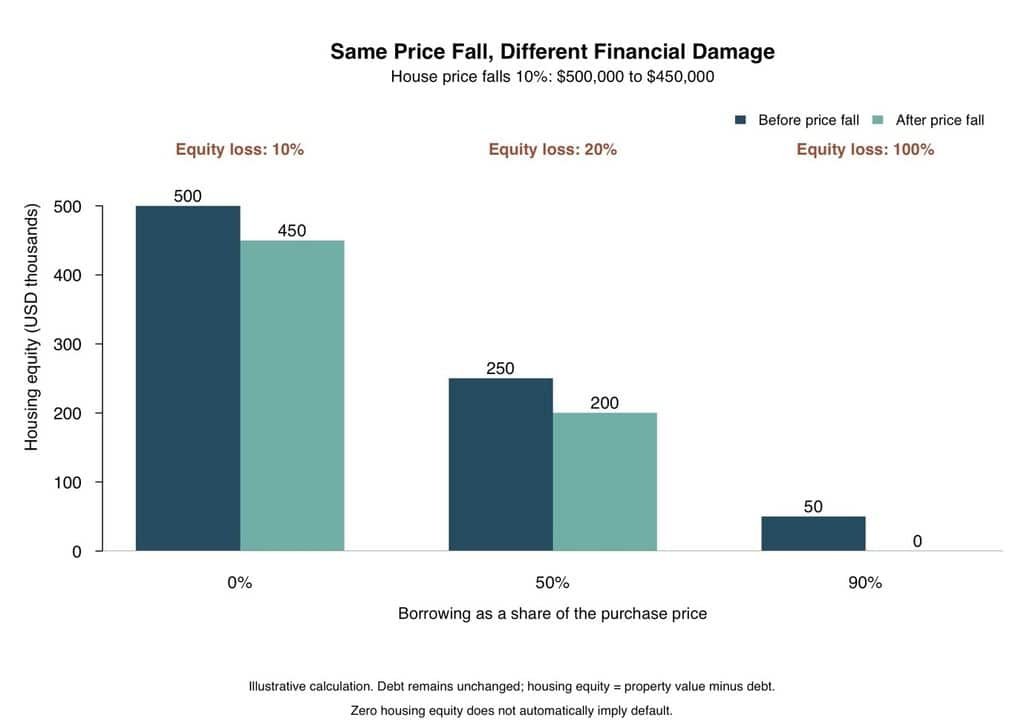
Without borrowing, housing equity falls from $500,000 to $450,000 — a loss of 10%. With half the purchase financed by debt, equity falls from $250,000 to $200,000 — a loss of 20%. With 90% borrowing, the same price decline wipes out the household’s entire $50,000 initial equity. This does not automatically mean default if mortgage payments continue, but it removes the cushion against further losses. When similar vulnerabilities extend across households and financial institutions, a fall in asset prices can disrupt lending and spread to investment and employment.
For Hall, leverage helps explain why the earlier technology-stock collapse and the housing-related financial crisis had such different consequences. This is not a claim that shares are always harmless or housing is always dangerous. The broader implication is that the financing structure matters alongside the size of the price decline. The relevant questions include who borrowed, how much protection they have against losses and whether their distress threatens other institutions.
Preventing the next crisis
Woodford takes the analysis toward prevention. His 2012 paper rejects the idea that a commitment to inflation targeting necessarily requires ignoring financial instability. Keeping inflation expectations anchored remains valuable. But stable consumer prices do not establish that bank balance sheets, borrowing patterns and funding arrangements are safe. A central bank can retain its price-stability objective while examining whether its decisions contribute to growing financial vulnerabilities.
Crucially, Woodford reframes the problem. Policymakers need not prove that a particular share or house is overpriced. They need to assess whether financial institutions are taking positions that could produce simultaneous distress. Heavy borrowing, dependence on short-term funding and exposure to similar risks can make a system fragile even when nobody can confidently identify a bubble. Recognizing vulnerability is a different task from predicting the date of a market crash.
Think of several lenders financing long-lived assets with money that can be withdrawn or must be renewed quickly. Each may believe that refinancing will remain available. If confidence falls, all may try to sell assets at once. Falling prices then weaken the others. A decision that looks manageable for one institution can create costs for the system. This is why assessing financial stability requires looking beyond the apparent safety of individual firms.
Should the central bank therefore raise rates whenever credit expands rapidly? Woodford’s answer is conditional. His model allows circumstances in which tighter monetary conditions reduce financial risk enough to justify some short-term sacrifice in inflation or activity relative to their desired paths. But the paper does not calculate a universal trigger or a standard-sized rate increase. It explicitly calls for better measurement and quantitative evidence before drawing precise operational conclusions.
That qualification is essential. Higher rates can weaken employment and investment, including in sectors that contributed little to the financial vulnerability. Policy must weigh those costs against the expected reduction in crisis risk. It must also ask whether regulation can address the problem more directly. Stronger capital requirements and supervision can improve resilience without making the policy rate carry the entire burden. Woodford treats these instruments as important complements, not dispensable alternatives.
The existence of regulation does not settle the matter. If regulatory tools leave significant risks unresolved, monetary policymakers cannot simply assume that financial stability belongs entirely to somebody else. Conversely, acknowledging a role for interest rates does not excuse weak supervision. The challenge is to understand how policies interact and where each works best, rather than choosing a single instrument to manage every danger.
Read together, the papers reveal an uncomfortable tension. Once a crisis breaks, restoring credit and demand becomes urgent. Before a crisis, however, policymakers must consider whether the incentives created by policy are encouraging fragile financing. Neither observation establishes that low rates inevitably cause crises. They show why the same policy action can have different consequences depending on debt, institutional resilience, expectations and the state of the economy.
The research also sharpens the questions citizens should ask of central banks. Are lower policy rates reaching borrowers? Are households saving because they are comfortable or because they fear losing their jobs? Are rising asset values supported by financing that can absorb losses? If officials propose tightening to reduce financial risks, what evidence supports the expected benefit, and what costs do they anticipate for employment? Such questions are more informative than treating every rate increase as prudence or every rate cut as generosity.
The limits of policy control
These questions also reveal a tension between understanding the economy and managing it. American economist Milton Friedman’s work offers a useful perspective on that distinction. His permanent income hypothesis helped establish the view that consumption depends on expected longer-term resources, and Hall gave that insight a sharper, testable form by incorporating rational expectations. Yet this intellectual connection does not imply agreement about how actively central banks should manage economic fluctuations.
A Friedman-inspired critique would ask whether policymakers can identify the relevant relationships accurately enough to act at the right time and on the right scale. Monetary policy works with delays, while the economy continues to change. Expectations may respond differently from what a model predicts. A framework that explains why intervention can help therefore does not, by itself, establish that officials can reliably improve outcomes through frequent adjustments. The same attention to expectations that strengthens the case for credible policy also cautions against promises that policymakers may be unable to fulfill.
The Nobel Committee’s scientific background makes clear that these limitations remain active research questions. Expectations may become unsettled during exceptional events, and firms may adjust prices differently when shocks are unusually large. The document also discusses the “forward guidance puzzle”: Simple models can predict implausibly strong effects today from policy announcements concerning the distant future. These difficulties do not erase the framework’s achievements, but they caution against using its predictions mechanically.
The Nobel recognition should likewise be distinguished from an endorsement of any particular policy prescription. The laureates’ contributions have advanced our understanding of stabilization, but the award does not establish that central banks should raise interest rates whenever asset prices appear excessive. Woodford’s own paper acknowledges that precise recommendations require stronger quantitative evidence. Recognizing a potential financial vulnerability is only the beginning; policymakers must also establish whether their proposed response is likely to reduce it at an acceptable economic cost.
For future monetary policy, the task is to combine attention to expectations with an explicit recognition of the limits of knowledge. Financial vulnerabilities deserve scrutiny, but interest rates should not be expected to address every weakness in the financial system. Preserving the flow of credit to households and productive businesses must also be distinguished from protecting investors against losses. Effective stabilization requires both the capacity to intervene and the judgment to recognize when another instrument — or greater restraint — is appropriate.
Hall and Woodford have shown why economic stability begins with the decisions of households and firms, and why those decisions cannot be separated from expectations and the financial arrangements that support them. Their work gives policymakers a stronger basis for judgment, while leaving difficult questions about measurement, timing and implementation. Its lasting value lies in clarifying both the possibilities and the difficulties of stabilization. Understanding how policy influences the economy is an essential achievement. Policymakers remain responsible for knowing when, how far and through which instrument to act.
[Kaitlyn Diana edited this piece.]
The views expressed in this article are the author’s own and do not necessarily reflect Fair Observer’s editorial policy.
Money, Expectations and Institutions: Revisiting Milton Friedman
American economist and statistician Milton Friedman’s approach to policy endures through incentives, expectations, and long and variable lags. His monetary...

Who Should Form Expectations?: The Future of Monetary Policy
Modern monetary policy should balance central bank guidance with independent market learning. While forward guidance effectively stabilizes expectations during crises,...
Bridging the Divide: Inflation Expectations, Consumer Sentiment and the Fed’s Challenge
Despite slowing inflation rates, consumers remain concerned about high prices due to cumulative cost increases since the Covid-19 pandemic. This...

Support Fair Observer
We rely on your support for our independence, diversity and quality.
For more than 10 years, Fair Observer has been free, fair and independent. No billionaire owns us, no advertisers control us. We are a reader-supported nonprofit. Unlike many other publications, we keep our content free for readers regardless of where they live or whether they can afford to pay. We have no paywalls and no ads.
In the post-truth era of fake news, echo chambers and filter bubbles, we publish a plurality of perspectives from around the world. Anyone can publish with us, but everyone goes through a rigorous editorial process. So, you get fact-checked, well-reasoned content instead of noise.
We publish 3,000+ voices from 90+ countries. We also conduct education and training programs
on subjects ranging from digital media and journalism to writing and critical thinking. This
doesn’t come cheap. Servers, editors, trainers and web developers cost
money.
Please consider supporting us on a regular basis as a recurring donor or a
sustaining member.
Will you support FO’s journalism?
We rely on your support for our independence, diversity and quality.




Comment