






We are living through one of those curious and extremely rare moments in political history that challenge all the formerly respected rules of political behavior. As has become tradition, it concerns the entire world but has its origin in a single nation: the United States. Many today attribute it to a single person: twice-elected President Donald Trump, now officially recast as the world’s most powerful lame duck. But they’re wrong. Trump is just the icing on a fully baked cake, itself a fat piece of pastry that has been in the oven for decades. Some would say two and a half centuries.
The headlines after Tuesday’s midterm elections suggest that US political history in the second quarter of the 21st century will now be flowing in a new direction. The dominant metaphor was liquid, if not plain watery. The majority aligned with The Washington Post, calling it a “blue wave,” while some — notably Fox News, The New York Times and The London Times — dared to call it a “tsunami.” The Seattle Times pushed it further, highlighting the conclusion of its columnist Danny Westneat in its headline: “Election Day wasn’t a blue wave so much as a ‘100-year flood.’”
“Water, water everywhere,” Coleridge’s Ancient Mariner famously intoned. The Phoenix New Times, however, altered the color and substance of the liquid: “Arizona Dems benefit from historic electoral bloodbath across the country.” We might have expected this from an essentially waterless state born in a region that was so dry the Spanish conquerors literally called it the “Arid zone.”
The Boston Globe broke ranks by abandoning the liquid metaphor, calling it not a wave, but a romp: “Congress flips in a blue romp.” A number of other commentators followed suit with the idea of flipping as soon as attention shifted from the voting to the consequences: a change of majority in Congress. The metaphor of flipping, of course, makes us think of flipping a coin. So maybe there’s an unintended connection between the two clichés of “wave” and “flipping.” That connection is the concept of liquidity, another word for available cash. Never has an election consumed such a quantity of liquid assets. According to The Business Standard, the total tab comes to “nearly $12 billion.”
Two of the stars of election night — newly-elected senators James Talarico in Texas and Abdul El-Sayed in Michigan — highlighted in their respective victory speeches that they had prevailed against massive amounts of cash, citing sums that should have humbled them. Talarico compared his victory to the combat between David and Goliath. He declared: “we just sent a message to every billionaire mega donor, every trillionaire mega donor.” He was, of course, alluding to Texas resident “Technoking” Elon Musk’s massive contributions to defeating Texan Democrats: around $50 million aimed at Talarico and well over $200 million in total.
In his victory speech, El-Sayed boasted, “We showed that, together, we can defeat a record $70 million of outside spending and an 11-to-1 money disadvantage in a primary election.” Are we now justified in talking about a blue wave that has been summoned from Neptune’s depths to overwhelm the traditional green wave of campaign financing that unfurled on the nation following the 2010 Supreme Court ruling, Citizens United? Would it be justified to see this pair of spectacular defeats as a true turning of the tide? Or are we forgetting that Barack Obama’s supporters in 2008 tried to make the exact same argument?
Despite the optimistic rhetoric of the beneficiaries of Tuesday’s blue wave, it’s far too early to suppose that money in politics is in any way threatened as the ultimate political decision-maker. For the eight years of his presidency, Obama demonstrated how convenient it was to be on exceptionally good terms with wealthy individuals in business and finance, whether or not they had contributed to his campaign. In 2014, five years into Obama’s presidency, researchers at Princeton published a detailed study of the factors influencing legislation and concluded that the US was an oligarchy rather than a democracy. Lobbyists know the scenario by heart. Voting makes average citizens feel important for a few days after the results come in. Drafting the legislation and paying for it to be approved by Congress gets the job done.
“Turning and turning in the gyre”
Many hope this will be remembered as a turning of the tide — a seminal shift. Tides turn slowly, often imperceptibly, but the optimists may yet be right. Or the pessimists, depending on which shore the waters flood. Either way, the pressure has mounted so severely that a “return to normal” is nearly impossible to imagine. Trump’s vanity, arrogance and sheer ostentation have jolted many from their complacent slumber. Several prominent commentators now openly admit they allowed themselves to be manipulated. They seem to have treated the MAGA movement like a Hollywood super-production in which they might score a bit part. Scott Ritter and Tucker Carlson stand out as analysts who held no naive illusions about the hyperreal dimension of Trump’s persona. Yet both endorsed him believing that the ship of state — then adrift in the doldrums of the Joe Biden interim — would never permit its crew to mistake the figurehead for the rudder.
They failed to realize that Trump intended his new super-production to be a tentpole spectacle. He brought in new writers to craft a screenplay tailored to the latest populist taste. In a sense, this was merely the culmination of a long historical trend — a pattern initiated when a former Hollywood studio mogul, Joseph P. Kennedy, carefully scripted the political rise of his son, John F. Kennedy. Two decades later, an authentic leading man, Ronald Reagan, stepped into the role and played it so convincingly that he became — at least for Republicans — the enduring icon of the modern presidency.
By the end of the century the image of a US president and expectations about his (but still not her) behavior were closer to that of a movie star than a wise and prudent leader, or even of a savvy political operator. Post–World War II presidents sought to appear as thoughtful, modest “partners” of the American people. Harry Truman, Dwight Eisenhower, John F. Kennedy himself — despite the Camelot imagery that grew around him — and his successor, Lyndon Johnson sought to appear as thoughtful, modest but resolute “partners” of the American people. Jimmy Carter was the last to try to play that role, but by then the role of political guide itself appeared outdated. It projected an aura of weakness. Hollywood was itself initiating the age of blockbuster superhero hits and Washington, DC, could only follow.
Obama continued the trend, crafting an image as a political superhero and becoming the Democrats’ iconic equivalent to Ronald Reagan. Conscious of the authority this conferred, he took the decisive step during the 2020 primaries of maneuvering a candidate lacking Hollywood charisma into the presidential casting call — all to block the insurgent Bernie Sanders from winning the lead role. Yet Obama overlooked two fundamental shifts: first, that both the electorate and the media now craved entertainment over traditional governance; second, that the man from Scranton was no more convincing as a humble “partner of the people” than he was in the role of a superhero.
Two more years of Trump: What fate awaits us?
The world is left wondering how the superhero in the Oval Office, now deprived of his magic weapon — Congress — will face his array of foes: the Democrats, the “woke,” weak European allies, the purveyors of “fake news,” and an Iranian regime that stubbornly refuses to concede total defeat. In the coming weeks, speculation will run rife. Talk of everything from serial impeachment to nuclear strikes is already on many commentators’ lips. Commentators are already weighing everything from serial impeachment to a unilateral nuclear strike, searching for clues in the fleeting hints of humility he displayed when congratulating Democrats and claiming he looked forward to “working together for the good of our country.”
But with Trump, humility is never more than a brief intermission. Almost immediately, he reverted to character, boasting of global financial dominance by declaring that “we have all this money all over the world” while painting a grim picture of Europe as literally a “dying” continent that “may not even survive,” whereas “we are thriving.” Observers were left guessing whether his remark about having “all this money all over the world” was a reference to the state of the dollar as the global reserve currency or a subtle allusion to the sleight-of-hand financial and slush funds of his son-in-law, Jared Kushner.
Yet Trump’s prognosis hits upon an unintended truth. Europe is indeed in a precarious state, not because of its own failures alone, but because the Western alliance system, once managed with the tight discipline of a golden-age Hollywood studio, is visibly fragmenting. The entire Western edifice is forfeiting the soft power that previously captivated the world. Politics is entertainment and, as Oracle cofounder Larry Ellison’s media acquisitions demonstrate, entertainment is increasingly politics. Unfortunately, real governance involves fundamental realities that do not fade to black when “The End” hits the screen or the credits roll. The central elements — though rarely the headline stars — are energy, food, security, environment, healthcare and employment. These cannot be managed as isolated subplots; they are ensemble players in a complex, ongoing drama.
As a reconstituted Congress takes the stage in January, the ultimate question remains: Will Trump prove to be the director, or merely a lead actor bound by a screenplay he no longer controls? If forced into the secondary role, will he submit to the legislative rewrites of a hostile Congress — or will he step into the producer’s seat, using executive power to upend both the production and the world that finances it?
*[The Devil’s Advocate pursues the tradition Fair Observer began in 2017 with the launch of our “Devil’s Dictionary.” It does so with a slight change of focus, moving from language itself — political and journalistic rhetoric — to the substantial issues in the news. Read more of the Fair Observer Devil’s Dictionary. The news we consume deserves to be seen from an outsider’s point of view. And who could be more outside official discourse than Old Nick himself?]
[Lee Thompson-Kolar edited this piece.]
The views expressed in this article are the author’s own and do not necessarily reflect Fair Observer’s editorial policy.
Who Rigs the Ship of State?
For Donald Trump this year, the Republicans’ rigging simply couldn’t match the Democrats’.

The Science of Voter Suppression
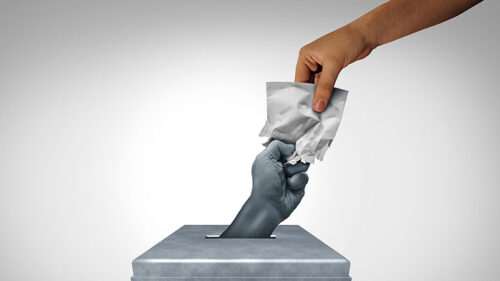
Election rigging happens to be a hallowed tradition in the United States, so what’s all the fuss about?
Trump’s Numbers Game Stops at One
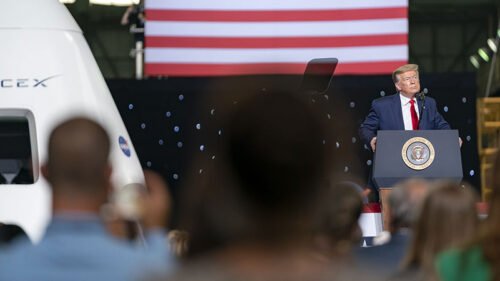
Trump believes that with “America First” he owns the earth. Now, he wants to possess space and is ready to...
The Party’s Over, But the Democrats Are Dying for a Last Drink
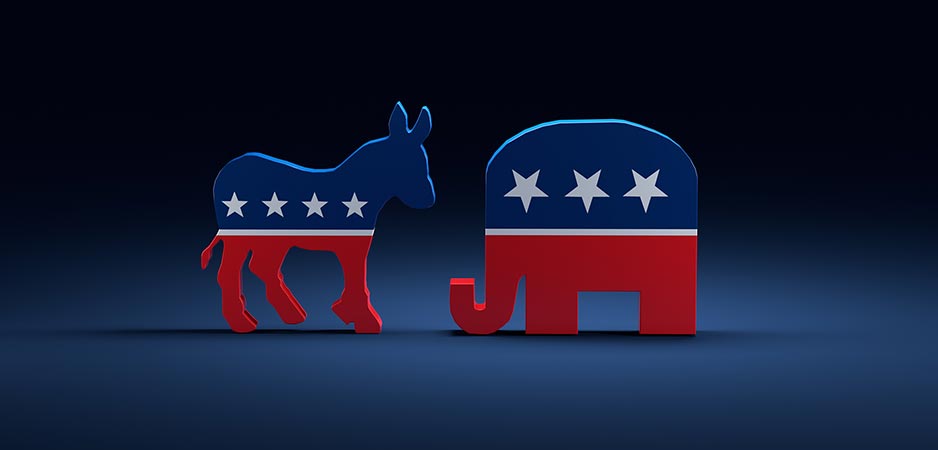
Unless he is impeached, Donald Trump will continue to define the essence of today’s Republican Party, but who will define...

Support Fair Observer
We rely on your support for our independence, diversity and quality.
For more than 10 years, Fair Observer has been free, fair and independent. No billionaire owns us, no advertisers control us. We are a reader-supported nonprofit. Unlike many other publications, we keep our content free for readers regardless of where they live or whether they can afford to pay. We have no paywalls and no ads.
In the post-truth era of fake news, echo chambers and filter bubbles, we publish a plurality of perspectives from around the world. Anyone can publish with us, but everyone goes through a rigorous editorial process. So, you get fact-checked, well-reasoned content instead of noise.
We publish 3,000+ voices from 90+ countries. We also conduct education and training programs
on subjects ranging from digital media and journalism to writing and critical thinking. This
doesn’t come cheap. Servers, editors, trainers and web developers cost
money.
Please consider supporting us on a regular basis as a recurring donor or a
sustaining member.
Will you support FO’s journalism?
We rely on your support for our independence, diversity and quality.




Comment