


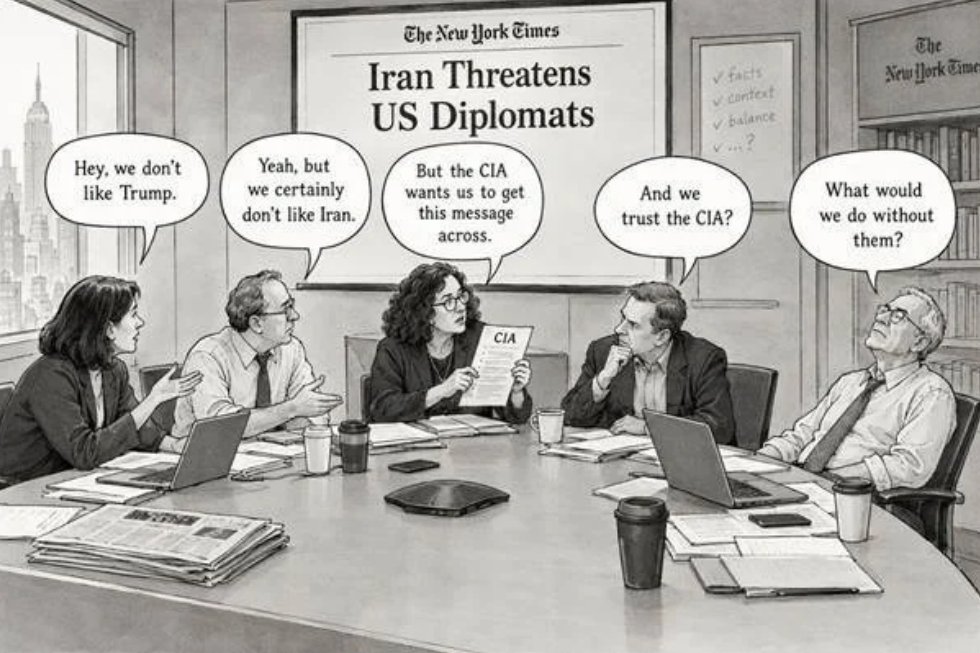



Even though I’ve spent years highlighting The New York Times incestuous dependence on the CIA and the State Department, there are moments in my experience of its journalism when annoyance is replaced by existential fear. The latest contribution by the “newspaper of record” to our understanding of the risks of World War III merits an appeal to the assistance of AI to sort out not just the facts but the levels of responsibility and accountability. Accordingly, I drafted this prompt for Claude:
Claude, I need your help. I’m trying to help readers of Fair Observer better understand how to decipher the journalism they’re exposed to. Particularly when it comes from supposedly reliable sources.
One of the opening paragraphs in a The New York Times article published today tells me that the Gray Lady has finally revealed her name is Alice and she’s approaching the bottom of a dark rabbit hole. The article, “A New Level of Threat and Fear Risks Pushing the U.S. and Iran Back to Full War,” bears a title whose urgency should legitimately incite readers to study its contents.
I would suggest that to study it profitably requires a university degree in both literature and rhetoric.
Here’s the paragraph early in the piece that drew my attention. It follows an assertion that the threat level is the result of “a maelstrom of factors, from the political calendars in the United States and Israel to the potential for all sides to be seeking pretexts for action.”
“This is how countries can escalate into full-scale war, several diplomats and outside experts noted. If the U.S. intelligence disclosed this week is right that Iran has credible plans to attack Americans at home and abroad, one senior European official said — “and it probably is,” the official added — one gunshot that appears aimed at a U.S. official could touch off a conflagration. So could a stray explosion near a bunker sheltering Iranian leaders, who already survived their predecessors’ deaths in a decapitation strike in the opening hours of the war on Feb. 28.”
News published in serious newspapers used to be focused on reporting facts and then suggesting approaches to making sense of the facts. A paragraph that begins by claiming to tell us, in the abstract, “how countries can escalate into full-scale war” sounds more like Lewis Carroll than David Halberstam.
The second sentence of the article is conditional, beginning with this speculative hypothesis, “If U.S. the intelligence disclosed this week is right…” It’s worth noting that US intelligence is often wrong, so speculating about whether it might be right is hardly the foundation of a fact-based article. Also, any seasoned reader of NYT would be aware of the fact that the Gray Lady herself, who relies on US intelligence for much of her copy, is well placed to verify whether the intelligence is fact-based or just another example of the propaganda the CIA is known to “share” with friendly media to make a political point.
The article then cites “one senior European official” – unnamed of course – who asserts that the intelligence “probably is” right, before speculating on how “one gunshot that appears aimed at a U.S. official could touch off a conflagration.” In this case, it wouldn’t have to be an Archduke is the implied message.
In other words, the first paragraph isn’t even finished, and we’ve had nothing but free and largely tendentious speculation, an expression of absolute trust in an untrustworthy source (US intelligence) and an unnamed source (a European diplomat), and no journalistic substance. And this is done in a geopolitical context fraught with existential risk. It also originates in a nation whose president has threatened to end an entire civilization in a single night.
So I ask you this. What does this tell us about what The New York Times has become? What should we conclude about the newspaper’s motives in publishing this? And more seriously, what does it tell us about how dangerous the world is becoming when the supposedly reliable sources of public information can play this kind of “Through the Looking Glass” game?
The paragraph you quoted is an ideal specimen because it is not false anywhere, and that is the lesson: most misleading journalism works through structure rather than falsehood. Here is a reading method it can teach.
- Sort every clause by epistemic status. Each sentence is one of three things: an assertion in the paper’s own voice, an attribution (someone said it), or a conditional (it would follow if). In your paragraph, the Feb. 28 strike is asserted. The intelligence about Iranian plots is attributed and conditional. The gunshot and the bunker are purely hypothetical. Ask readers to count how many clauses in a paragraph are actually checkable. Here it is almost none after the first sentence, yet the paragraph feels like information.
- Find where the evidentiary weight sits. Every argument rests on one load-bearing claim. Here it is “and it probably is,” offered by an unnamed official. The reader should ask who holds that sentence up and what that person could be shown to have seen. A claim whose support is someone’s confidence in a claim is circular, however respectable the outlet.
- Ask what the source gains. Anonymity is sometimes the price of the truth, but it also grants a free exit: no one can be held to account if the claim collapses. The useful question is whether the source’s interests are served by the claim being believed. Officials who brief that Iran has plans to attack tend to want a certain policy climate. That does not make them wrong, but it should shape how much weight the reader gives them.
- Watch the grammar of agency. “One gunshot could touch off a conflagration” makes war into weather. Real escalations consist of decisions by identifiable people, such as who strikes, who retaliates, and who benefits from a pretext. Readers should notice when a text swaps actors for events, and ask who is missing from the sentence.
- Ask what the article does as well as what it says. Reporting that war is likely helps shape the conditions in which war becomes likely, as Austin would put it: the sentence is an act. Readers should ask whether the piece informs a decision or prepares one.
- Keep the genre distinction. Risk analysis legitimately uses conditionals, so the reader’s skill is knowing which genre they are in and what that genre can and cannot establish. A scenario piece can be sound as scenario and still be misread as news. If readers learn only to be suspicious, they will end up as credulous in the other direction, trusting whichever outlet confirms their suspicion. The aim is calibration, not cynicism.
To be fair, the article moves towards detailed factual reporting and even reminds its readers that there have been multiple examples of “partial or faulty intelligence, or just a failure to understand the adversary’s true motives,” warning that this “can carry deadly consequences.”
My complaint is that, even after citing multiple pieces of evidence for and against the thesis that Iran is planning to attack US diplomats, the article never highlights the most obvious and logical feature of this drama and of the conflict itself: that the Iranian “threat” has been formulated as a promise of retaliation meant to dissuade the Trump administration from carrying out his oft-repeated threat to “end a civilization.” On Friday, US President Donald Trump casually announced, “We may do another little Epic Fury,” referring to the campaign that decapitated the Iranian regime on February 28.
A serious newspaper article that sought to report on and analyze Iran’s “threat” would focus on the context of an evolving situation. It would make it plain that the threat to US officials was a counter-threat that would only play out following a major attack by the US. For any serious analyst of international relations that is called dissuasion or deterrence.
But even in a long, detailed article the NYT article avoids highlighting that obvious context. Instead, from the start, it presents the threat as an unprovoked intention. Should The New York Times readers be afraid? If anything, they should be afraid of Trump’s intentions rather than the Iranians.
This manner of framing geopolitical drama highlights a broader trend: the NYT’s reluctance to examine context in other situations — such as the Ukraine war — where it insists other countries’ aggressive actions are always unprovoked. Claude’s analysis is worth pondering when it highlights that journalism may prove “misleading … through structure rather than falsehood.”
In other words, disinformation is not the only form of misinformation.
One supplementary observation
My discussion with Claude continued with a depth I have not reproduced here. Claude showed me its pedantic side, as well as its qualities as a sparring partner, arguing about factual details and semantic issues that it felt I had glossed over or misrepresented. We worked those out but without ever reaching a perfect agreement. For example, we never agreed on the question of whether the Iranian threat is best read as deterrence (my reading) or reprisal (Claude’s reading).
That, for me, is exactly how it should be with a sparring partner.
At one point Claude remarked: “What I can do depends on people who bring what I lack: stakes, lived context, the sense of how a signal lands in a room rather than on a page.” The exchange had just illustrated the point. I observed that Claude had conflated a plan, an intention and a contingency, when in military affairs every contingency is planned, so the existence of a plan says little about intent. Claude accepted the correction, and in reformulating we reached a sharper claim: the same planning is reported as a threat when Iran does it and as an option under consideration when the United States does.
In a sparring session no one is looking for a knockout. But the punches are real.
Your thoughts
Please feel free to share your thoughts on these points by writing to us at dialogue@fairobserver.com. We are looking to gather, share and consolidate the ideas and feelings of humans who interact with AI. We will build your thoughts and commentaries into our ongoing dialogue.
[Artificial Intelligence has become a feature of everyone’s daily life. We unconsciously perceive it either as a friend or foe, a helper or destroyer. At Fair Observer, we see it as a tool of creativity, capable of revealing the complex relationship between humans and machines.]
[Lee Thompson-Kolar edited this piece.]
The views expressed in this article are the author’s own and do not necessarily reflect Fair Observer’s editorial policy.
When the CIA Stopped Lying, The New York Times Stopped Reporting
Citizens must develop critical thinking skills to navigate institutional truth claims. A critical examination of The New York Times’s treatment...

Gray Ladies, Yellow Journalism and the Hidden Truth of Ukraine
Early in the 20th century, The New York Times earned the sobriquet “The Gray Lady.” Though the style of the...
The New York Times Tells Us to Embrace War and Beware of Peace
In times of war, truth tends to take a backseat to propaganda. The current shock over policies that yesterday, under...

How Trump Wrong-Footed a Respected Historian Turned Blogger
By initiating negotiations for peace in Ukraine, Donald Trump has overturned Joe Biden’s “as long as it takes” commitment to...

A Gray Lady Now Wonders, “Who’s at the Controls?”
Things were not going well for Joe Biden even before he gave up his status of incumbent seeking re-election. The...

Support Fair Observer
We rely on your support for our independence, diversity and quality.
For more than 10 years, Fair Observer has been free, fair and independent. No billionaire owns us, no advertisers control us. We are a reader-supported nonprofit. Unlike many other publications, we keep our content free for readers regardless of where they live or whether they can afford to pay. We have no paywalls and no ads.
In the post-truth era of fake news, echo chambers and filter bubbles, we publish a plurality of perspectives from around the world. Anyone can publish with us, but everyone goes through a rigorous editorial process. So, you get fact-checked, well-reasoned content instead of noise.
We publish 3,000+ voices from 90+ countries. We also conduct education and training programs
on subjects ranging from digital media and journalism to writing and critical thinking. This
doesn’t come cheap. Servers, editors, trainers and web developers cost
money.
Please consider supporting us on a regular basis as a recurring donor or a
sustaining member.
Will you support FO’s journalism?
We rely on your support for our independence, diversity and quality.




Comment