

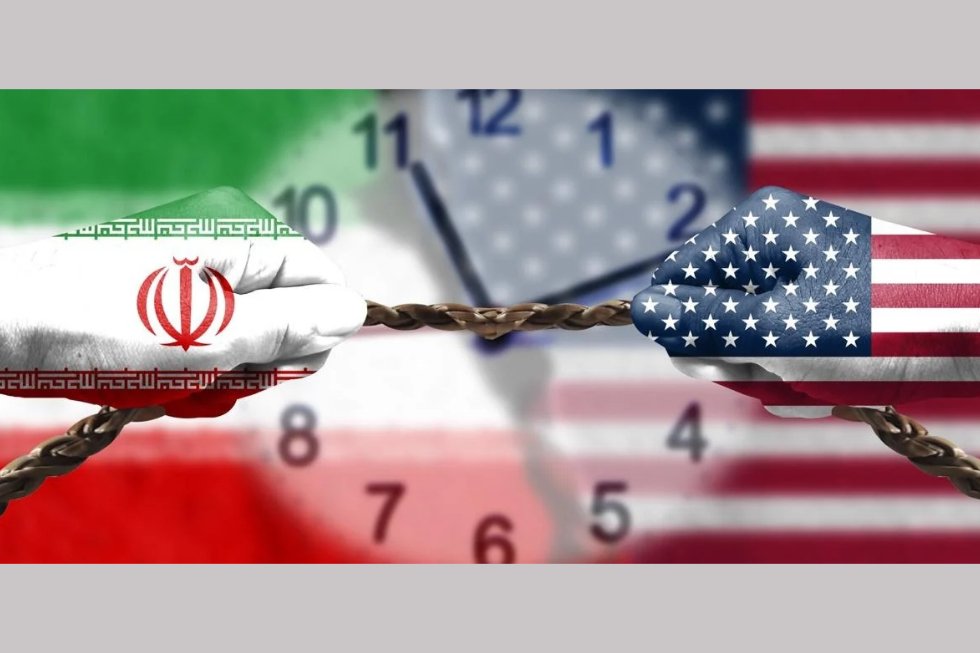


US President Donald Trump’s rejection of Iran’s proposal to conditionally open the Strait of Hormuz is no surprise. In fact, Iran likely expected Mr. Trump to reject it, although the Islamic Republic sweetened the proposal by envisioning a quick return of relatively free navigation through the waterway and an almost immediate negotiation of its nuclear program.
Even so, the proposal served Iran’s purpose. By offering the proposal, Iran projected itself to audiences at home, in the United States and across the globe as the more flexible party willing to return to the negotiating table.
The problem is that there is no chance for constructive negotiation as long as both the Trump administration and Iran refuse to budge from their fundamental positions and strategy since the initial US-Israeli attack on Iran on February 28. If there is one thing Iran and the United States agree on, it’s the belief that the party with the longer breath and the greater ability to suffer pain will ultimately emerge as a winner.
Iran and the Trump administration’s deep distrust of one another reinforces a strategy by both the administration and the Islamic Republic that is centered on securing outcomes upfront and on defeating the other. In doing so, the administration and Iran misread each other’s calculations, risking another round of fighting that both increasingly see as inevitable and expect to strengthen their negotiating position.
The election gamble
The US Congressional midterm elections on November 3 are one core element of the misreading. Iran appears to believe that widespread US popular opposition to the war, higher gasoline and diesel prices, and Mr. Trump’s poor performance ratings put pressure on the president in advance of the elections. The question is whether it does, despite Mr. Trump’s endorsement of candidates and campaigning on behalf of the Republican Party.
More often than not, Mr. Trump has suggested that electoral concerns are not his top priority, arguing that he is not on the ballot. The president has insisted that temporarily higher gasoline prices were a small price for Americans to pay to ensure that Iran will never be able to develop a nuclear weapon. Moreover, rather than working toward an end to the war before the election, Mr. Trump is promising an end after the election.
A zero-sum game
Underlying Mr. Trump’s approach is his misreading of his presidential powers, the powers of his office, and his belief that bullying, coercion, military force and economic strangulation will ultimately produce results.
For its part, Iran is betting on the maxim that air power alone is not enough to secure victory and that Mr. Trump does not have the stomach to put boots on the ground. Leaving aside Iran’s taking note of US concerns that the military has already used much of its ammunition and air defense stockpiles, Iranian officials believe that they would have the upper hand in a ground war, given that Iranian forces would be fighting on their own territory and are more capable of suffering a large number of casualties.
Moreover, Iran sees the war’s impact on global markets and Gulf state economies and its ability to increase the pain as a United States and Gulf state vulnerability. As a result, by approaching their differences as a zero-sum game and insisting that they will not surrender perceived levers of leverage, both the United States and Iran miss opportunities to create off-ramps.
A rethink of strategies
Iran’s insistence on permanent control of the Strait of Hormuz has prevented the Islamic Republic from reaching an agreement with Oman that is acceptable to Gulf states for both a temporary reopening of the Strait of Hormuz and its post-war status.
Similarly, Iran could have boosted the chances of Mr. Trump accepting its most recent proposal to open the Strait had it accompanied its willingness to speed up negotiations on its nuclear program with unambiguous language specifying what it is willing to do and what not. Instead, a senior Iranian official insisted that Iran would show no flexibility over its nuclear program even if the United States accepts its proposal.
The official could have reiterated Iran’s position in past negotiations that it would agree to suspend but not surrender its right to enrich uranium at agreed levels and stockpile it in Iran under supervision of the International Atomic Energy Agency (IAEA). Similarly, Mr. Trump could have sought to inspire confidence by applying a universal standard to nuclear programs in Iran and Saudi Arabia rather than agreeing with the kingdom on terms that are far more permissive.
Without Iranian and US willingness to rethink their strategies, the prospect looms ever larger of a renewed round of fighting that may not bring the warring parties any closer to a resolution.
[The Turbulent World first published this piece on September 27, 2026.]
[Kaitlyn Diana edited this piece.]
The views expressed in this article are the author’s own and do not necessarily reflect Fair Observer’s editorial policy.
Ethnic Strife Looms Large As Trump’s Weighs Options In Iran
Recently, Shiite clerics in Bahrain were arrested, while Baloch and Kurdish religious figures were assassinated in Iran. These events risk...
Closing Hormuz Cost Iran More Than It Bought
For four decades, Iran repeatedly threatened to close the Strait of Hormuz without following through, until February 2026. Before February,...

US vs. Iran: Battle of Wills in the Gulf
The Iran War has inflicted severe economic pain on Iran and political strain on the United States after six months....

Support Fair Observer
We rely on your support for our independence, diversity and quality.
For more than 10 years, Fair Observer has been free, fair and independent. No billionaire owns us, no advertisers control us. We are a reader-supported nonprofit. Unlike many other publications, we keep our content free for readers regardless of where they live or whether they can afford to pay. We have no paywalls and no ads.
In the post-truth era of fake news, echo chambers and filter bubbles, we publish a plurality of perspectives from around the world. Anyone can publish with us, but everyone goes through a rigorous editorial process. So, you get fact-checked, well-reasoned content instead of noise.
We publish 3,000+ voices from 90+ countries. We also conduct education and training programs
on subjects ranging from digital media and journalism to writing and critical thinking. This
doesn’t come cheap. Servers, editors, trainers and web developers cost
money.
Please consider supporting us on a regular basis as a recurring donor or a
sustaining member.
Will you support FO’s journalism?
We rely on your support for our independence, diversity and quality.




Comment