





A genuine Devil’s Advocate spends time poring over the biographies of potential saints to determine whether the exceptionally virtuous life of each candidate reflects a state of grace that will justify designating them officially as examples to emulate. To cross the finish line towards canonization, they must also be accountable for at least two miracles.
In other words, the Devil’s Advocate has little commerce with the devil himself or with people whose demonic behavior marks them as exceptional. You might say the office places the advocate in a bubble of virtue that obscures even awareness of the extent of diabolical doings that characterize much of what appears in the news. That’s why it may sometimes feel refreshing to turn our attention to the dossiers of prominent people who, once subjected to the same kind of scrutiny we apply to saints, might qualify as diabolical or demonic.
If we listen to people like Peter Thiel, J.D. Vance, Mike Pompeo, Steve Bannon, Mike Huckabee or Mike Pompeo, we may come away with the impression that the imaginary forces of Good and Evil are already forming their battle lines and that the expanding conflict in the Middle East is Act I. In 2015, Pompeo, who would subsequently become the first Trump administration’s CIA Director and the Secretary of State, offered this reading of our civilizational drama:
“We will continue to fight these battles. It is a never-ending struggle. Until that moment Pastor Fox spoke about, until the Rapture be part of it, be in the fight.”
In December of last year, Huckabee, the current US ambassador to Israel, proclaimed:
“And things like this, what’s happening right now in Israel is part of the awakening in the last days for many Jewish people to come to faith in Jesus, in Yeshua. So we need to keep praying for the Jewish people. God’s not done with them, He loves them, and He wants us to be instruments of His, in helping to evangelize our brothers and sisters around the world who need Christ.”
He has also called the current hostilities a cosmic conflict “between heaven and hell. Light and darkness. Truth and lies.”
Focusing for once on the demonic
Clearly, multiple devils have been unleashed on the world. It’s time for the Devil’s Advocate to begin looking at some of those cases, just to keep up to speed on how the cosmic struggle is playing out.
Just this week, US Secretary of State Marco Rubio, while visiting Greece, backed up the same reading with a more secular version, but the message seemed to rhyme as he explained that “the story of our civilization is the greatest story ever known to man… a civilization that we must fight to defend today.” Standing on European soil, he made it plain that it’s all about “whether the West maintains its place at the head of the world or resigns itself to a future of atrophy and servitude and decline,” before clarifying that “the United States has made its choice. We choose the unapologetic pursuit of national power.”
So, if it’s about Washington’s “unapologetic pursuit of national power” and occupying a place “at the head of the world,” where does that leave Greece and every other allied country in Europe? Pretty clearly as vassals behind an unapologetic leader in a combat that pits, if not Good against Evil, then at least the “good guys” against the “bad guys.” This is, nevertheless, the same man who last year declared:
“So it’s not normal for the world to simply have a unipolar power. That was not — that was an anomaly. It was a product of the end of the Cold War, but eventually you were going to reach back to a point where you had a multipolar world, multi-great powers in different parts of the planet.”
The author of the article on Responsible Statecraft, Trita Parsi lucidly observes that “It’s not clear how far Rubio has thought this through, and he makes no mention of ending primacy as a grand strategy.” Rubio’s speech in Athens made it clear that primacy is the goal.
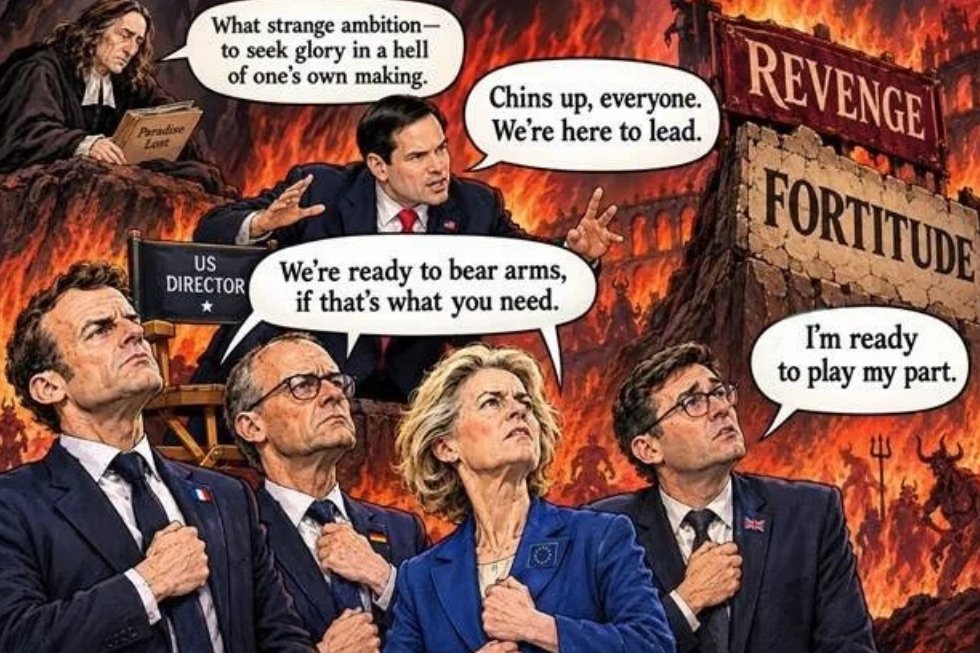
For someone who once specialized in 17th century English literature, it’s difficult not to be reminded of Satan’s obsession with primacy in Paradise Lost:
To reign is worth ambition though in Hell:
Better to reign in Hell, then serve in Heav’n.
But wherefore let we then our faithful friends,
Th’ associates and copartners of our loss
Lye thus astonisht on th’ oblivious Pool,
And call them not to share with us their part
In this unhappy Mansion, or once more
With rallied Arms to try what may be yet
Regaind in Heav’n, or what more lost in Hell?
The “associates and copartners” for Rubio are the European countries called upon to follow the United States “to try what may be yet regained.”
This takes us full circle and raises some interesting questions. Huckabee made it clear that Rubio’s “head of the world” was the side called heaven and its enemies were hell. But Rubio’s language echoes Satan, the master of hell, and not the glorious Christian God Huckabee believes the Jews will now come to embrace. The multipolar world Rubio evokes — but also appears to fear — implies free will for the nations of the world, but his unapologetic nationalism as the head of the head casts the allies as the fallen angels who are sprawled out alongside Satan on the floor of hell.
All this underlines Parsi’s observation that can be applied to all these apocalyptic militants: It’s not clear how anything they affirm has been thought through. One thing is clear, however: The idea of conflict and what Pompeo terms a “never-ending battle” appears to dominate all their thoughts and guide all their actions. Gordon Gekko in the 1987 film, Wall Street, famously told us that “Greed is good.” All Western leaders now seem to agree that “War is good.” The symbolism of an American Secretary of State promoting this fundamental end-of-the-world bellicosity on European soil is revealing.
The European nations’ irreversible abandon of sovereignty
If we’re left asking which side is heaven and which side is hell, we might also wonder what this means for the saints. Who should they be rooting for? Pope Leo and Francis before him, speaking on behalf of the saints, have made it clear. Their tradition established its position dating from its origins: the peacemakers have their vote. We now find ourselves living in a world, presumably dominated by Christian nations, in which, as former US President George W. Bush could declare, “Either you are with us” (in our waging of war) “or you are with the terrorists.” In such a world, what role do the peacemakers have? The official answer has been repeated over and over again. As French President Emmanuel Macron made it clear to Leo during his sojourn in France in September, they are condemned to irrelevance.
It’s a formula that worked during the Cold War. The peacemakers accepted their irrelevance because the “rules-based order” managed to tick over and conflicts emerged only in the “margins of civilization.” We’re living in a different world today. For Europeans, it’s a shock. But having been put to sleep by the routine of a seemingly comfortably managed conformity, the question not just of choosing between heaven and hell but of learning to recognize which is which has come to the fore.
For most Europeans, it still makes no sense. The nonsense has never been more apparent. A pattern has emerged. The elected leaders of our European democracies, within months of their election, have a talent for becoming massively unpopular. Their electorates have finally begun to notice that their leaders’ most significant decisions have amplified the dangers they were intended to address. And this applies to all the critical domains: the economy (uncontrolled debt); the environment, including climate change (Europe is heating faster than the rest of the world); and of course geopolitics, the domain in which kinetic war, the drama that most assuredly defines the boundary between heaven and hell, traditionally plays out. Europe’s voting populations are increasingly inclined to see their leaders as agents of hell, without necessarily understanding why. The leaders themselves don’t seem to understand why or, for that matter, even care. Instead of fulfilling their role as guardian angels of democracy, they increasingly appear as dangerous demons.
The current generation of demons ruling over us have names like Merz, Modi, Macron. Von der Leyen, Starmer, Burnham, Biden. The more extreme cases may be named Trump or Netanyahu. The degree of diabolical intent amongst them varies, but they all appear to be prisoners of the logic expressed by Milton’s Satan.
On the surface, all these leaders claim to be dedicated to promoting great “civilizational” values orientated towards defending the interests of their populations. But instead of striving to fulfill “the will of the people,” when faced with the insurmountable problems they themselves have either contributed to or even created, they appear to believe in the same cause of mobilizing “rallied Arms to try what may be yet Regaind.” Unwilling to admit any of the myriad mistakes that have made their own people suffer, the easiest solution is to preach a crusade against the infidel (anyone who disrespects their carefully crafted “rules-based order”). But crusades and wars work only when the populations believe in the cause, and even then, they tend to fail more often than succeed. The US should have discovered that and retained the lesson with Vietnam. It didn’t. And with the US as “head” of the West (according to Rubio), Satan’s fellow fallen angels have dutifully aligned with their leader.
My severe assessment as Devil’s Advocate may alarm some readers. But an article this week in The Washington Post provides the perfect illustration of the inversion of heaven and hell. It concerns the latest peace proposal for the war in Ukraine, an initiative predictably led by the Trump duo of US Special Envoys Jared Kushner and Steve Witkoff. Here is how the Post summarizes it: “The rationale for this vexed peace initiative draws on the maxim: ‘whenever you run into a problem you can’t solve, make it bigger.’” In a world in which nobody possesses the “superintelligence” required to solve even a minor problem, making the problem bigger means turning an uncomfortable peace into local war by refusing to negotiate and then turning a local war into ever-escalating conflict.
The Post cites a US official who participated in the meeting. “We need to make the problem and the solution bigger to help both sides see what the postwar situation would be — and then make concessions.” Does this make sense? In the minds of Kushner and Witkoff, it worked in Gaza, where the “bigger” response to local conflict was genocide. They reason that, though it may seem extreme, it led to the glorious solution of Trump’s Board of Peace, an instrument not just “to make concessions,” but especially to permit the kind of “concessions” (of property) that real estate professionals savor.
A poetic epitaph
In which European churchyard, following in the footsteps of 18th-century poet Thomas Gray, should we now seek out “Some mute inglorious Milton” who, decades or centuries ago, might have warned us of the “associates and copartners” (of Satan) who would be elected in the 21st century? John Milton himself strove to imagine a future England of “wise and faithful labourers, to make a knowing people, a Nation of Prophets, of Sages and Worthies.” Instead, what the Brits got was a series of neocolonial vassals entertaining themselves by theatrically playing at a comedy called the “coalition of the willing” alongside the towering personalities of Emmanuel Macron and Friedrich Merz (current popularity ratings respectively 15% and 10%).
*[The Devil’s Advocate pursues the tradition Fair Observer began in 2017 with the launch of our “Devil’s Dictionary.” It does so with a slight change of focus, moving from language itself — political and journalistic rhetoric — to the substantial issues in the news. Read more of the Fair Observer Devil’s Dictionary. The news we consume deserves to be seen from an outsider’s point of view. And who could be more outside official discourse than Old Nick himself?]
[Lee Thompson-Kolar edited this piece.]
The views expressed in this article are the author’s own and do not necessarily reflect Fair Observer’s editorial policy.







Join the conversation
Share your perspective
Log in to share your thoughts and take part in the discussion.