


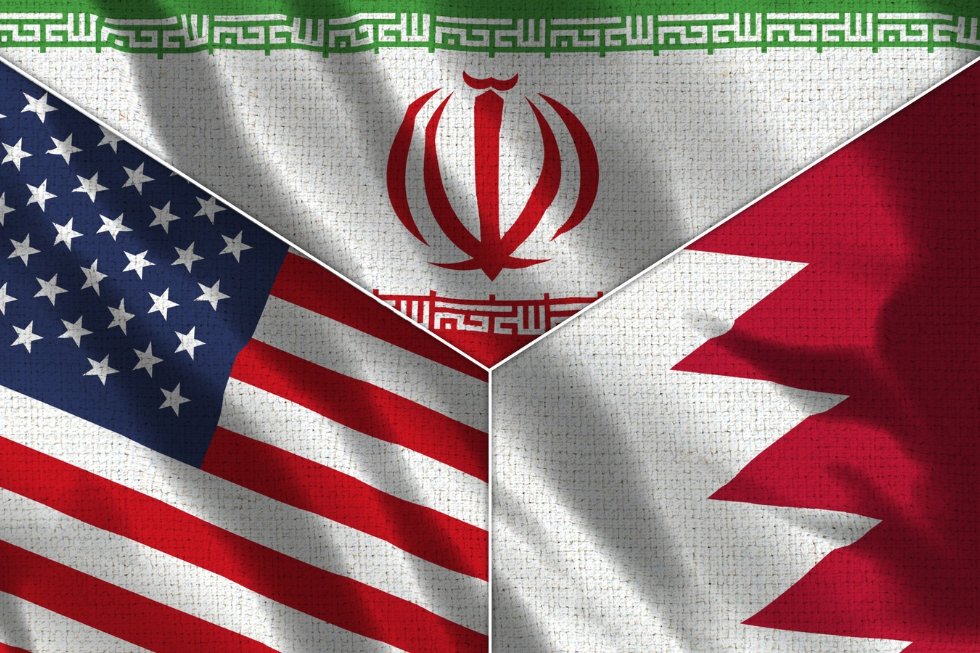


In recent months, Bahrain — the only Gulf state that is home to a Shiite Muslim majority and a prime target of Iranian retaliatory strikes in the Islamic Republic’s on-off tit-for-tat war with the United States — has rounded up scores of religious scholars whom authorities accuse of conspiring with Iran.
The arrests sparked protests and threats by armed Iranian-backed militant groups formed in the wake of mass anti-government protests in 2011, the Arab Spring’s largest in the Gulf, that were squashed by a Saudi-led intervention force. The Armed Conflict Location & Event Data (ACLED) monitoring group said it had counted 125 demonstrations in Bahrain in solidarity with the clerics since their arrest on May 9.
The militants, united under the umbrella of the Islamic Resistance in Bahrain, threatened earlier this month to attack the country’s energy and communication infrastructure if the government failed to release 41 detained clerics and other political prisoners. The Prison Affairs Authority-Bahrain (PAA), a non-governmental organization, reported in April that 251 people had been arrested since the start of the war, often in late-night raids in Shiite villages reminiscent of nighttime house raids in 2011. The government’s crackdown has fueled sectarian tensions, with Shiite and Sunni Muslims denouncing each other online and in person to the authorities.
Shiites have long complained that Bahrain’s ruling Sunni Al-Khalifa family marginalizes them:
The risk is that without a clear change in the Bahraini government’s heavy-handed strategy, the Shiite opposition will continue to face heightened repression and, in turn, become more likely to protest, potentially triggering a wave of demonstrations that test the government’s ability to maintain order.
— ACLED’s unidentified Bahrain researcher.
If Shiite unrest in Bahrain creates opportunity for Iran, minority stirrings in the Islamic Republic’s Kurdish and Baloch provinces threaten the country’s fragile domestic stability and potentially its territorial integrity.
Ethnic insurgency threatens Iran’s stability
Iranian officials have long believed that the United States and Israel want to see the breakup of Iran as a nation-state. The officials point to past US and Israeli backing for Kurdish and Baloch insurgents going back to the 1979 Islamic Revolution. The ethnic minorities’ demography and geography magnify the threat of domestic strife in a destabilized Iran.
Iran’s ethnic and religious minorities account for approximately 43% of the Iranian population. Their strategic importance is highlighted by the fact that minorities straddle the country’s borders: Azeris in the northwest Turkish-Azerbaijani-Iranian triangle, Kurds in the west along the borders with Turkey and Iraqi Kurdistan, Arabs in the southwestern oil-rich province of Khuzestan that straddles the frontier with Iraq, and Baluch along the southeastern border with Pakistan and Afghanistan. Not to mention the Turkmens in the north and the Lors in the south and southwest.
In the latest incident of ethnic violence, unidentified gunmen earlier this month killed prominent pro-government Sunni Muslim Baloch cleric Molavi Yousef Gorgij, the Friday prayer leader of the Mohammad Rasoulallah Mosque in Zahedan, the capital of predominantly Baloch Sistan and Balochistan Province. Mr. Gorgij’s killing followed the assassination in July of another Sunni Baloch pro-government cleric, Molavi Mohammad Anvar Rigi, a Sunni Friday prayer leader in the southeastern Iranian border town of Mirjaveh.
A recently formed alliance of Baluch militants — the Popular Fighter Front — fought pitched battles earlier this month with Iran’s Islamic Revolutionary Guard Corps (IRGC) in Saravan in Sistan and Balochistan. The Front was established in December by Jaish al-Adl (the Army of Justice). Jaish al-Adl is a US-designated Pakistan-based group that traces its roots to Saudi-backed anti-Shiite groups in Iran with a history of attacking Iranian security forces and other Baloch groups that have jihadist antecedents.
Sistan and Balochistan borders the restive Pakistani province of Baluchistan. Sistan and Balochistan and Baluchistan both host armed Baloch groups, eager to take advantage of opportunities created by the Iran war and Pakistan-Afghanistan border skirmishes, with the international community’s attention focused on the Strait of Hormuz and the Bab al-Mandeb waterway.
Afghan politician and analyst Ajmal Sohail reported that the Taliban were reviving Jaish al-Adl’s predecessor, Jundallah, to destabilize Sistan and Balochistan. Mr. Sohail, quoting an official Taliban document, said the Taliban had nominated Baloch cleric Mawlawi Abdul Ghafar Naqshbandi to lead Jundallah and were supplying him with arms.
Mr. Naqshbandi attracted international attention in late 2022, when he accused a local Iranian police commander of raping a 15-year-old girl. His allegations triggered mass protests in Zahedan, in which security forces killed some 100 protesters. A former Friday prayer leader in the predominantly Baloch city of Rask, Mr. Naqshbandi has since fled Iran to Afghanistan.
Iran’s mass deportations of Afghan nationals and harsh border crackdowns, as the country struggles economically because of the war with the United States, have strained relations between the Islamic Republic and Afghanistan. The pattern of Baloch violence is also evident with the Kurds.
Unidentified gunmen killed Mamosta Mohammad Nezhati, a pro-government Sunni Kurdish cleric and prayer leader in the town of Piranshahr who maintained close ties to the Basij, a voluntary paramilitary militia under the command of the IRGC, in West Azerbaijan Province, days before Mr. Gorgij’s assassination. West Azerbaijan borders Iraq’s Kurdish autonomous region. The IRGC, days after Mr. Nezhati’s assassination, blamed Kurdish opposition groups for the death of Eslam Kak Darvishi, an IRGC operative, in predominantly Kurdish Piranshahr County.
Kurdish vulnerability and US withdrawal
Meanwhile, continued Iranian strikes against Iranian Kurdish bases and refugee camps in autonomous Iraqi Kurdistan could persuade the Kurds to abandon their caution as they become more vulnerable with the withdrawal of US forces from Iraq by the end of this month. The withdrawal means the Kurds will no longer enjoy the protection of US air defense systems.
Iranian Kurds have been reluctant to take advantage of the Iran war to attempt to carve out an autonomous region of their own in Iran, despite Israeli and US prompts and offers of support. Iranian Kurdish leaders fear that they would be going out on a limb with no guarantee that the United States and/or Israel would stay the course. However, Iranian Kurds are increasingly caught in a Catch-22.
Under pressure from Iran and exposed by the US withdrawal, Iranian Kurds fear that their presence in Iraqi Kurdistan may have become more precarious with the recent integration of the predominantly Kurdish Syrian Democratic Forces into the Syrian military. With Syrian President Ahmed al-Sharaa pushing to integrate the Kurds into a unified Syria, the dream of a self-governing Kurdish state in the northeast of the country has all but come to an end. Iraqi Kurds worry that this could be their future too, with the Iraqi government in Baghdad looking to Syria as a potential model.
Trump’s decisive role
In the ultimate analysis, US President Donald Trump may determine which way the wind blows for both Iran and its ethnic minorities. Mr. Trump has twice suggested in 72 hours that he was weighing a return to all-out war with Iran.
On Tuesday, Mr. Trump plans to solicit the views of Gulf leaders with whom he is scheduled to meet in New York on the sidelines of the United Nations General Assembly. The leaders are likely to pressure Mr. Trump to seek a diplomatic off-ramp rather than escalate hostilities. If Mr. Trump disregards their advice, reignites his bombing campaign and eventually commits ground troops, he could see Kurds, Baloch and other ethnic militants as a pillar of a potential ground offensive.
[The Turbulent World first published this piece on September 21, 2026.]
[Kaitlyn Diana edited this piece.]
The views expressed in this article are the author’s own and do not necessarily reflect Fair Observer’s editorial policy.
Iran Turns Kurdistan Region Into a Proxy Battlefield
The Kurdistan Region of Iraq (KRI) has faced relentless attacks from Iran and its proxies, despite its declared neutrality in...
How the US–Israel–Iran War Costs the Gulf States
The US-Israeli attacks on Iran have placed the Gulf states, particularly the Gulf Cooperation Council members, in a precarious position....
The Road to Quagmire in Iran: Why Arming the Kurds Risks Destabilizing the Region
The US-Israeli bombing campaign against Iran risks escalating into a dangerous attempt at regime change. Arming Kurdish groups could destabilize...
Support Fair Observer
We rely on your support for our independence, diversity and quality.
For more than 10 years, Fair Observer has been free, fair and independent. No billionaire owns us, no advertisers control us. We are a reader-supported nonprofit. Unlike many other publications, we keep our content free for readers regardless of where they live or whether they can afford to pay. We have no paywalls and no ads.
In the post-truth era of fake news, echo chambers and filter bubbles, we publish a plurality of perspectives from around the world. Anyone can publish with us, but everyone goes through a rigorous editorial process. So, you get fact-checked, well-reasoned content instead of noise.
We publish 3,000+ voices from 90+ countries. We also conduct education and training programs
on subjects ranging from digital media and journalism to writing and critical thinking. This
doesn’t come cheap. Servers, editors, trainers and web developers cost
money.
Please consider supporting us on a regular basis as a recurring donor or a
sustaining member.
Will you support FO’s journalism?
We rely on your support for our independence, diversity and quality.





Comment