






Wars are no longer confined to the battlefield, nor are they declared in the traditional sense. As ancient Chinese strategist Sun Tzu observed, “The supreme art of war is to subdue the enemy without fighting.” Today, that principle is being operationalized through artificial intelligence, cyber operations and information warfare on a global scale.
Empirical evidence increasingly supports this shift: According to Microsoft’s Digital Defense Report (2024), state-linked cyberattacks against critical infrastructure and government systems have risen sharply since 2022, with Ukraine consistently ranking among the most targeted countries in the world.
Russia’s war against Ukraine has become the clearest illustration of this transformation. Alongside conventional artillery and trench warfare, Ukraine has faced sustained cyberattacks on its infrastructure, AI-assisted targeting through drones and satellite intelligence, and continuous information operations aimed at weakening domestic and Western political cohesion.
At the same time, the conflict has turned Ukraine into a laboratory for digital warfare — where open-source intelligence, commercial satellite data and rapidly evolving drone technologies are reshaping how wars are fought and observed in real time. Studies of the conflict also indicate that commercial satellite imagery and open-source intelligence now compress battlefield information cycles from days to hours, fundamentally changing operational decision-making.
How states are adapting
But this is not an isolated theater. Across Europe, Russian-linked hybrid activity continues to target critical infrastructure, political processes and public trust. From cyberattacks on logistics and energy systems to disinformation campaigns designed to exploit social divisions, the objective is not territorial conquest but strategic exhaustion: the gradual erosion of political cohesion within NATO and the European Union.
Simultaneously, the United States and China are locked in a systemic technological rivalry that increasingly defines global power. Export controls on advanced semiconductors, competition over AI governance standards and the militarization of digital infrastructure in the Indo-Pacific reflect a broader shift: control over compute power, data flows and critical technologies is becoming as strategically significant as control over territory once was.
In the Middle East, the Israel–Hamas war and wider regional tensions have further demonstrated how information warfare and digital mobilization now operate in parallel with kinetic conflict. Narratives spread across social media platforms in real time influence diplomatic positioning, domestic legitimacy, and escalation dynamics between regional and global actors. Research on recent conflicts shows that viral information that spreads on social platforms can reach global audiences within minutes of events unfolding, often shaping perception before verified reporting becomes available.
Within this global environment, the Euro-Atlantic order faces a structural challenge. NATO is not only responding to Russia’s conventional threat on its eastern flank; it is also adapting to a persistent gray-zone contest that spans cyber defense, critical infrastructure protection, election security and technological sovereignty. The European Union, meanwhile, is attempting to regulate and govern the same digital ecosystem that is increasingly being used as a domain of strategic competition.
War has changed
Artificial intelligence intensifies all of these dynamics. It lowers the cost of disinformation, accelerates cyber operations, enhances autonomous military systems and compresses decision-making cycles in ways that strain traditional deterrence models. In effect, AI does not merely support hybrid warfare — it scales it.
Sun Tzu’s insight therefore feels less like ancient philosophy and more like contemporary geopolitics made explicit. The most effective form of conflict today is not necessarily destruction, but disruption: undermining trust in institutions, fragmenting alliances and shaping perceptions faster than democratic systems can respond.
The central strategic question for the Euro-Atlantic community is no longer whether hybrid warfare exists — it demonstrably does. The question is whether liberal democracies can sustain cohesion, technological parity and strategic clarity in an international system where conflict is continuous, attribution is difficult and the line between peace and war has effectively dissolved.
[Casey Herrmann edited this piece]
The views expressed in this article are the author’s own and do not necessarily reflect Fair Observer’s editorial policy.
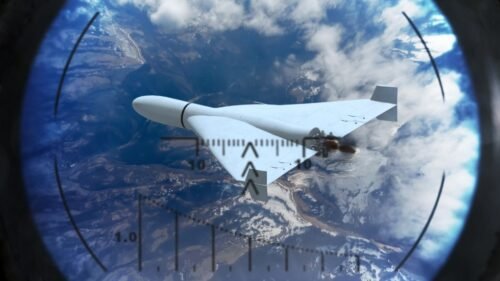
The Future of AI-Enabled Drone Warfare After the US–Iran Conflict
Technology has always outrun the laws of war, and AI-enabled drones are no different. The recent US–Iran conflict produced 13,000...
Ukraine at the Frontline: Russia’s Hybrid War and the Euro-Atlantic Order
Russia’s assault on Ukraine is a multifaceted hybrid strategy aiming to undermine the Euro-Atlantic order by blending military force with...
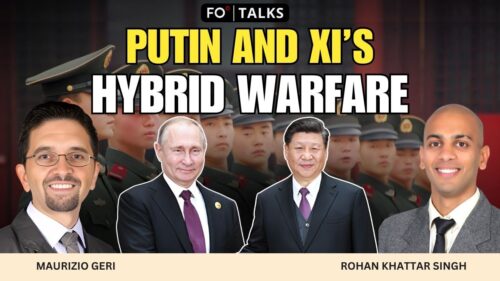
FO° Talks: Russia and China’s Hybrid Warfare Explained | What Are NATO and the EU’s Options?
In this episode of FO° Talks, Rohan Khattar Singh and Maurizio Geri examine how Russia and China use hybrid warfare...
Support Fair Observer
We rely on your support for our independence, diversity and quality.
For more than 10 years, Fair Observer has been free, fair and independent. No billionaire owns us, no advertisers control us. We are a reader-supported nonprofit. Unlike many other publications, we keep our content free for readers regardless of where they live or whether they can afford to pay. We have no paywalls and no ads.
In the post-truth era of fake news, echo chambers and filter bubbles, we publish a plurality of perspectives from around the world. Anyone can publish with us, but everyone goes through a rigorous editorial process. So, you get fact-checked, well-reasoned content instead of noise.
We publish 3,000+ voices from 90+ countries. We also conduct education and training programs
on subjects ranging from digital media and journalism to writing and critical thinking. This
doesn’t come cheap. Servers, editors, trainers and web developers cost
money.
Please consider supporting us on a regular basis as a recurring donor or a
sustaining member.
Will you support FO’s journalism?
We rely on your support for our independence, diversity and quality.





Comment