


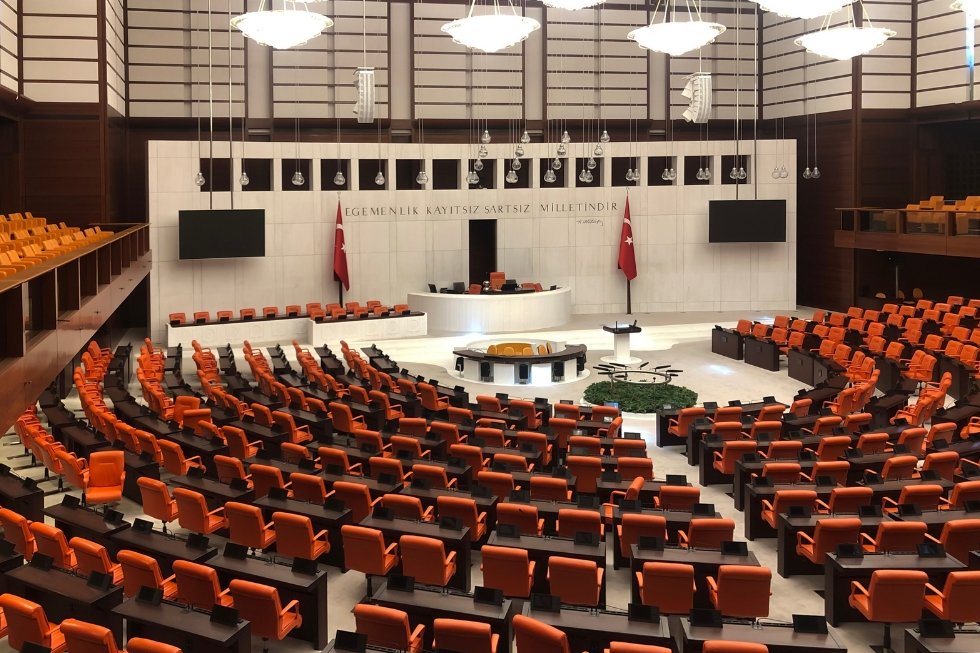



A very significant development took place in Turkey recently. A crucial law was passed as part of the process that began a year ago, aiming to dissolve the Kurdistan Workers’ Party (PKK), thereby ensuring a political resolution to the Kurdish issue in Turkey. The draft law followed months of work by a commission of lawmakers from various political parties. The Grand National Assembly of Turkey (TBMM) finally passed it on August 10, with 467 votes in favor and 87 against. This law, commonly referred to as the “Framework Law,” is officially titled the “Law on Strengthening National Solidarity and Social Integration.”
Consisting of 12 articles, it essentially revolves around: a) exempting tens of thousands of people against whom investigations are ongoing due to PKK membership from prosecution; b) securing the release of convicts and detainees currently in prison due to PKK membership; and c) paving the way for individuals currently abroad due to PKK membership to return to Turkey. The law has three key provisions.
First, investigations and prosecutions for crimes related to PKK membership that carry a maximum sentence of 15 years or less of imprisonment will be deferred for five years. Investigations and prosecutions for crimes carrying a sentence of more than 15 years of imprisonment, life imprisonment or aggravated life imprisonment will be deferred for 10 years.
Second, the crime of intentional homicide committed as part of PKK activities, as well as crimes committed before June 1, 2005, that carry a sentence of life imprisonment or aggravated life imprisonment, are excluded from this provision.
Third, a high-level commission, chaired by the vice president — who will oversee the PKK’s disarmament and integration process and may request the enactment of necessary new legislation — will be established, and numerous subcommissions will be formed under it.
Öcalan’s possible political role
According to media reports, under this law, nearly 4,000 prisoners and detainees will be released. Among them is, of course, Selahattin Demirtaş, the former co-chair of the Peoples’ Democratic Party (HDP) and one of the most prominent figures among Kurdish politicians. This law will affect some 75,000 ongoing investigations and prosecutions related to the PKK and similar charges, along with nearly 50,000 confidential investigations. Furthermore, thousands of Kurdish activists and politicians currently abroad will be able to return home. As a result, this new legal framework will directly affect more than 100,000 people.
However, the founder of the PKK, Abdullah Öcalan — who has been imprisoned on Imrali Island since 1999, serving a life sentence, and is among the key actors in the peaceful resolution of the Kurdish issue — is excluded from the scope of this law. At the same time, hundreds of individuals holding leadership positions within the PKK are also ineligible to benefit from this law. It appears that both the Kurdish side and the state have agreed to spread this out over time, taking such critical steps one by one in the coming months or years.
According to another news report, Öcalan is expected to head the subcommittee on disarmament and political integration that is to be established. If this happens, Öcalan will attain an official status recognized by the state for the first time. Öcalan’s transition from being labeled a “terrorist leader” and “baby killer” to holding an official status within the bureaucracy can be seen as clear evidence of the state’s strong determination to resolve the Kurdish issue.
For these provisions to be implemented, the PKK and all groups affiliated with it must be dissolved; the commission must confirm that all weapons in their possession have been surrendered; and this must be announced by the state and made official. The high-level commission overseeing this process convened recently and is working to ensure the necessary steps are taken so that the process proceeds without a hitch.
It appears that the official step required for this law to take effect — namely, the state’s declaration that the PKK has been dissolved — will take place in the coming months, provided, God forbid, there are no provocations or adverse developments that could derail the process. This declaration will also eliminate the legal basis for accusing Kurdish politicians of “separatism” and subjecting them to prosecution, thereby broadening the scope for political activity.
Reactions to the peace process
There are three distinct reactions to this law. First, one can claim that the majority of the Turkish and Kurdish populations unconditionally support the bill and view it as a significant step toward a peaceful resolution of the Kurdish issue. This group includes people from various ideological backgrounds — democrats, Muslims, religious conservatives, nationalists and leftists.
In addition to the ruling party lawmakers who voted in favor of the bill’s passage in Parliament, along with their allies in the Nationalist Movement Party (MHP) and the pro-Kurdish Peoples’ Equality and Democracy Party (DEM) lawmakers, there are also lawmakers from the main opposition Republican People’s Party (CHP) — which split into two separate parties last month — and the New Party (YENİ). Consequently, it can be said that this legislative amendment is supported by a broad political spectrum.
The second type of reaction comes from groups that support this process but criticize the enacted law for various reasons. This reaction consists primarily of experts, academics, politicians and journalists who are closely following the issue.
The third reaction, however, comes from groups that are opposed not only to this specific law but to the entire process that has begun. In terms of political parties, the Good Party (İYİ) — founded by politicians who broke away from the MHP, which has a parliamentary group — and the Zafer Party, which has gained prominence for its opposition to Syrian refugees in Turkey, are at the forefront of this movement. Of course, this camp is not limited to voters of these two parties. Another segment voted for pro-process parties in previous elections but now opposes this course. One could say the primary factor uniting them is a shared concern about Turkish identity.
This group — which can be described as the Kemalist and secular opposition — understands that a political resolution to the Kurdish issue will ultimately lead to demands for the legal recognition of Kurdish identity, which they view as a threat to Turkish identity. To prevent such a development, they rely on the argument that the half-century-old narrative regarding the PKK is structural and immutable.
In their view, generally speaking, “sitting down at the negotiating table with Abdullah Öcalan and PKK leaders to resolve the Kurdish issue is absolutely unacceptable, because these individuals are terrorists forever, and one must always fight terrorists—not negotiate with them.” This stance is, in a sense, akin to telling an organization that says, “I am laying down my arms,” “No, you cannot lay down your arms.” The desire, in fact, is for the status quo regarding the Kurdish issue to continue as it has until now, for the current order to persist unchanged.
Although such objections are raised, this process, which aims to resolve the Kurdish issue on a political basis through the dismantling of the PKK, continues thanks to the strong will of the parties involved. Certainly, a strong will alone is not enough for this process to conclude successfully. Other factors — goodwill and trust — are just as important. When the “peace process” collapsed in 2015, we saw that what was actually missing was mutual trust.
On the other hand, those who follow the process with optimism worry that it, despite beginning with good intentions, might be derailed by provocation or other unforeseen factors. These people watch the process with bated breath, fearing that something bad might happen at any moment. The beautiful dream that this senseless armed conflict — which has continued for so many years and caused the deaths of thousands of people — might finally come to a peaceful end forms the core motivation behind this anxiety.
Of course, one could argue that the most significant factor that could harm this process is ethnic nationalism. This is characterized by exclusionary, divisive rhetoric that can easily devolve into chauvinism. In this regard, in addition to the extreme Turkish nationalist faction mentioned above — which opposes this process aimed at resolving the Kurdish issue peacefully — certain forms of radical Kurdish nationalism have similarly resisted this process. Furthermore, actions within the Kurdish community that evoke the idea of an independent Kurdistan may well trigger a backlash within Turkish society and harm the process.
Kurds and regional integration
Meanwhile, developments on the Kurdish issue are not limited to Turkey. On August 25, Mazloum Abdi, a leading figure among Syrian Kurds and leader of the Syrian Democratic Forces (SDF), announced that the SDF’s integration into the Syrian army was complete and that the organization had been dissolved. Turkey supported this policy from the beginning, and US Ambassador to Turkey and Special Representative for Syria and Iraq Tom Barrack played a major role in bringing it about. Consequently, it can be said that the US supports efforts aimed at enabling Kurds in the region to attain legal status within nation-states.
In short, aside from the Hormuz crisis, developments in Middle Eastern politics — particularly involving Turkey — could be described as radical. According to news reports, a house is also being built on Imralı Island for Abdullah Öcalan, where he is currently detained. The process is continuing amid Turkey’s other pressing issues.
The parallel moves in Turkey and Syria suggest a broader, coordinated effort to redefine the role of Kurds within existing state structures, moving away from armed confrontation toward political integration. However, the path forward remains fraught with challenges. As Turkey and the region enter this uncharted territory, the world watches closely, hoping these radical developments will lead to lasting peace and a more inclusive future for all. The agenda is packed, and there are breaking developments every day. Stay tuned…
The views expressed in this article are the author’s own and do not necessarily reflect Fair Observer’s editorial policy.
A New Peace Process in the Kurdish Question in Turkiye
Turkish politics faces a historic shift as Kurdish leaders, state officials and nationalist figures seek an end to decades of...
Making of a Dictator: What the PKK’s Surrender Means for Turkey
On March 1, the insurgent Kurdish Workers’ Party (PKK) unilaterally announced that it was laying down arms against the Turkish...

The Syrian Revolution Is a Big Opportunity for Turkey
Turkey’s strategic influence in Syria has grown after dictator Bashar al-Assad’s fall, with cautious gains amid past setbacks. Turkish President...
Support Fair Observer
We rely on your support for our independence, diversity and quality.
For more than 10 years, Fair Observer has been free, fair and independent. No billionaire owns us, no advertisers control us. We are a reader-supported nonprofit. Unlike many other publications, we keep our content free for readers regardless of where they live or whether they can afford to pay. We have no paywalls and no ads.
In the post-truth era of fake news, echo chambers and filter bubbles, we publish a plurality of perspectives from around the world. Anyone can publish with us, but everyone goes through a rigorous editorial process. So, you get fact-checked, well-reasoned content instead of noise.
We publish 3,000+ voices from 90+ countries. We also conduct education and training programs
on subjects ranging from digital media and journalism to writing and critical thinking. This
doesn’t come cheap. Servers, editors, trainers and web developers cost
money.
Please consider supporting us on a regular basis as a recurring donor or a
sustaining member.
Will you support FO’s journalism?
We rely on your support for our independence, diversity and quality.





Comment