


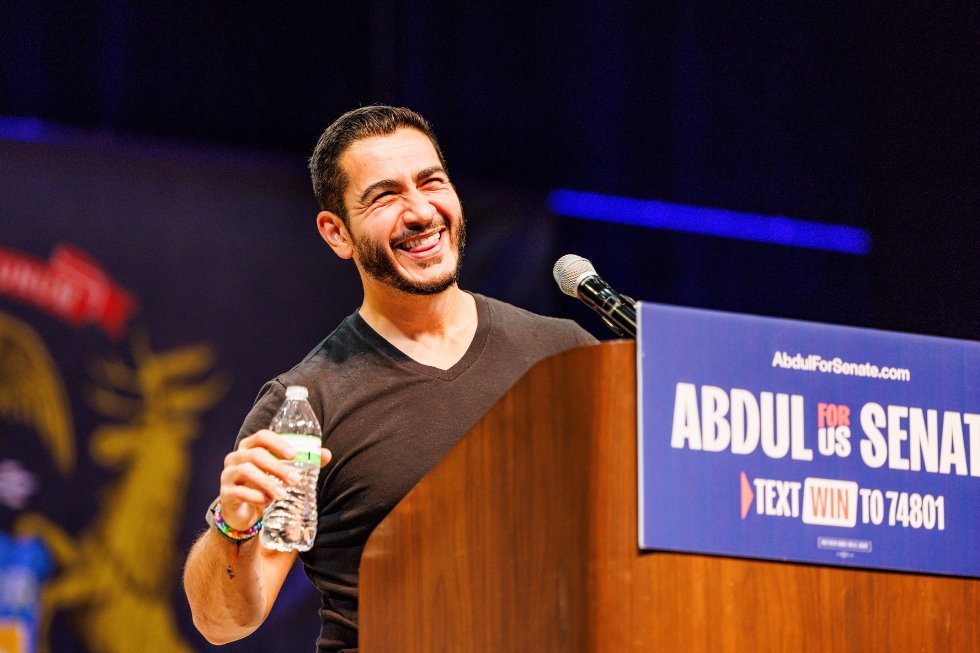


When Abdul El-Sayed won Michigan’s Democratic Senate primary this month, my first reaction was surprise. My second was dread. Surprise, because a Muslim American with an unmistakably Arab name and an unapologetically pro-Palestinian record had won a statewide primary in a swing state. He ran well to the left of the Democratic establishment without hiding who he is. Dread, because I already knew what was coming.
Sure enough, it came within hours. The National Republican Senatorial Committee’s (NRSC) first attack ad opened not with “Abdul El-Sayed” but with “Abdulrahman Mohamed El-Sayed”. It deployed his full name the way “Barack Hussein Obama” once was, making a familiar face sound foreign. Senate Majority Whip John Barrasso called him dangerous and extremist from the Senate floor.
Hatem Bazian, a scholar of Islamophobia at the University of California, Berkeley, said he’d seen this playbook before, comparing it to the 2008 conspiracy theories that Obama was secretly Muslim. Run an actual Muslim candidate who criticizes Israeli policy, Bazian said, and the terrorism associations follow automatically.
I don’t think that’s a controversial thing to say. It’s also not the whole story, and El-Sayed’s admirers do him no favors by pretending it is.
Why El-Sayed?
Here’s the case for him, briefly: The Democratic Socialists of America (DSA) is a real organization, not just a Republican slur. It has actual dues-paying members and a platform built on public ownership and treating capitalism itself, not just its excesses, as the problem. El-Sayed has real ties to it. He spoke at DSA events for years. Detroit organizers still call him a longtime friend. But he is not a dues-paying member and was not on the DSA’s own national endorsement list. He even insists on the distinction: “I’m not technically or practically DSA,” he told The Wall Street Journal. Instead, he believes that capitalism shouldn’t determine access to the essentials of a decent life, healthcare chief among them. In short, he believes that capitalism needs regulating, not replacing.
His actual program is closer to muscular social democracy than to anything that should alarm a normal Michigan voter: Medicare for All, stronger unions, higher taxes on the wealthy, a fight against corporate concentration. He beat Representative Haley Stevens, who had the institutional money and machine behind her. He did it by rebuilding the Sanders coalition: unions, young voters, the grassroots left. And it worked. By the “Sanders coalition,” I mean Bernie Sanders’s base of younger voters, organized labor, working-class progressives and small-dollar donors. They were united around Medicare for All, economic inequality and hostility to corporate influence in politics. Sanders never converted that movement into the Democratic nomination, but the coalition and the political infrastructure around it survived him.
Now he has to do it again, statewide, in a state that went for US President Donald Trump twice in three tries.
Where he creates his own problems
His opponent is Mike Rogers, a former Federal Bureau of Investigation (FBI) agent and congressman. Rogers didn’t waste time. Within days of the primary, he released a video pitching disillusioned Stevens voters directly, telling them there’s “still hope.” El-Sayed has hit back, calling Rogers beholden to corporate interests and someone who has spent his career trying to “lick every single boot Donald Trump owns.” AIPAC’s super PAC spent nearly $30 million against El-Sayed in the primary. It isn’t done either, vowing to make sure voters reject what it calls his “radical anti-Israel agenda” in November.
Here is where I start to worry about El-Sayed on his own terms, apart from what his opponents are doing to him. In April, on a podcast, El-Sayed went after US Vice President JD Vance, pointing out that Vance’s wife is the daughter of Indian immigrants and their children are biracial. He even used the phrase “Brown kids.” How, he asked, does Vance square that with a politics that treats people like his own family as less American? Then he speculated that Vance’s children might grow up to reject their father, and told their mother, Usha Vance, to “get out.” That’s not a critique of hypocrisy anymore. That’s dragging children into a fight they didn’t choose.
I keep coming back to this because it previews what worries me most about El-Sayed: He likes a fight, maybe too much. In an era when Democratic politicians often sound like six consultants have cleared every sentence, his spontaneity and sharpness are genuinely refreshing.
El-Sayed’s willingness to campaign alongside Hasan Piker presents a different problem altogether.
The controversial left-wing streamer gives him access to millions of young voters, but also saddles him with some extraordinarily inflammatory political baggage. Piker has called Chinese Leader Mao Zedong one of history’s great leaders, apparently untroubled by the tens of millions who died under the disastrous policies of Mao’s rule. El-Sayed has disavowed Piker’s “America deserved 9/11” line. He has not, as far as I can tell, drawn an equally hard line around the Mao worship. Even if he doesn’t, Republicans will spend three months making this race about Mao instead of about the thing that’s actually interesting: what El-Sayed believes about American power.
What he actually believes is more coherent than his critics allow. He opposes military aid not just to Israel but to Egypt, Jordan, Pakistan, Saudi Arabia, the UAE and Qatar — a list that includes his own ancestral country. That’s worth sitting with.
The politics beneath the controversy
It’s easy to dismiss “Israel skepticism” from a Muslim candidate as identity politics by another name; it’s harder to dismiss a standing rule that judges Cairo’s human-rights record the same way it judges Jerusalem’s. I don’t agree with cutting off Egypt or the Gulf states wholesale. That aid buys real influence and serves real American interests. But asking why Michigan sends billions abroad while Detroit’s roads fall apart is a legitimate populist question.
The parts of the case against him that aren’t Islamophobia deserve to be named just as clearly as the parts that are. Federal Election Commission (FEC) records show at least 41 donors connected to the Council on American-Islamic Relations (CAIR) — the country’s largest Muslim civil rights and advocacy organization. His own father-in-law gave more than $100,000 to his campaign. Whether it means anything depends on what you think CAIR is: A federal court named the group an unindicted co-conspirator in a 2007 terrorism-financing case. CAIR has never been charged with a crime since. It also disputes the “Hamas front” label outright. I’d want a lot more before calling that disqualifying.
El-Sayed should also have to answer for his response to the March attack on Temple Israel in West Bloomfield. After Ayman Ghazali rammed a truck into the synagogue and opened fire, El-Sayed condemned the attack but then sought to explain it through the violence Ghazali’s family had suffered in Lebanon, invoking the maxim that “hurt people hurt people.” Ghazali had lost relatives in an Israeli airstrike days earlier, including a brother whom Israel identified as a Hezbollah commander. El-Sayed’s larger point was that violence abroad can breed retaliatory violence at home. But in making it, he risked drawing a causal line from Israeli military actions to an attack on American Jews who had nothing to do with them.
That distinction matters: Explaining how a man came to attack a synagogue is legitimate; appearing to shift part of the moral explanation from the attacker to Israel, while the victims were Michigan Jews, is considerably more troubling.
None of that makes him a radical muslim, a phrase I find nearly meaningless applied to a man with an M.D. from Columbia and a doctorate from Oxford who spent his career running public-health departments in Detroit. And skepticism of aid to Israel specifically isn’t even radical anymore. Recent polling puts most Democratic voters there too, well ahead of a party leadership still committed to the old consensus. What’s actually further out than his party’s rank and file is the sweep of his position: he applies the same standard to Cairo, Amman, Islamabad, Riyadh and Abu Dhabi that most Democrats now reserve for Jerusalem alone. He wants aid ended outright rather than merely conditioned. Conflating that with his faith is precisely the trick his harsher critics are playing, and it works because it’s easier than arguing with him about aid to Egypt.
What I keep landing on is this: El-Sayed has the raw material to be something genuinely new.
The bigger question
He’s a Muslim American who can talk about Islamophobia without playing the victim, about Palestine without excusing the region’s autocrats and about immigration without treating this country as a shameful place to have landed. His economics reach people who couldn’t find Gaza on a map but care very much about their premiums. That combination is rarer in Democratic politics than it should be.
Whether he gets there depends on him, not the NRSC. Leave the Vance kids alone. Put real distance between himself and Mao worship. Answer the questions about CAIR and the synagogue attack directly. El-Sayed will encounter genuine Islamophobia, and he should call it out without hesitation. But legitimate scrutiny of his record is not the same thing as anti-Muslim bigotry. Sometimes the charge will be warranted; sometimes it won’t. Conflating the two risks costing him the very credibility he needs. Do that, and he becomes a lot harder to caricature.
I don’t know if Abdul El-Sayed is the Muslim politician America needs. I think he might be evidence of something the Democratic Party needs more — proof that you can run well to the left on economics, criticize Israel without curdling into antisemitism, keep an immigrant name and a Muslim faith intact and still win in the industrial Midwest. Michigan will tell us in November. I’ll be watching. So, I suspect, will a lot of people who don’t usually pay attention to Senate races.
[Yasmine Haji edited this piece.]
The views expressed in this article are the author’s own and do not necessarily reflect Fair Observer’s editorial policy.
How Democracies Traded Political Expertise for Incompetence
Voters across the Western world have grown disillusioned with experienced political leaders and turned toward outsiders promising a break from...
A Disgruntled South Carolinian’s Breakdown of South Carolina’s Republican Senate Runoff
After Senator Lindsey Graham’s death in July 2026, South Carolina held a special primary to fill his seat. This race...

Support Fair Observer
We rely on your support for our independence, diversity and quality.
For more than 10 years, Fair Observer has been free, fair and independent. No billionaire owns us, no advertisers control us. We are a reader-supported nonprofit. Unlike many other publications, we keep our content free for readers regardless of where they live or whether they can afford to pay. We have no paywalls and no ads.
In the post-truth era of fake news, echo chambers and filter bubbles, we publish a plurality of perspectives from around the world. Anyone can publish with us, but everyone goes through a rigorous editorial process. So, you get fact-checked, well-reasoned content instead of noise.
We publish 3,000+ voices from 90+ countries. We also conduct education and training programs
on subjects ranging from digital media and journalism to writing and critical thinking. This
doesn’t come cheap. Servers, editors, trainers and web developers cost
money.
Please consider supporting us on a regular basis as a recurring donor or a
sustaining member.
Will you support FO’s journalism?
We rely on your support for our independence, diversity and quality.





Comment