





US President Donald Trump has long held that NATO was costing the US “too much money.” As a presidential candidate in 2016, he pointed out that “NATO was set up when we were a richer country” and the time had come for Europe to share more of the costs of this longstanding alliance. In his second term, Trump has ratcheted up the pressure on America’s NATO allies. He has announced troop withdrawals, cut off military support for Ukraine and lashed out at leaders of America’s closest allies.
Trump is unique in his capriciousness and brashness, but misgivings about the US carrying the water for Europe predate him. For years, many American strategists have believed that the American focus on Europe was outdated. The rise of China necessitated a new strategy. Barack Obama tried to do so with his Asia Pivot, which never really took off and is now certainly on the back burner. The US is now yet again trapped in the Middle East, and the war with Iran is sharpening tensions with both European and East Asian allies.
Trump called NATO a “paper tiger” that “wasn’t there for us” and threatened to pull out of the alliance. Yet NATO is not going anywhere. Trump did attend the NATO summit in Ankara, where 32 NATO heads of state and key partners gathered for the alliance’s thirty-sixth summit. Trump did a U-turn, called NATO leaders smart and took credit for NATO countries spending more on defense. In doing so, Trump underscored Under Secretary of War for Policy Elbridge Colby’s concept of NATO 3.0. According to this concept, America’s European allies need “to step up and assume primary responsibility for the conventional defense of Europe.”
How big of a burden is NATO to the US?
The US has clearly been the dominant figure in NATO. Its GDP is 50% of the entire GDP of the NATO bloc (vs. 33% for the EU members). Of all NATO countries’ defense spending, the US accounts for 60–64% of NATO’s total. This is indeed much more than any other single NATO member state pays but far short of Trump’s claim that the US once shouldered 100% of the NATO budget. His perception that “we have been treated unfairly, we pay disproportionately” is exaggerated, and the 100% claim is false.
Digging deeper into the numbers reveals clearly that only some of the US defense spending is for Europe: A lot of American spending on NATO has little to do with Europe. Instead, this money funds the role the US plays as a global power. Historically, the cash that flowed into NATO was used for wars in Vietnam, Iraq, Afghanistan, etc, which were American, not European, wars. If we strip these expenses out, the US pays only 16% of the NATO budget.
Also, the burden America bears for NATO is diminishing with European members stepping, albeit belatedly, to increase their defense spending. In 2014, they promised to spend 2% of their GDP on defense. After dragging their feet for years, virtually all NATO members have achieved this 2% figure. Note that Fred Bakker, my co-author of The Smartest Places on Earth, wrote extensively and with some alarm five years ago about European foot dragging on increasing defense spending. He acknowledged that Europeans needed a “kick in the ass” from Trump to get their act together.
It is indeed true that Europe had become dependent on the US for its security needs. In the former Yugoslavia and Kosovo, Europe left too much of the initiative to the US. Europe has also relied too heavily on the US Navy to protect its oil supplies from the Middle East. The US has shouldered the primary burden of keeping sea lanes and chokepoints like the Strait of Hormuz or Bab el-Mandeb open. Furthermore, Europe naively relied on Russian gas for years for the bulk of its energy needs. The argument that Europe outsourced its security to the US and its energy to Russia has a ring of truth.
Who exactly is ungrateful?
Trump specializes in the politics of grievance and claims Europe is ungrateful. The US liberated Europe from the Nazis, protected half the continent from the Soviets and guarantees its security to this day. The argument that European welfare states are funded by American taxpayers is often made in Trump’s circle. Yet this narrative ignores an inconvenient fact that Europeans have supported the US in many wars and sacrificed their lives for the American cause. On a per capita basis, many more British, Danes, Swedes and Hungarians have died in combat under NATO command than Americans.
Trump’s claim that European troops “stayed a little back” from the frontlines in Afghanistan is blatantly untrue. Europeans were often in combat positions, not in the “second line.” British forces deployed to Helmand Province as part of the NATO-led International Security Assistance Force (ISAF) faced some of the fiercest combat the British military had seen since the 1950–53 Korean War. Dutch troops also engaged in heavy combat in Uruzgan Province while serving in ISAF. Going back to the Korean War, nine European countries and Turkey served in Korea under US/NATO command. The US may have bankrolled European security, but the Europeans have also sacrificed for common causes.
Europe also contributes significantly to the American defense industry. The US has been the major beneficiary of European defense spending. European militaries rely on American military kit, which benefits US companies. European reliance on American equipment helps lower overall costs, especially for jet fighters such as the F-35, missile defense systems, helicopters, long-range artillery, radars and drones. Servicing this equipment, along with demand for spare parts and software updates, is very costly. This spending boosts the American defense establishment, of which Lockheed Martin, Raytheon, Boeing, General Dynamics and Northrop Grumman are the leading members.
Per the Stockholm International Peace Research Institute (SIPRI), the US further increased its share of global arms exports to 43% for the period 2020–24. SIPRI also reports that arms imports by European NATO members more than doubled between 2015–19 and 2020–24. To be precise, they went up by 105%. Of the total European imports, 64% came from the US, higher than the 52% figure for the 2015–19 period. It is almost a cliché that European militaries are armed by America.
In contrast, the US buys relatively little defense equipment from Europe. The few American purchases from Europe include Airbus’s Lakota helicopters, BAE’s naval guns, Hellfire and Meteor air-to-air missiles, and some specialized munitions and night-vision equipment, which is preferred for its better quality rather than price.
Even when it comes to Ukraine, Europe has shouldered most of the burden in supporting the country. By June this year, the EU had dispensed “$226 billion in financial, military, humanitarian, and refugee assistance” to Ukraine. In contrast, the US had made $195 billion available to Ukraine by March 31, 2026. Yes, it is true that American intelligence was the first to expose the risk and then reality of a Russian invasion of Ukraine, but Europe has since stepped up. The Kiel Institute rightly points out that while Europe is the largest donor of military aid, American weapons are still critical for Ukraine.
Can Europe alone defend itself without the US?
The Russia–Ukraine War and the US/Israel–Iran War have strained and continue to strain US–Europe relations. The Trump administration’s withdrawal of meaningful support for Ukraine and its incoherent war with Iran has caused a loss of trust in Washington. The 2025 National Security Strategy of the US argued that Europe’s “economic decline is eclipsed by the real and more stark prospect of civilizational erasure,” touching a raw nerve in European capitals. In particular, the Greenland Crisis has profoundly shaken Europe’s faith in the US.
Europeans did not expect the US to turn on a NATO ally in such a visceral fashion. Greenland became “one of the biggest challenges to US–European diplomatic relations in a generation.” In the words of Canadian Prime Minister Mark Carney, there has been a “rupture” in transatlantic relations. Even after Trump eventually leaves office, the US will take years to regain the trust he lost.
So, the multibillion-dollar question inevitably arises: Can Europe alone defend itself without the US?
The answer is potentially fast but under duress. Ukraine has demonstrated that an existential threat can focus the mind. Ukrainians have built a new defense industry, involving cutting-edge drones and munitions, and adapted to a radically changed nature of warfare speedily. As both Ukraine and Iran have demonstrated, the new nature of warfare involving satellites, drones and missiles makes tanks, jet fighters, armored personnel carriers and man-to-man fighting essentially outdated in many types of war situations. Europe could learn from Ukraine and Iran to adapt fast. There are historical precedents for fast adaptations. During World War II, American manufacturing transformed within record time to a war economy.
Note that Europe has most of the technology but lacks scale and reserves. It would also need to improve unified command. With greater focus and larger defense budgets, many analysts estimate that a European NATO could build sufficient drone, missile, armored cars and munitions capacity within two years. Note that NATO estimates that “Russia could have the ability to invade a NATO partner country in 2029.” European leaders are preparing for that eventuality
Despite its military buildup, Europe would not be a match for Russia for nearly a decade when it comes to nuclear weapons. The British and French nuclear capabilities fall well short of Russian ones. However, the 500 warheads that the UK and France possess are already a significant deterrent and adequate shield. Notably, both countries came up with the Northwood Declaration in July 2025. It marks “the most far-reaching step yet in UK–France nuclear cooperation, committing both states to coordinating nuclear policy, capabilities and operations.” Importantly, this declaration also “strengthens NATO’s deterrence posture, reassures European allies and offers a fallback should the United States’ nuclear umbrella over Europe come into question.” In a nutshell, Russia cannot bully NATO with nuclear weapons even if the US were to stay out of a potential conflict.
When it comes to troop levels, the EU and the UK together have 1.5 million active military personnel, matching Russia’s estimated 1.3 million active military personnel and 2 million reservists. Russians may have more large-scale artillery and drone warfare experience, but Europeans have watched Ukraine closely. Even though training and combat experience remain a problem, they can be addressed. Russia can certainly mobilize its reserves faster, but the Russian military is much more extended given the humongous size of the world’s largest nation.
The US has an estimated 80,000 active military personnel in Europe, including about 68,000 on a permanent basis according to the US Defense Manpower Data Center. It could potentially add another 200,000–300,000 within two to four months. Yet the main loss for Europe if the US were to pull out would not be troops but strategic airlift, space and cyber integration, missile defense, and precise long-range strikes. However, each of these can be addressed by “work-around” measures. If the US turned off its Global Positioning System (GPS), European militaries would still function fine because of Galileo, the EU’s global navigation satellite system. In certain locations, the Galileo system has a greater horizontal accuracy than GPS. Europeans can also call upon the EU’s Copernicus Programme as a core asset for Intelligence, Surveillance and Reconnaissance (ISR) operations. The Europeans also have Ariane, which provides vital technologies for Europe’s missile early warning, space surveillance, and secure launch capabilities.
Major gaps and challenges remain. Despite advanced encryption, EU military and satellite communications face significant security challenges and fragmentation, leaving parts of their infrastructure vulnerable to Russian electronic warfare and orbital interception. Yet Europeans could overcome this challenge. Their technology is superior to Russia’s and member states could overcome structural fragmentation, integrating their patchwork of diverse radios, cryptographic gear and battlefield systems speedily in a crisis. Once the different EU national systems achieve full interoperability, they can more than match the Russians.
[Members of Fair Observer’s Young Editors Program edited this piece.]
The views expressed in this article are the author’s own and do not necessarily reflect Fair Observer’s editorial policy.
FO Live: Making Sense of NATO’s Future
In this episode of FO Live, Atul Singh, Gary Grappo, Glenn Carle and Peter Hoskins examine NATO’s future as it...
Europe’s Alliance Trap: Autonomy Ambitions and NATO Dependence
The war in Iran has emerged as a major challenge for the decades-old transatlantic alliance with European allies resisting Donald...
FO Talks: Why Are Europe and Canada Pivoting Away From the US?
In this episode of FO Talks, Atul Singh and Elliot Neaman examine the growing rupture between the United States and...
Imagine There’s No NATO: Germany as a New Middle-Sized Military Power in an Anarchic International Order
The fracturing of the Atlantic alliance under US President Donald Trump’s erratic leadership forces Germany to reconsider its security strategy...
NATO and European Defense in the Face of Russian Resurgence and America First
The Russo-Ukrainian War and the trend for US disengagement from Europe, particularly under the Trump administration, have brought the inadequacy...
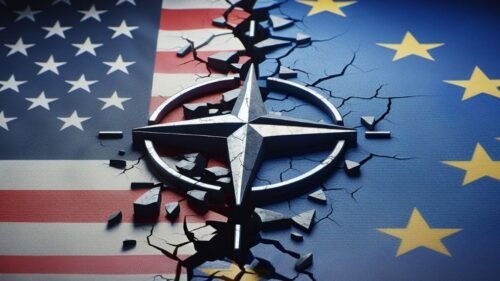
Support Fair Observer
We rely on your support for our independence, diversity and quality.
For more than 10 years, Fair Observer has been free, fair and independent. No billionaire owns us, no advertisers control us. We are a reader-supported nonprofit. Unlike many other publications, we keep our content free for readers regardless of where they live or whether they can afford to pay. We have no paywalls and no ads.
In the post-truth era of fake news, echo chambers and filter bubbles, we publish a plurality of perspectives from around the world. Anyone can publish with us, but everyone goes through a rigorous editorial process. So, you get fact-checked, well-reasoned content instead of noise.
We publish 3,000+ voices from 90+ countries. We also conduct education and training programs
on subjects ranging from digital media and journalism to writing and critical thinking. This
doesn’t come cheap. Servers, editors, trainers and web developers cost
money.
Please consider supporting us on a regular basis as a recurring donor or a
sustaining member.
Will you support FO’s journalism?
We rely on your support for our independence, diversity and quality.





Comment