


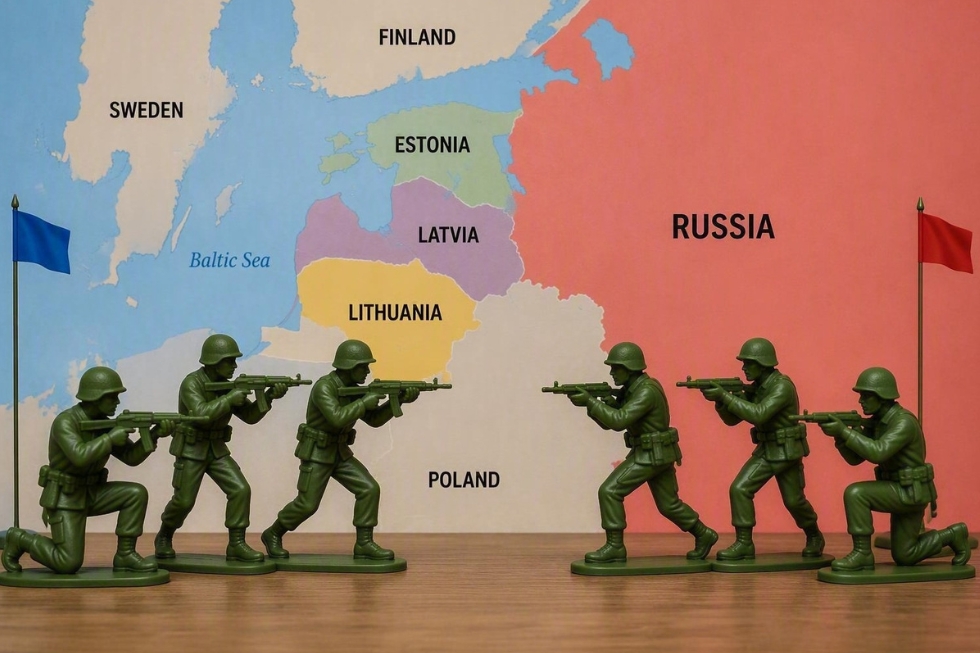



The Germans, it is said, love to be afraid. They fear recessions, inflation, immigration, climate change, pandemics and, of course, war. They celebrate these fears so fervently that the term “German angst” has made its way into the English language.
Currently, war is once again dominating the German media. Hardly a day goes by without a German general, military historian or think tank expert offering their assessment of an impending Russian attack. According to these experts, Russian statements as well as production rates in the Russian arms industry suggest that the country is preparing for a major war. In spring 2025, for example, Germany’s most renowned military historian warned that the country might experience its “last summer of peace.”
The tendency to exaggerate the threat posed by Russia is not unique to Germany. Other countries have their fair share of doomsayers, too. In the UK, for example, retired General Sir Richard Shirreff has gained notoriety by presenting alarming scenarios to highlight the potential consequences of neglecting one’s defense. However, given their proverbial fearsomeness, one might expect the Germans, in particular, to raid supermarkets to stock up on canned food, drinking water, flashlights and batteries. Yet all is quiet. What happened? Has “German angst” been replaced by “German complacency”?
Not at all. The general public is well aware of the deterioration in European security caused by Russia’s invasion of Ukraine. Germans are also well aware of the problems caused by US President Donald Trump’s dismissive attitude towards allies and alliances. Consequently, a majority of Germans approve of supporting Ukraine, increasing defense spending and even reinstating the draft. If they remain calm nonetheless, it is because they view much of the alarmism from military and academic experts as entertainment rather than serious analysis. And they have every reason to do so.
Why Germans aren’t buying the alarmism
The most obvious reason to take the Cassandras’ (the German alarmists who predict catastrophe — similar to the ancient Greek seer Cassandra) statements with a grain of salt is their insistence that Russia’s war against Ukraine is only the beginning of a much wider conflict fueled by the desire to recreate the Soviet Union. Even if such ambitions exist, Russia’s poor military performance in Ukraine makes a subsequent attack on NATO seem highly unlikely. Hybrid actions by Moscow or its proxies are of far greater immediate concern, especially since Germany has become a primary target. However, one cannot conquer countries merely through sabotage or fake-news campaigns.
Another reason for skepticism is the attack scenario deemed most plausible by many German military experts and think tank analysts. Some whisper that various allied intelligence services have assessed that Russia is preparing for a war against NATO in just a few years (the German government seems to have settled on 2029). However, once the question is raised as to how this attack will unfold, the answers become rather lame.
German experts tend to focus on Russia occupying one or two predominantly Russian-speaking cities in Estonia, seizing the Norwegian island of Svalbard or attacking a Baltic country from Belarus. The narrative is that, faced with a small Russian land grab, NATO allies would be torn between fighting and backing down, and might opt for the latter. Russian President Vladimir Putin would have successfully “tested” NATO and exposed the alliance as a paper tiger.
However, how likely is it that NATO would collectively commit suicide by failing to push back Russian troops who have advanced into its territory? If a lack of political solidarity among its members is NATO’s core problem, would adding more military muscle make a difference? And if this scenario is as urgent as the Cassandras claim, why does Germany persist with its notoriously sluggish defense procurement policy? Why does it take so long to deploy a brigade in Lithuania? If 2029 could be the critical year, why is the German government still evading the question of conscription, despite the verdict of most defense experts that the officially favored “voluntary solutions” will not suffice to reach Germany’s stated force goals?
In interviews and on talk shows, Germany’s military leadership revels in alarmism. However, Germany’s actual defense policy suggests that these dire threat assessments are not so much triggered by fears of Russia as by concerns that Germany’s Zeitenwende (turning point) in foreign and security policy could lose momentum.
The Zeitenwende and the cost of defense
This major shift in German foreign and defense policy was proclaimed immediately after Russia’s assault on Ukraine in February 2022. As a result of the Zeitenwende, Germany — once among the laggards in allied defense spending — is now investing heavily in defense, with Berlin even stating its ambition to build “the strongest conventional army in Europe”.
However, given Germany’s economic troubles, it seems unlikely that current spending levels, largely made possible by borrowing, can be sustained for long. A social welfare state like Germany, with a rapidly aging society, has to cater to too many parochial interests to sustain the current defense spending extravaganza for many years.
When fear becomes a policy tool
Against this backdrop, it becomes clear why large parts of Germany’s political and military elite feel the need to peddle fear. As long as the Russian threat looms large, high levels of military spending may be easier to sustain. Given three decades of Germany neglecting its armed forces and the pressure from Washington on its European allies to shoulder a greater share of the transatlantic defense burden, the logic of higher defense spending cannot be dismissed outright.
However, it is also evident that exaggerating the threat posed by Russia while downplaying NATO’s existing deterrent capabilities is counterproductive. If NATO were so weak and divided that Moscow could launch an attack within three years, would investing heavily in defense really still make a difference? And what if a Russian attack does not occur by 2029? Would postponing this ominous date by a year or two be enough to convince one’s electorate that defense budgets have to stay so high? Or, to put it bluntly, how many times can one cry wolf before losing all credibility? In short, fearmongering will most likely undermine rather than strengthen the credibility of German defense policy.
When asked this summer about his warning of the previous year that Germany might be enjoying its “last summer in peace”, the aforementioned German military historian backtracked. He stated that he was now “a bit more optimistic,” given Ukraine’s improved situation. It seems that even Cassandras can change their minds.
[Kaitlyn Diana edited this piece.]
The views expressed in this article are the author’s own and do not necessarily reflect Fair Observer’s editorial policy.
Germany’s Return to Conscription Is Not a Mistake; It’s an Obligation.
Germany’s Military Service Modernization Act marks a crucial shift toward rebuilding its defense capabilities amid growing geopolitical threats and waning...
Germany’s (Reluctant) Nuclear Arsonists
Germany’s nuclear debate has resurfaced amid transatlantic tensions and US policy shifts, reigniting discussions about national security and deterrence. While...
Trump and German Rearmament: Sowing the Seeds of Upheaval in Europe
After eight decades of continuous peace in Western Europe, US President Donald Trump is actively sowing the seeds of upheaval....
Imagine There’s No NATO: Germany as a New Middle-Sized Military Power in an Anarchic International Order
The fracturing of the Atlantic alliance under US President Donald Trump’s erratic leadership forces Germany to reconsider its security strategy...
Support Fair Observer
We rely on your support for our independence, diversity and quality.
For more than 10 years, Fair Observer has been free, fair and independent. No billionaire owns us, no advertisers control us. We are a reader-supported nonprofit. Unlike many other publications, we keep our content free for readers regardless of where they live or whether they can afford to pay. We have no paywalls and no ads.
In the post-truth era of fake news, echo chambers and filter bubbles, we publish a plurality of perspectives from around the world. Anyone can publish with us, but everyone goes through a rigorous editorial process. So, you get fact-checked, well-reasoned content instead of noise.
We publish 3,000+ voices from 90+ countries. We also conduct education and training programs
on subjects ranging from digital media and journalism to writing and critical thinking. This
doesn’t come cheap. Servers, editors, trainers and web developers cost
money.
Please consider supporting us on a regular basis as a recurring donor or a
sustaining member.
Will you support FO’s journalism?
We rely on your support for our independence, diversity and quality.





Comment