





When someone accuses a public figure of manifesting “a textbook case of obsession and demonisation,” this Devil’s Advocate deems it time to intervene. Who hasn’t noticed that there are many cases of truly demonic behavior in the world today, committed not only by individuals but especially by governments? In such a context, when pleading a case one should be very careful about the parties one characterizes as guilty of “demonisation.”
Let’s set the scene of an unfolding drama. The obsessive demonization in question, as reported by Al Jazeera, concerned the Hollywood actor Mark Ruffalo:
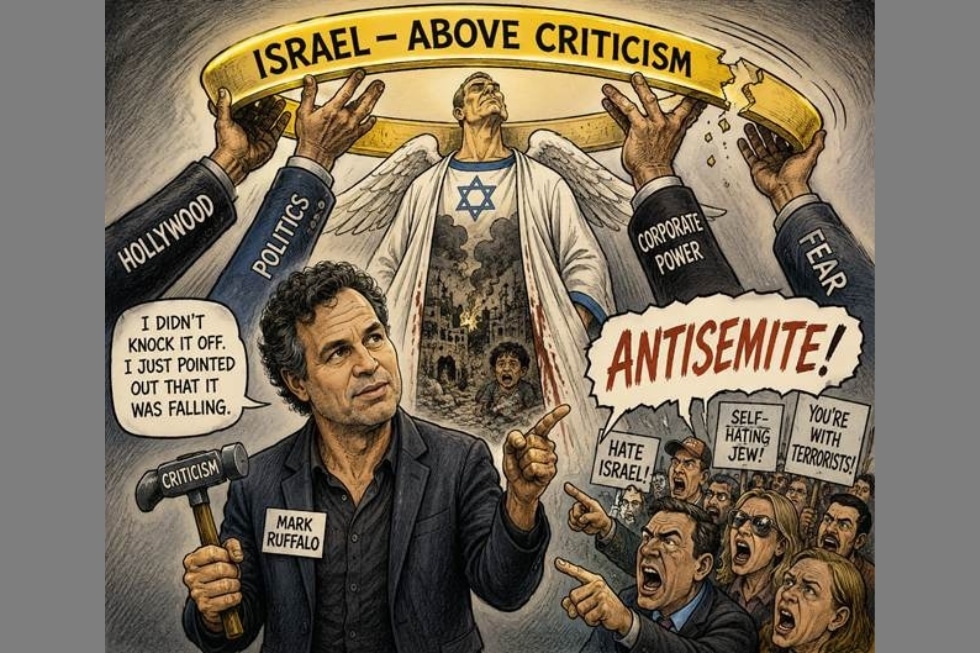
“Ruffalo, on August 21, shared an old clip on his Instagram story of Oracle Executive Vice Chair Safra Catz, proudly highlighting the company’s work to support Israel following the Hamas-led October 2023 attack on southern Israel, claiming the California-based tech company helped ‘advance the agenda for the Israeli military’ during its genocide in Gaza.”
Ruffalo was responding to a quote by Catz concerning Oracle’s possession of “some really profoundly scary technology” and the fact that the company “wanted to make sure that it was available for the effort.” Ruffalo raised his tone and accused Catz “of revelling in ‘genocide’ committed by what he called an ‘apartheid system of oppression powered by Oracle.’” To be clear about what he deemed potentially dire consequences, the actor added a crucially significant observation concerning his own workplace: “Mergers like this are almost always bad for workers, consumers, and the industry they tend to dominate.”
Most people in a sane world would call this a form of reasoned political commentary, which citizens of an evolved democracy should always be encouraged to make. But multiple voices inevitably and predictably spoke up calling it something else: antisemitism.
In a long tweet on X, Ruffalo made a more detailed case that contained this paragraph:
“This merger has real consequences for real people, and for the entire country. Scrutinizing the Ellisons, including Oracle’s business built on data, surveillance technology and government contracts, and the serious threat to editorial freedom and the loss of a livelihood for thousands of families, is fair and necessary. The $111 billion deal would hand one family control over CNN, HBO and Warner Bros., backed in part by foreign money whose influence on editorial decisions has never been fully explained to the public.”
This is the context in which “Simon Wiesenthal Center CEO, Jim Berk, denounced Ruffalo’s comment as “a textbook case of obsession and demonisation” of Jews.
Weaponizing language is not the privilege of wokism alone
When analyzing the language Berk used, we must first ask ourselves what he means by “a textbook case.” What kind of textbooks does Berk read?
He may be right if he’s referring to some of the textbooks published for Israeli schools. The publication The Christian Century, described by Wikipedia as “the flagship magazine of US mainline Protestantism,” highlights some of the research on Israeli education.
“Civics educators and academics allege that political appointees in Israel’s Education Ministry—controlled by the right-wing Jewish Home party—rewrote the textbook to water down discussion of democracy and Israel’s Arab minority, while filling it with content emphasizing Israel’s Jewish religious character.”
The problem with citing a “textbook case” is that it’s always possible to find a textbook to support whatever one has to say.
But let’s move beyond such formulaic reasoning to address the substance of Berk’s complaint, the pathology he describes as “obsession and demonisation” of Jews. Is Ruffalo a clinical case? Berk suggests that this is about a widespread evil. It’s as if certain self-appointed spokespersons for the Jewish people — there seem to be quite a few — who despite living in a cosmopolitan world that has vehemently and fairly definitively shamed Naziism out of existence are pining for a world inhabited and controlled by imaginary Nazis.
The case can be made that the temptation to “demonize” entire groups exists today. But the obvious candidates for that status would be those who indiscriminately accuse anyone daring to draw attention to Israel’s manifest ethnocentric policies and extreme military behavior as a “textbook case” of antisemitism.
In many Western countries, the trend has emerged to use accusations of antisemitism as a tactic for ostracizing public figures who fail to conform to a tacit consensus about how to judge Israel’s politics. All the major titles of the legacy media have obediently joined the campaign. Perhaps the first prominent victim of the trend was the United Kingdom’s former Labour leader, Jeremy Corbyn.
Even the supposedly progressive and traditionally Labour-oriented Guardian became complicit. Its opinion section frequently hosted commentary from journalists — such as Jonathan Freedland, Hadley Freeman, Polly Toynbee and anti-Corbyn Labour MPs — who condemned their duly elected leader on the grounds of his past associations with anti-Zionist groups. Unable to provide material evidence of actual antisemitism, they made the case that Corbyn’s failure to honor every politician’s implicit obligation to sympathize with Israel on all issues proved his personal indifference to antisemitism.
It reached a stage of oxymoronic (or simply moronic) comedy when, in a parallel case to Corbyn’s, one of Washington’s rare Jewish senators, Bernie Sanders, was publicly branded as an antisemite. This occurred — coincidentally? — at a time when he had become positioned as the frontrunner in the Democratic presidential primary in 2020. Former US President Barack Obama stepped in to restore order, ensuring that a wise old Joe Biden would have the privilege of succeeding Donald Trump.
The pattern is clear, whenever anything on the political horizon appears to challenge the requirement imposed on public institutions in the West to pledge fealty to Israel, that challenge will be labeled antisemitism and the guilty party will pay the price.
Shifting winds?
This week, more than 180 Jewish figures signed a letter backing Ruffalo. It’s too soon to tell whether a roster of nearly two hundred public figures will now be identified as antisemites, resulting in damage to their professional reputation and loss of work opportunities. Among the signatories are Abbi Jacobson, Alex Winter, Gina Gershon, Ilana Glazer, James Schamus, Joel Coen, Larry Charles, Kate Berlant, Naomi Klein, Sarah Sherman, Jane Schoenbrun, Todd Haynes and Tony Kushner.
Before getting their support, Mark Ruffalo dared to stand alone against a techno, financial and political cabal seeking to turn Oracle into a media behemoth. It was a project supported by the Trump administration. Between the takeover of Paramount/Skydance, Warner Bros. Discovery (WBD) and TikTok US, the total planned outlay is close to $200 billion.
Ruffalo now has 180 allies in what’s turning into a more balanced showdown. In their letter of support they claimed that the “proposed merger of Paramount and Warner Brothers Discovery is no mere combination of two huge multinational companies” because “it will destroy thousands upon thousands of livelihoods” and “further consolidate the oligarchic control of our media.” It will also “strangle competition and creativity in film and television production and distribution.”
But they go further. Their letter, reproduced by Variety, evokes the political and geopolitical question that Hollywood has always insisted on ignoring.
“But it will do all this and more as part of a larger project of tech-driven domination, a project Larry Ellison and his partners have never been shy about trumpeting — and one they themselves have explicitly linked to their support for the ongoing depredations being visited on the people of Palestine and their silencing of critics of those horrors.”
On the question of media coverage of a story about unprecedented concentration of media control, The New York Times has avoided even mentioning Ruffalo’s challenge, a story already more than a week old. The “newspaper of record” makes it clear what “serious” journalism thinks of the issue, either because it judges that one man’s protest has no meaning or it prefers not invoking a new debate about antisemitism. On the other hand, The Times of Israel covers the story and helpfully cites the Hollywood cabal that defines itself as Ruffalo’s enemies in tinseltown. They’re called “The Brigade.”
“The Brigade, a Hollywood group describing itself as comprising nearly 1,000 members, friends and allies of the Jewish community, accused Ruffalo of singling out Jewish executives and portraying them through tropes of secretive wealth and power. It said invoking Israel in that context echoed conspiracy theories historically weaponized against Jews.”
The Times of Israel article gives an objective account of the events. One simply wonders whether the mention of a group of 1,000 facing off against 180 isn’t its way of describing who needs to be taken seriously.
Al Jazeera offers a statistic Ruffalo’s supporters cited: “A survey by Gallup in February showed 41 percent of Americans sympathised more with Palestinians, while 36 percent remained more favourable to the Israelis.” They contrast this with polling from October 2023, which showed that “54 percent of Americans sympathised more with Israel and 31 percent with Palestine.”
The narrative has been shifting and will probably continue to shift, given the growing unpopularity of Trump’s catastrophic war against Iran, which people increasingly see as being conducted solely on the initiative of Israel’s relentless and unsinkable Prime Minister, Benjamin Bibi Netanyahu. This is all part of an ambience characterized by mass indiscriminate murder, multiple war crimes, collective punishment, genocide and ethnic cleansing led by two political leaders who have been accused of multiple crimes by their own justice systems and, in Bibi’s case, by the International Criminal Court.
This is where a Devil’s Advocate has no other choice to wonder about how people involved in so much demonic behavior can dare to accuse those who point to it as “demonizing” another group of people.
*[The Devil’s Advocate pursues the tradition Fair Observer began in 2017 with the launch of our “Devil’s Dictionary.” It does so with a slight change of focus, moving from language itself — political and journalistic rhetoric — to the substantial issues in the news. Read more of the Fair Observer Devil’s Dictionary. The news we consume deserves to be seen from an outsider’s point of view. And who could be more outside official discourse than Old Nick himself?]
[Lee Thompson-Kolar edited this piece.]
The views expressed in this article are the author’s own and do not necessarily reflect Fair Observer’s editorial policy.
FO Live: Antisemitism Is Rising Again — Why and Why Now?
In this episode of FO Live, Atul Singh, Emma Isabella Sage and Josef Olmert discuss the historic roots and modern...
The Problem of Hate Speech Ain’t Speech — Part 2
Who controls the meaning of “hate speech” controls the conversation and ultimately, who is silenced? Our conversation follows Lewis Carroll’s...
Moral Hypocrisy About Jews in the Israel–Hamas War
Recent campus protests against Israel demonstrated an appalling double standard on hate speech. While progressive-minded people are quick to condemn...

Antisemites, Like Everyone Else, Benefit From Jewish Medicine
Since the outbreak of the Israel–Hamas war, antisemitism has flared up again worldwide. The irony of the situation is that...
Antisemitism Is Popular Again. How Can Jewish Students Respond?
Historically, Jews as a group are often blamed and abused for the actions of some Jews. Sometimes, they fled; other...
Support Fair Observer
We rely on your support for our independence, diversity and quality.
For more than 10 years, Fair Observer has been free, fair and independent. No billionaire owns us, no advertisers control us. We are a reader-supported nonprofit. Unlike many other publications, we keep our content free for readers regardless of where they live or whether they can afford to pay. We have no paywalls and no ads.
In the post-truth era of fake news, echo chambers and filter bubbles, we publish a plurality of perspectives from around the world. Anyone can publish with us, but everyone goes through a rigorous editorial process. So, you get fact-checked, well-reasoned content instead of noise.
We publish 3,000+ voices from 90+ countries. We also conduct education and training programs
on subjects ranging from digital media and journalism to writing and critical thinking. This
doesn’t come cheap. Servers, editors, trainers and web developers cost
money.
Please consider supporting us on a regular basis as a recurring donor or a
sustaining member.
Will you support FO’s journalism?
We rely on your support for our independence, diversity and quality.





Comment