





Since US President Donald Trump’s return to power, he has often floated the idea of a third term. During the 2025 government shutdown, he was photographed with a red “Trump 2028” baseball cap sitting on the Resolute Desk whilst meeting with Democratic congressional leaders Hakeem Jeffries and Chuck Schumer. He seems ready to break the gentleman’s agreement that presidents since Franklin Delano Roosevelt have honored, but unlike Roosevelt, he can’t simply choose to run again because the Constitution now forbids it. So it’s only fair to ask: What happens to the Republican Party (GOP) without him?
Orbán’s continued absence
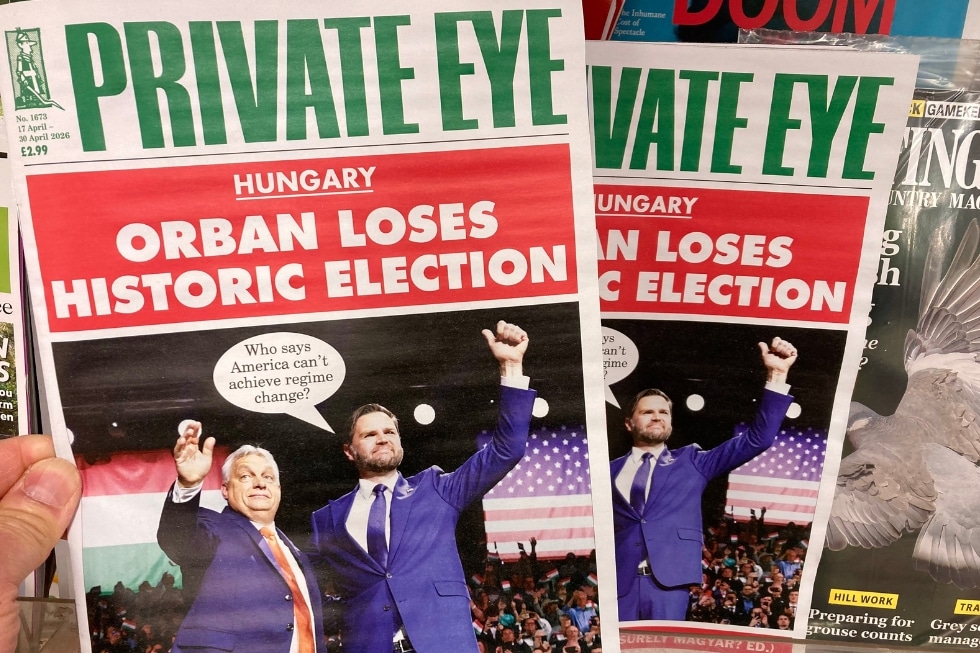
A good example to study as a counterfactual is a country that, until recently, had no term limits: Hungary. After 16 years as prime minister, Viktor Orbán and his party, Fidesz, were ousted from power after their opponents won a two-thirds majority. His opponent? Péter Magyar, a former Fidesz loyalist who, even upon entering politics, noted that Orbán was the Sun to Fidesz’s solar system.
Magyar’s victory and that of his political movement, Respect and Freedom (Tisztelet és Szabadság, or TISZA), signaled a sharp turn against right-wing populist leaders with autocratic tendencies. This has been analyzed extensively, including in the United States. What’s often left out is how quickly the structural foundations of a populist party crumble once the leader is unseated.
To understand the comparison, we need to look at two decisions: the introduction of a strict two-term limit for prime ministers and the ongoing ousting of the Fidesz-appointed President Tamás Sulyok. Both were bold campaign promises from Magyar, designed to systematically dismantle the legal infrastructure of the old regime. After his party’s landslide victory, he delivered on them. The media subsequently dubbed the term-limit law “Lex Orbán” and the presidential removal “Lex Sulyok.”
Fidesz, now in opposition, has to show that even in this weakened state, it can bring the firepower needed to challenge Magyar’s decisions. To Lex Orbán, the party responded with fiery speeches in Parliament and on social media, but with its coalition with the Christian Democratic People’s Party (KDNP) shrunk to 52 members of Parliament, it could not stop the institutional ceiling from being slammed down on their leader’s future.
In response to Lex Sulyok, Fidesz relied on standard opposition tactics by attempting to mobilize the public. But neither the embattled President Sulyok nor Viktor Orbán himself showed up to lead the charge. The official line was simple: this was not Orbán’s moment. When Parliament voted on the constitutional changes, Fidesz boycotted the proceedings entirely.
Faction leader and former Orbán minister Gergely Gulyás stepped down after Parliament also passed a three-term limit on members of Parliament (MPs), calling the day the death of Hungarian democracy. One question loomed over the empty opposition benches: Where was Orbán? Why didn’t he defend his own political ecosystem?
Instead, he was across the Atlantic, appearing on the live broadcast of internet streamer IShowSpeed during the France v. Spain World Cup semi-final, seemingly more invested in a referee’s call than his own party’s survival. While his faction leader resigned in disgrace at home, Orbán was halfway across the world chasing a distraction. This phenomenon of an entire party confused and paralyzed without its populist center is most likely the future awaiting the Republican Party in America.
The limits of inherited magic
How is this relevant to the United States and the GOP? As Trump’s net approval drops to minus 27 points under the weight of foreign conflict and a stagnating economy, one thing is certain: the race for the 2028 Republican nomination will expose a structural void. Whether US Vice President JD Vance or Secretary of State Marco Rubio decides to run, they will face two distinct problems: Trump’s lingering shadow and the total lack of Trump’s unique political physics.
The underlying issue is best explained by German sociologist Max Weber, who coined the term charismatic authority. Weber defined this as a form of leadership where legitimacy stems not from long-standing traditions or written laws, but from a leader’s perceived extraordinary, even superhuman personal qualities. Because it thrives on shattering existing rules, charismatic authority is inherently revolutionary.
However, it is also deeply unstable; it lasts only as long as the leader maintains his or her personal success and perceived “magic” of charismatic ability. Rewatching some Trump rallies back when he first ran: it is quite easy to see what drew people into his political movement. Considering the current war with Iran and the subsequent rise of gas prices, this magic seems to be fading; yet, Trump is one of the only political figures who possesses this ability.
The GOP must confront the fact that the institutional Republican Party does not have a loyal voter base anymore; Trump and the MAGA (Make America Great Again) movement do. We saw this reflected in Hungary, where Fidesz’s grand call to protest the removal of President Sulyok drew a meager one thousand people. Fidesz discovered it didn’t have a legitimate, self-sustaining voter base either; Orbán did.
Stripped of its strongman’s gravitational pull, Fidesz’s popularity has quickly cratered to just 23.9% in an aggregation of national polls. Both parties allowed themselves to be transformed into one-man shows, completely dependent on the gravitational pull of a singular actor.
As mentioned, the MAGA empire has two heir-apparents at the moment: Vance and Rubio. They share at least one trait: both of them were harsh critics of Trump early in his political career. Mr.Rubio represents the old institutional establishment trying to wear the costume of populism. When he adopts Trumpian rhetoric, it feels like a rehearsed political calculation lacking authentic, raw power. The base senses the underlying conformity of a traditional politician.
On the other hand, Vance represents the intellectualized, ideological branch of the movement. He can articulate the policy framework of economic nationalism with sharp precision, but he lacks that “magic” that Max Weber emphasized. The other two forms of authority Weber coined are traditional and rational-legal; neither helps the two outspoken technocrats in their goals. These figures are not Trump, nor could they ever be. They are traditional politicians trying to operate in a system that has been rewired to only accept a force of nature. They’re, for lack of a better word, boring.
Who will lead Fidesz if Orbán calls it a day? Who will the GOP base trust to carry the flames of the MAGA movement into 2028? These are institutional crises masquerading as standard election cycles. Without their central Sun, both of these massive political parties will be forced to rebuild an entire electoral universe from scratch. The red “Trump 2028” baseball cap that once held voters on the edge of their seats is ultimately an illusion. It is a piece of merchandise. And when the man who gave it meaning finally exits the stage, the Republican Party will find that you cannot inherit the magic, and without that, you are simply left holding an empty hat.
[Patrick Bodovitz edited this piece]
The views expressed in this article are the author’s own and do not necessarily reflect Fair Observer’s editorial policy.
Why Viktor Orbán’s Defeat Matters
Prime Minister Viktor Orbán’s recent electoral defeat in Hungary signals a potential turning point in the fight against rising nationalist...
The “Old” and the “New”: Trump’s Approach to Central and Eastern Europe Revives Bush-Era Themes
For decades, the US viewed European integration as beneficial to transatlantic interests, even as it voiced frustration about “who to...
Viktor Orbán, the Other Transgressor: Hungary’s Role in the Erosion of International Justice
Israeli Prime Minister Netanyahu recently visited Hungary despite his outstanding arrest warrant from the International Criminal Court (ICC). Hungary’s invitation...
Support Fair Observer
We rely on your support for our independence, diversity and quality.
For more than 10 years, Fair Observer has been free, fair and independent. No billionaire owns us, no advertisers control us. We are a reader-supported nonprofit. Unlike many other publications, we keep our content free for readers regardless of where they live or whether they can afford to pay. We have no paywalls and no ads.
In the post-truth era of fake news, echo chambers and filter bubbles, we publish a plurality of perspectives from around the world. Anyone can publish with us, but everyone goes through a rigorous editorial process. So, you get fact-checked, well-reasoned content instead of noise.
We publish 3,000+ voices from 90+ countries. We also conduct education and training programs
on subjects ranging from digital media and journalism to writing and critical thinking. This
doesn’t come cheap. Servers, editors, trainers and web developers cost
money.
Please consider supporting us on a regular basis as a recurring donor or a
sustaining member.
Will you support FO’s journalism?
We rely on your support for our independence, diversity and quality.





Comment