



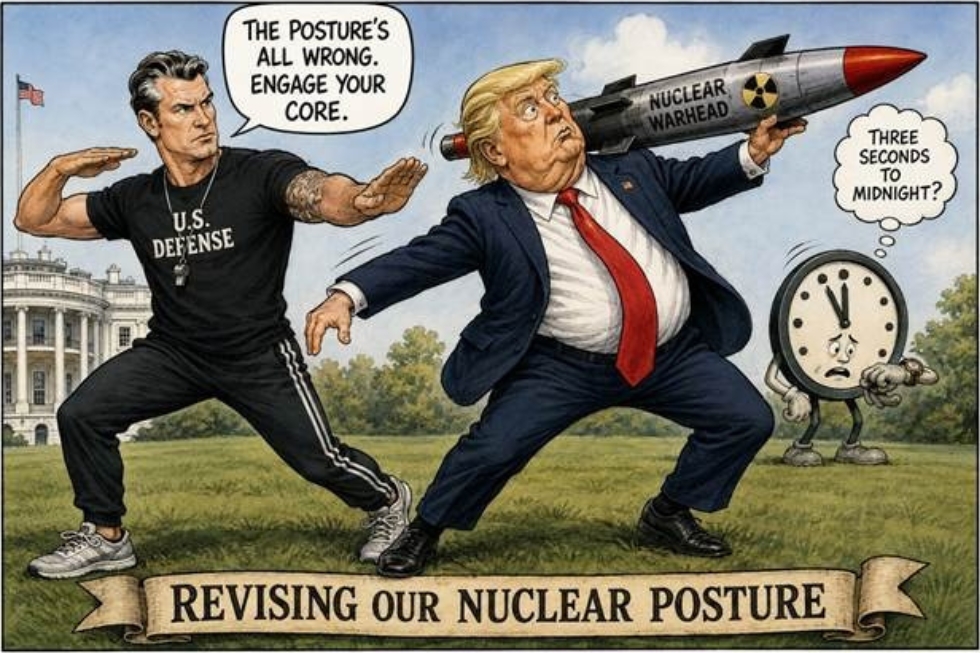



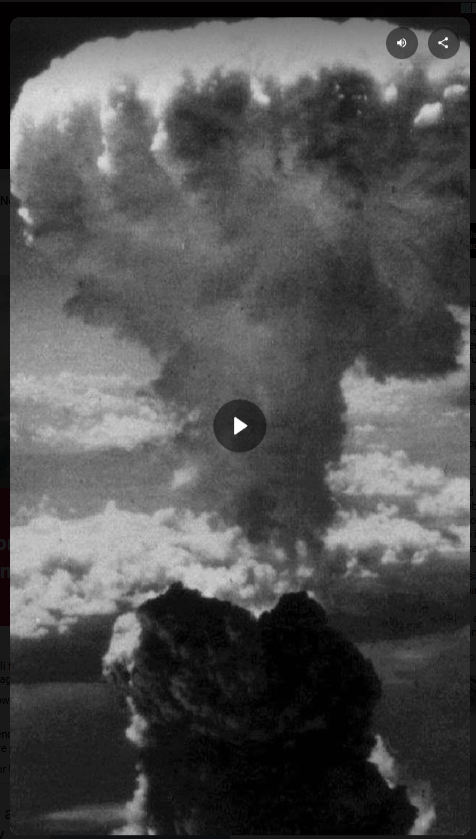
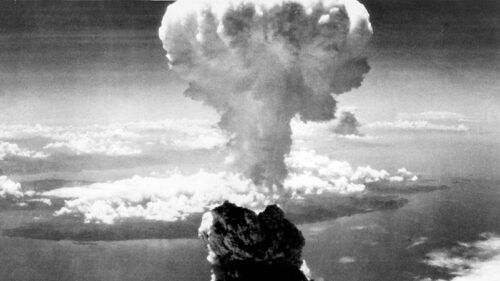
On the 81st anniversary of the atomic bombing of two Japanese cities, Nagasaki’s Mayor Shiro Suzuki, in the presence of Japan’s Prime Minister Sanae Takaichi, emphatically declared that “humanity and nuclear weapons cannot coexist.” It isn’t difficult to sense what Suzuki is getting at. But is he right or wrong?
If we treat it as an empirically factual statement the assertion is manifestly false. We can easily prove that humanity has coexisted with nuclear weapons for at least 81 years. Humanity and nuclear clearly can coexist so long as the first, humanity does not put the second, nuclear weapons, to the use they were built for.
When I asked Microsoft Co-pilot, it explained: “Suzuki’s statement is not factually true, but it is morally and politically true within a specific worldview. It is a normative claim, not an empirical one.” When we apply rhetorical rather than formal linguistic analysis to it, we discover that the Nagasaki mayor’s assertion is a moral‑political appeal that uses absolutism, identification and ceremonial authority to reshape collective attitudes toward the politics surrounding nuclear weapons.
If we adhere to Suzuki’s moral perspective, we should have to conclude that humanity currently exists in an abnormal state. Many people — especially within the Beltway — complain that the visible disorder of today’s geopolitical landscape is the result of our abandonment of the sacred idea of a “rules-based order.” They put it forward as a state of supposed equilibrium that defines what should be considered “normative.” Suzuki dares to suggest that the “normative order” of the past 80 years is abnormal to the extent that it has tolerated the co-existence of two incompatible realities: humanity and nuclear weapons.
Though few people today are actively calling for a nuclear ban, Suzuki’s “normative claim” nevertheless rings true as a rhetorical gambit underpinning a moral reflection. The British philosopher of language, J.L. Austin analyzed what he called the “illocutionary” content of discourse. He would contend that Suzuki’s utterance is constative in form but hortatory in function. The mayor exhorts us to recognize the risk not just of the destructive potential of nuclear weapons, which should be objectively obvious to all, but also exhorts us to object to the idea of a nation hoarding them to use as the ultimate threat.
Fellow philosopher John Searle would probably call the Nagasaki mayor’s assertion both a “commissive-like act” and a “constitutive act.” A commissive act seeks to shape collective values and identities, signaling the speaker’s personal commitment to a future course of action, in this case nuclear abolition. A constitutive act seeks to shape collective values and identities (“humanity” vs. “nuclear weapons”). But if we want to be honest about the role of rhetoric in today’s culture, that same statement could also be purely performative, which is what most political discourse tends to be.
Beyond rhetoric to lived reality
No one can reasonably quibble with the truth content of another of Suzuki’s assertions. “We must face the reality that the more we rely on nuclear deterrence, the higher the risk of nuclear war becomes.” The logic here is impeccable because it is purely statistical. The potential for actual use of any device mechanically increases with the degree of its availability.
Suzuki continues with a more provocative statement that any moral philosopher, linguist or Devil’s Advocate would be tempted to weigh in on. “Nuclear weapons,” he proclaims, “are not a ‘necessary evil’ but an ‘absolute evil.’ Technically speaking, this is a normative, rhetorical and evaluative utterance. Its “truth value” for the recipient will depend on the degree of acceptance of the moral framework Suzuki appeals to.
This raises two important questions. Suppose we agree on the basic definition of evil as “deliberately or intentionally harmful.” Can we then distinguish between relative and absolute evil? Extremes along a spectrum exist, but is there a point beyond which we can identify an “absolute” instance? In current debates about political orientations, not everyone agrees about the appropriateness of labeling a party “extreme right” or “extreme left.” “Absolute” is more problematic. Most people understand “absolute evil” as meaning “in total contradiction not just with the law but with the most basic moral principles.” There are no circumstances in which absolute evil can be condoned.
Suzuki’s assertion calls into question the long history of a historical artifact known as “Mutually Assured Destruction” (MAD), a foundational theory underpinning the Cold War. It put forward the idea that possessing nuclear weapons is a lesser evil on the grounds that the extreme (absolute?) level of fear caused by nuclear weapons reduces the chances that anyone might launch a massively destructive war. That is, of course, purely hypothetical.
Suzuki implies that the current, accepted understanding of the status of nuclear weapons can be characterized in the following terms. Because of their exceptional destructive power they can be categorized as evil. Thus no nation should keep them in their foreign policy toy box. Leaders, however, have the responsibility of acting with “realism.” This justifies the belief that, despite recognizing them as evil, circumstances require having them. The reasoning relies on the conviction that other nations that possess such weapons may have intentions that are naturally more evil than one’s own.
Most people would agree that the evil one holds in one’s own hands (and preciously cultivates) doesn’t stop being evil. It’s simply tolerated and sometimes embraced as the lesser of two (or more) evils. The reason one can accept a relative evil lies in the belief that the other side may be guilty of absolute evil and the corresponding belief that one’s own side would never be guilty of absolute evil. Once again, that is purely hypothetical.
Traditional moral theory generally rejects the idea that one may keep or cultivate an evil on the grounds that someone else might commit a greater evil. Suzuki’s point is therefore consistent with most respectable philosophical traditions. The one “dissenting” tradition that emerged in modern times is Consequentialism, which supports “realism” but only to the extent that it refuses to consider Suzuki’s claim that nuclear weapons are by definition absolute evil.
Just war theory
Suzuki pleads with the world to recognize what appears obvious: that anything as extreme and indiscriminate in its destructive potential is by definition absolute. And yet, the best any of the world’s leaders, past or present has been able to do is to agree to limit the proliferation of nuclear weapons. That happens to be one of the most morally awkward exercises anyone could attempt. If limits are drawn forbidding the possession of nuclear weapons by some nations, what qualifies any nation to possess instruments of absolute evil? For 80 years, that policy effectively creating an order in which a tiny elite of nations are allowed to manage evil, has been implicitly accepted as “normative.”
The only world leader in recent times to publicly challenge that feature of the “rules-based order” was the late Pope Francis. In his 2020 encyclical, Fratelli Tutti, he argued that nuclear, chemical and advanced high-tech weaponry inflict damages far disproportionate to any potential good, eliminating the possibility of meeting traditional proportionality standards. Francis documented in detail Suzuki’s claim about absolute evil and even used it to undermine what was long considered to be the Catholic church’s “just war” doctrine.
Though Francis avoids appealing to the notion of “absolute evil,” at one point he quotes Pope John Paul II’s evocation of “moral norms prohibiting intrinsic evil.” Instead, he specifically focuses on the weakness of a relativist argument. “Relativism always brings the risk that some or other alleged truth will be imposed by the powerful or the clever.”
Francis insists that the exercise of political power cannot exempt a leader or a nation from recognizing manifestations of unadulterated evil and acting to oppose it. According to his reasoning, absolute equality trumps absolute evil. “Before the demands of morality we are all absolutely equal.”
Is evil an expanding option?
The website Breaking Defense last week published an article with the headline: “Pentagon wants ‘expanding options’ for nuclear weapons, officials say.”
Appearing two days before the commemoration of the Nagasaki bombing, the article begins with this sentence: “The Pentagon has launched a review of America’s nuclear posture, focused on providing more ‘options’ for the White House, two top officials said this week.” It goes on to inform us that Undersecretary of Defense for Policy Elbridge Colby “repeatedly emphasized the term ‘options.’”
The most alarming information in the article appeared in this comment by US Strategic Command head Adm. Richard Correll: “The department is looking at ways of ‘expanding options’ available to the president and providing the “decision space for any conceivable escalation scenario.”
Does the world really need to expand Donald Trump’s options? And have we moved beyond both “relative evil” and “absolute evil” to end up with “optional evil?”
*[The Devil’s Advocate pursues the tradition Fair Observer began in 2017 with the launch of our “Devil’s Dictionary.” It does so with a slight change of focus, moving from language itself — political and journalistic rhetoric — to the substantial issues in the news. Read more of the Fair Observer Devil’s Dictionary. The news we consume deserves to be seen from an outsider’s point of view. And who could be more outside official discourse than Old Nick himself?]
[Lee Thompson-Kolar edited this piece.]
The views expressed in this article are the author’s own and do not necessarily reflect Fair Observer’s editorial policy.
The Story of World War II
On the 80th anniversary of the beginning of World War II, we look at the story of this tragic conflict....

Nuclear War Only Happens Once
Assistant Editor Farhang Faraydoon Namdar explains how Russia’s faltering war in Ukraine has exposed the limits of its conventional forces...

The Art of Choosing the Victim to Justify Your War
The Ukraine conflict can be understood from a variety of angles but one thing is clear it has produced victims...

Was the Bombing of Hiroshima and Nagasaki the Mother of All War Crimes?
If the bombing of Hiroshima and Nagasaki was a war crime, it was nothing more than another episode in a...

The Mother of All War Crimes
Historians know what official history has chosen to forget: The bombing of Hiroshima and Nagasaki was the mother of all...
Support Fair Observer
We rely on your support for our independence, diversity and quality.
For more than 10 years, Fair Observer has been free, fair and independent. No billionaire owns us, no advertisers control us. We are a reader-supported nonprofit. Unlike many other publications, we keep our content free for readers regardless of where they live or whether they can afford to pay. We have no paywalls and no ads.
In the post-truth era of fake news, echo chambers and filter bubbles, we publish a plurality of perspectives from around the world. Anyone can publish with us, but everyone goes through a rigorous editorial process. So, you get fact-checked, well-reasoned content instead of noise.
We publish 3,000+ voices from 90+ countries. We also conduct education and training programs
on subjects ranging from digital media and journalism to writing and critical thinking. This
doesn’t come cheap. Servers, editors, trainers and web developers cost
money.
Please consider supporting us on a regular basis as a recurring donor or a
sustaining member.
Will you support FO’s journalism?
We rely on your support for our independence, diversity and quality.





Comment