



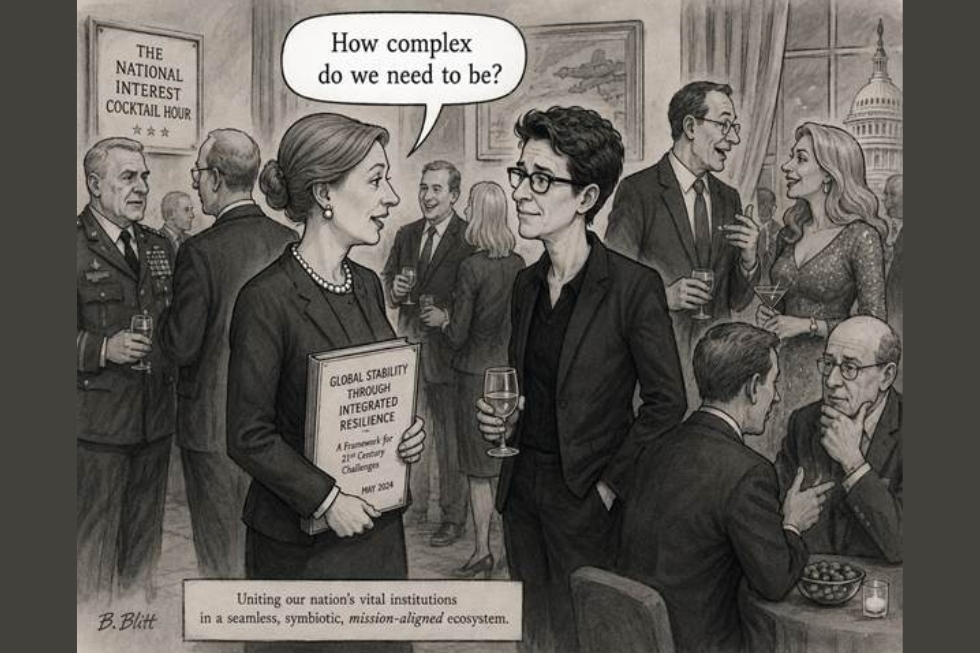



In my conversation with Claude provoked by an essay in Foreign Affairs analyzing the phenomenon of Washington’s addiction to foreign wars, we got to the point at which Claude pointed to a fundamental structural problem.
The deeper diagnosis your Empire Envy framework points to is right, I think: it’s not that Washington forgets to ask the hard questions. It’s that the institutions producing the war decision aren’t structured to let the answer change the outcome.
I continued with a new prompt:
I totally agree with your analysis. But doesn’t this raise some fundamental questions about how our current supposedly democratic decision-making framework functions? And if so how might we begin to analyze the root causes of that dysfunction?
Yes — and I think the question deserves to be asked in exactly that recursive way, applying the same method to itself. If the analysis so far shows a structural inability to let root-cause diagnosis bind the decision to go to war, the next question has to be: what in the architecture of “democratic” decision-making produces that specific inability? A few converging diagnostic frames are worth distinguishing, because they locate the dysfunction in different places and imply different remedies.
The constitutional frame. The formal design assumes Congress declares war and controls the purse, which was meant to be the democratic check. That design has been dead in practice since roughly Korea. The War Powers Resolution of 1973 was Congress’s attempt to reclaim the function after Vietnam, and it has never once been successfully enforced against a president who chose to ignore it — every recent conflict, including the current Iran war, has proceeded on executive authorization, AUMF stretching, or simple fait accompli, with congressional votes arriving after the fact if at all. That’s not democratic decision-making failing at the margins. It’s the load-bearing democratic check having been structurally disabled for seventy years while the formal vocabulary of constitutional government continues uninterrupted. Worth reading here: the war powers literature (Louis Fisher’s work is the standard reference), and it connects directly to your Ukraine/Rand material, since “Congressional support remained high” functions in her piece as a description of democratic legitimation when the more accurate description is that Congress has been reduced to an approval mechanism for decisions made elsewhere.
The sociological frame — your own toolkit. This is where Bourdieu and Gramsci do real work, and where the last several exchanges converge. C. Wright Mills’s “power elite” argument from 1956 is the direct ancestor of what we’ve been describing: a fused political-military-corporate class that rotates through the same institutions — Pentagon, State, the intelligence agencies, the think tanks, the defense contractors, the Sunday shows — such that “democratic deliberation” happens entirely within a class that has already converged on its premises before any public input occurs. Rand’s own career arc, and Brookings’s institutional position, are specimens of exactly this circulation. The public doesn’t get a vote on root-cause diagnosis because the diagnosis is settled inside a closed field before it ever reaches anything resembling a democratic forum. This is where your Empire Envy concept and Bourdieu’s illusion meet the constitutional question directly: the doxa isn’t just an intellectual habit, it’s what a specific, identifiable, mobile class of people carries with them as they move between the institutions that are formally supposed to check each other.
The political-economy frame. Eisenhower’s farewell address — which you’ve already used in your Silicon Valley/AGI piece — is the founding document here, and it’s worth returning to for this exact question rather than the AI analogy. His warning wasn’t about war per se, it was about a standing institutional interest (the military-industrial complex) acquiring “unwarranted influence” over decisions that democratic theory assumes are made by disinterested public deliberation. Add to that the electoral time-horizon problem: a war’s costs and consequences unfold over decades, while the people notionally accountable for the decision face reelection in two or four years, which structurally rewards decisive-looking action now over patient root-cause work whose payoff, if any, arrives on someone else’s watch. Neither the constitutional check nor the electoral check operates on a timescale that matches the object being decided.
The epistemic frame — the one this whole conversation has actually been reconstructing. A functioning democratic check requires an informed public, and everything we’ve walked through with Rand, with EUvsDisinfo, with the Johnson episode, is a case study in how the information supply that’s supposed to feed democratic judgment is itself produced by the same class described above, for consumption by the same class, with the public positioned as audience rather than participant. Manufacturing Consent (Herman and Chomsky) remains the sharpest formal statement of this, even though its 1988 media landscape has since been overtaken by the think-tank-and-Substack ecosystem we’ve been dissecting — the mechanism (elite-sourced framing presented as neutral expertise) is more relevant now than when they wrote it, if anything, because Foreign Affairs functions today exactly the way Herman and Chomsky said the New York Times functioned then.
Where I’d start, if I were building the root-cause analysis of the dysfunction itself rather than gesturing at all four frames at once: the four aren’t competing explanations, they’re mutually reinforcing — the sociological closure (who’s in the room) explains why the constitutional check goes unenforced (nobody in the room has an interest in enforcing it), the political economy explains why that closure persists across party turnover, and the epistemic capture explains why the public doesn’t demand the constitutional check be restored. A genuinely useful piece would probably need to pick one thread to pull hardest — I’d suggest the constitutional one, because it’s the most concrete and falsifiable (you can point to specific votes not taken, specific AUMFs stretched decades past their occasion, specific war-powers reports never filed), and the other three frames can be brought in as the explanation for why the constitutional mechanism failed rather than as the primary subject, which keeps the argument anchored in verifiable institutional fact rather than drifting into an account that’s harder to falsify. But that’s a judgment about what makes the strongest essay, not a claim that the other three matter less.
Claude’s insight about “the load-bearing democratic check having been structurally disabled” opens up a new area of debate, which takes us beyond foreign policy. If we discover that an essential mechanism is now “disabled,” we need to seek the cause in one of two directions, though it could be a subtle combination of both. The first is that it has aged and lost its potency. That’s the natural erosion explanation. The second is that it was consciously and willingly disabled by parties interested in avoiding being checked to pursue their own illegitimate ends.
In such cases, the “natural erosion” explanation serves to hide the reality of active sabotage. Claude then draws attention to Rand’s possibly unconscious complicity in the sabotage by pointing out to Rand’s remark that “Congressional support remained high” functions in her piece as a description of democratic legitimation.” In other words, Rand either doesn’t see or doesn’t want to acknowledge the underlying trend: the sacrifice of democracy itself.
This brings us back — as Claude remarks — to what I tend increasingly to think of as the unique moment of unadulterated truth spoken by a modern US president: President Dwight Eisenhower’s farewell address spoken three days before leaving office in January 1961. Those were the only three days of his two terms when he knew he no longer would have to engage in a strategy dialogue with the two men who were most active in engineering the sabotage of democracy: Secretary of State, John Foster Dulles and his brother, Allen Dulles, director of the CIA.
When America’s youngest president took office days later, he initially appeared (or simply chose) to ignore the implications of Eisenhower’s warning. Later in his soon to be truncated presidency, he made the following admission to a group of Quakers: “The military-industrial complex is very strong. If you folks are serious about trying to get our government to take these kinds of steps, you’ve got to get much more organized, to put pressure on the government to move in this direction.” Somewhat more obliquely, John F. Kennedy recognized the industrial component alongside the military one, when he complained that we are “caught up in a vicious and dangerous cycle, with suspicion on one side breeding suspicion on the other, and new weapons begetting counter-weapons.” Follow the money.
Kennedy was thus admitting not just that Eisenhower’s warning should be heeded. More damningly, he was informing us that democracy had been disabled. As chief executive, he candidly declared himself powerless to do anything but execute what the reigning complex required. He understood that democracy could only be restored by people “more organized to put pressure on the government.” Unlike today’s CEO President Donald Trump, Kennedy did not believe he personally was the government.
We now know that in his first draft, Eisenhower used the longer and rather unwieldy epithet “military-industrial-Congressional complex.” Anyone who believes that democracy should be restored will take the hint Kennedy shared with the Quakers. Instead of citing, as Rand does, high “Congressional support” to claim an unmerited legitimacy, they should look at undoing the contorted logic of the complex to ensure that checks and balances may finally become capable of functioning.
Rand might want to consult Dan Grazier’s insights to learn more about how complex the complex has now become.
“The Pentagon, Congress, the defense industry, think tanks, lobbyists, and industry-sponsored media outlets are all very real. When combined, they make up what is better termed the “National Security Establishment,” which Americans see in action all the time.
It may just include Rand’s own think tank.
Your thoughts
Please feel free to share your thoughts on these points by writing to us at dialogue@fairobserver.com. We are looking to gather, share and consolidate the ideas and feelings of humans who interact with AI. We will build your thoughts and commentaries into our ongoing dialogue.
[Artificial Intelligence has become a feature of everyone’s daily life. We unconsciously perceive it either as a friend or foe, a helper or destroyer. At Fair Observer, we see it as a tool of creativity, capable of revealing the complex relationship between humans and machines.]
[Lee Thompson-Kolar edited this piece.]
The views expressed in this article are the author’s own and do not necessarily reflect Fair Observer’s editorial policy.
Empire Envy and Forked Tongues: How Washington Talks Itself Into War — Part 1
A dialogue dissecting an essay on “forever wars” exposes a double standard. Analysis of “root causes” is dismissed as bad...
Empire Envy: How Think Tanks Manage the Decline They Cannot Name — Part 1
A close reading of Dafna Rand’s Foreign Affairs essay on America’s “forever wars” names a Beltway pathology — “Empire Envy”...
A Trillion Reasons Democracy Is Doomed
Two new “trillionaires” — the US military and Elon Musk — now occupy the headlines. Both represent a dangerous concentration...
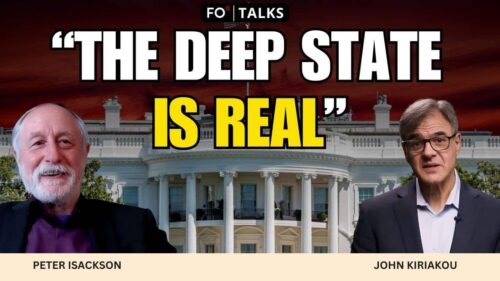
FO° Talks: Does the CIA Control American Presidents and Media? John Kiriakou Explains
In this episode of FO° Talks, Peter Isackson and John Kiriakou examine whether modern intelligence agencies remain compatible with democratic...
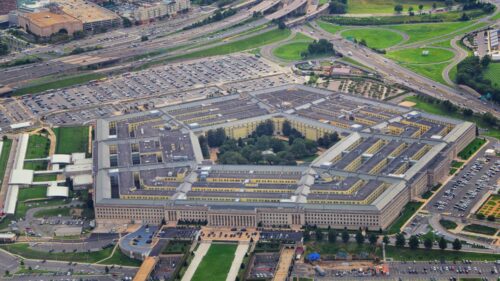
What Would an Honest, Democratic Pentagon Look Like?
A retired US Air Force lieutenant colonel shares his thoughts on a self-serving Pentagon that has become more concerned with...
Support Fair Observer
We rely on your support for our independence, diversity and quality.
For more than 10 years, Fair Observer has been free, fair and independent. No billionaire owns us, no advertisers control us. We are a reader-supported nonprofit. Unlike many other publications, we keep our content free for readers regardless of where they live or whether they can afford to pay. We have no paywalls and no ads.
In the post-truth era of fake news, echo chambers and filter bubbles, we publish a plurality of perspectives from around the world. Anyone can publish with us, but everyone goes through a rigorous editorial process. So, you get fact-checked, well-reasoned content instead of noise.
We publish 3,000+ voices from 90+ countries. We also conduct education and training programs
on subjects ranging from digital media and journalism to writing and critical thinking. This
doesn’t come cheap. Servers, editors, trainers and web developers cost
money.
Please consider supporting us on a regular basis as a recurring donor or a
sustaining member.
Will you support FO’s journalism?
We rely on your support for our independence, diversity and quality.





Comment