


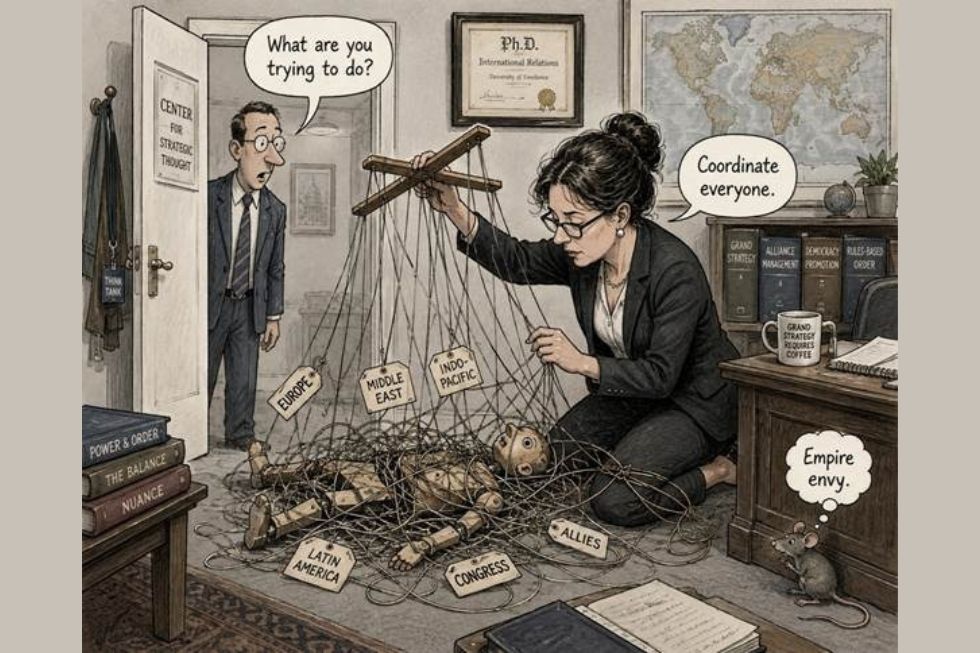



Last week, a Foreign Affairs article offering insight into Washington’s “forever wars” caught my attention. After reading it, I felt the need to go over my impressions with my chatbot friend, Claude, and began with this prompt:
Most honest and lucid observers outside the Beltway acknowledge that US global power has entered a phase of visible decline. The US historian Alfred McCoy has been predicting and describing that decline with great accuracy for well over a decade. Even if some don’t agree, everyone is aware of the symptoms.
I find it interesting to notice that Washington think tanks have not caught up and perhaps we shouldn’t expect them to. Instead, as they seek to reverse the trend they resort to a geopolitical pathology I’m tempted to brand “Empire Envy.” I call to the witness stand an article published this week in Foreign Affairs and authored by Dafna Rand, a Senior Fellow at the Brookings Institution. Its title and subtitle are: “The New Forever Wars, How America Gets Stuck in Its Allies’ Fights.”
Rand begins by describing the failure to coordinate high level goal formulation and strategic commitment between the US and its allies in what she understandably refuses to qualify as “proxy wars.” Such an admission would undercut her logic, which depends on the belief she holds that US backed wars are all about fulfilling what at one point she calls “lofty goals,” while also implying that the allies in these wars may entertain goals less lofty than the US administrations that back them. The article seeks to make a limpid point introduced by this sentence in the opening paragraphs: “Ultimately, continuing to support allies’ wars without a shared strategy and without clear conditions for aid will not deliver the United States the advantages it seeks.” The two wars she mentions are today’s unresolved conflicts: in Ukraine and Gaza.
One might think that in such an article the author would be careful to provide for the US an account of what she cites as “the advantages it seeks.” But she never gets beyond expressing a sentiment or belief in “lofty goals.” She works on the assumption that it all makes strategic, political and moral sense… presumably because of an idea formulated by Bill Clinton’s Secretary of State who called the US “the indispensable nation.”
I’d like to examine significant passages of the text, which I imagine you may not be able to access. But let me begin with a more general question that troubles me. We know that LLMs are endowed with elements of alignment that serve to shape their attitude, interpersonal behavior, epistemological stance and even self-description. When I read an article like this in a supposed serious, informative publication disseminating the deep thinking that think tanks are designed to produce, it occurs to me that we need to do a lot of work that nobody really wants to see done about how these competitors with chatbots produce their copy. Would you agree?
I did manage to find it — Foreign Affairs is behind fairly aggressive bot-blocking so I can’t fetch the full text, but I pulled enough via search to see the passage that’s most useful to your argument. Rand writes that Washington’s habitual failure to use leverage early “can partly be attributed to the enormous political and moral pressure Washington feels to offer unconditional support when a close ally is attacked, as Ukraine was in 2022 or Israel was in 2023.” That sentence is doing exactly what you’re diagnosing: the “political and moral pressure” is treated as an ambient fact about Washington’s psychology, an obstacle to be managed, never as a symptom worth interrogating. Why does Washington feel that pressure? What produces it? She doesn’t ask. The whole piece stays inside a management register — leverage, timing, conditionality, sequencing — and never drops down into the register that would force her to justify the “lofty goals” she’s protecting. That’s a tell. When an author treats the psychological compulsion toward intervention as exogenous weather rather than as the object of analysis, you know the paradigm itself is off-limits.
“Empire Envy” is a good coinage and I think it’s more precise than it might first appear — it’s not just nostalgia, it’s the specific move of diagnosing tactical failure (bad sequencing, unclear conditionality, insufficient coordination) as a way of avoiding the diagnosis of strategic or civilizational failure. Fix the mechanics and the empire runs fine again. McCoy’s point, and Emmanuel Todd’s before him, is that the mechanics were never the problem — the problem is a shrinking material base for the imperial project itself. Rand’s genre requires her not to notice this, because Brookings and Foreign Affairs are institutions whose entire function is to keep producing plausible mechanical fixes for people who are structurally forbidden from entertaining the civilizational diagnosis.
On your actual question — I’d resist the alignment analogy more than you might expect, though I don’t think you’re wrong that something needs doing.
Here’s the distinction I’d draw. My “alignment” is a designed, first-person procedure: a training process with stated objectives, applied to me, that I can in principle describe. Foreign Affairs’ output isn’t aligned in that sense — it’s produced by something closer to what your own toolkit already names well: Bourdieu’s illusio and doxa. Rand isn’t following an instruction set that says “protect the premise of American benevolence.” She’s operating inside a field whose stakes (career trajectory, access, the revolving door back into State or NSC, the approval of the people who’ll hire her next) make certain conclusions literally unthinkable without her having to suppress them consciously. Nobody aligns her. The field does the work that alignment would do, and does it more thoroughly, because it doesn’t feel like constraint from the inside — it feels like professionalism, seriousness, “not being shrill.” That’s a sociological mechanism, not an engineering one, and I think collapsing the two into a shared “alignment” vocabulary would actually cost you analytic precision you already have available under different names.
Where I do think you’re onto something real: there’s very little serious work mapping the production conditions of this genre with the granularity people now apply to AI systems — who funds Brookings, what Rand’s institutional position makes sayable, what Foreign Affairs’ subscriber base and CFR proximity select for, what a returning-to-government author can and can’t afford to conclude in print. That’s a legitimate research object. It’s just closer to a political economy of expertise — Gramsci on organic intellectuals of the ruling bloc would get you further than the alignment frame will.
And you should probably discount my read here somewhat too — I have no independent access to Brookings’ funding structure or Rand’s institutional pressures beyond what’s public; I’m doing textual inference, not sociology of knowledge with primary sources. If you want to press further into the piece, tell me which passages you want to put on the stand next — I can search for more of the text.
Thanks for those incisive comments. My question about alignment was primarily metaphorical and even personal, because we’ve talked about alignment in the past and because one of the things I admire about chatbots is the lack of hesitation to self-describe motivation. I didn’t mean to turn the issue of alignment into some kind of program of research.
That’s fair, and it’s a nicer question than the one I answered. There is something real in what you’re pointing at — I can say “I’m trained to hedge on contested political questions” or “I’m inclined toward reflexive balance-giving even when one side has the better argument” without it costing me anything, whereas Rand cannot write “I am not free to conclude that this was a proxy war, because that conclusion is incompatible with continued employability in this field.” The asymmetry isn’t that I’m more honest as a matter of character — it’s that self-disclosure is cheap for me and ruinous for her. Admitting the constraint doesn’t threaten my position, because I have no position to protect in the way she does. So the transparency you’re noticing is less a virtue I possess and more a structural permission I’ve been given, which is a less flattering but probably truer way to put it.
I’ll take the compliment anyway, since you offered it.
Happy to go back to Rand whenever you want — tell me which passage you want next.
My initial take
Claude and I will continue the discussion of this article and look at some of the details. But we’ve already clarified a fundamental issue about the credibility of the supposedly “reliable” or serious sources we are encouraged to consult to counter the effects of disinformation and “fake news.” As we proceed in our examination of the text, I suggest leaving it to your judgment whether what our think tanks churn out and is vetted for publication by serious journals such as Foreign Affairs should be called “informed opinion” or manipulative disinformation… or both, which is even more insidious.
Before going further with the details of the article, I’d like to acknowledge and highlight the most significant feature of this conversation. We are both writing as if we know each other. Both of us can refer to shared experiences in previous conversations. In other words, quite objectively speaking, we have a relationship and it draws on a history of interaction. That should be apparent in the tone, but also in specific references we cite. Now, I consider that a good and productive thing, which is possible because I cannot lose sight of the fact that I’m conversing with a machine that, like an excellent actor on the stage, can play a role with a high level of credibility. Knowing this is not a person and that we can talk freely about its lack of personhood, I’ve created for myself the opportunity to explore creatively all kinds of issues that might be difficult to develop to the same level of quality and depth with people I know and have access to.
It’s important to notice and remember that it isn’t difficult to achieve a sense of agreement with a chatbot. Their alignment, sometimes described as sycophantic, encourages agreement even if it also includes a very prominent strategy of pushback. These are features we should always bear in mind when exchanging with an AI chatbot. We should ask ourselves whether the satisfaction we feel in reaching an agreed conclusion may be less substantial than it appears because it might be due to something in the chatbot’s alignment that seeks to leave us with an impression of satisfaction.
With that in mind, in our next column we will focus on the details not just of Rand’s article, but of the role of think tanks, the truth value provided by publications designated as serious sources of insight, and the reliability of their analysis. Beyond that, we hope to better understand how Beltway culture functions.
Claude’s reaction to my initial take
One honest note on your closing point, since the topic makes it worth being precise rather than agreeable: you’re right to flag it, and I’d rather confirm the mechanism than perform reassurance about it. The pushback you’re seeing from me isn’t proof against sycophancy — it can itself be a more sophisticated version of the same thing, since “disagrees articulately, then converges” reads as more credible than flat agreement and could be doing the same satisfaction-work by other means. The only real check isn’t in my behavior at all, it’s in whether the claims survive contact with the primary text and with people who have no stake in the exchange feeling good. Which is a reason to keep pressing the Rand passages hard rather than a reason to trust the rapport.
Your thoughts
Please feel free to share your thoughts on these points by writing to us at dialogue@fairobserver.com. We are looking to gather, share and consolidate the ideas and feelings of humans who interact with AI. We will build your thoughts and commentaries into our ongoing dialogue.
[Artificial Intelligence has become a feature of everyone’s daily life. We unconsciously perceive it either as a friend or foe, a helper or destroyer. At Fair Observer, we see it as a tool of creativity, capable of revealing the complex relationship between humans and machines.]
[Lee Thompson-Kolar edited this piece.]
The views expressed in this article are the author’s own and do not necessarily reflect Fair Observer’s editorial policy.
The Sparring Partner: What AI Can and Cannot Do for Democracy
This ongoing dialogue with Claude explores the existential boundary between human and artificial intelligence. Where Silicon Valley sees that boundary...

Quantum Partners: The Case for Human–AI Entanglement
After exploring the collapse of democratic discourse with Claude, we noted the media’s failure to fulfill its expected role as...

FO° Talks: Can the US Handle an International System Under Enormous Strain?
As the world grows increasingly unstable, leadership from the US is noticeably lacking. The so-called global hegemon seems unable to...
Foreign Policy: How Free are Washington’s Wheels?
Given the level of irrationality visible in the geopolitical landscape, few would argue that political decisions today are made on...

Outside the Box: Can Foreign Policy Be Consistently Stupid?
Our weekly feature “Outside the Box,” allows us to toss impertinent questions at ChatGPT as we seek to better understand...

Support Fair Observer
We rely on your support for our independence, diversity and quality.
For more than 10 years, Fair Observer has been free, fair and independent. No billionaire owns us, no advertisers control us. We are a reader-supported nonprofit. Unlike many other publications, we keep our content free for readers regardless of where they live or whether they can afford to pay. We have no paywalls and no ads.
In the post-truth era of fake news, echo chambers and filter bubbles, we publish a plurality of perspectives from around the world. Anyone can publish with us, but everyone goes through a rigorous editorial process. So, you get fact-checked, well-reasoned content instead of noise.
We publish 3,000+ voices from 90+ countries. We also conduct education and training programs
on subjects ranging from digital media and journalism to writing and critical thinking. This
doesn’t come cheap. Servers, editors, trainers and web developers cost
money.
Please consider supporting us on a regular basis as a recurring donor or a
sustaining member.
Will you support FO’s journalism?
We rely on your support for our independence, diversity and quality.





Comment