


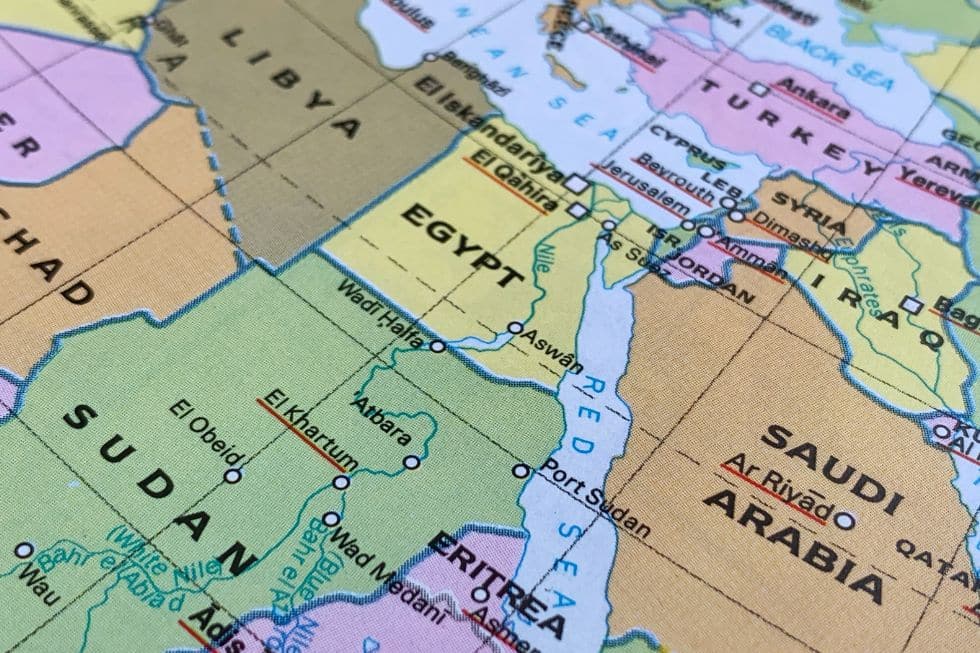



In May 2023, Saudi Arabia and the United States forced the Sudanese army and Rapid Support Forces (RSF) into a room in Jeddah. The two sides signed a declaration promising to protect civilians and open up aid routes. After a few days, they were back to fighting. Whenever the topic arises, Riyadh still refers to the agreement. When strikes hit Port Sudan and Kassala last May, the Saudi foreign ministry’s response ran through the same three beats it always does: condemn the attack, call for a ceasefire, insist on a “Sudanese-led” solution.
That posture — broker, not belligerent — has done a lot to bolster Saudi Crown Prince Mohammed bin Salman’s image in the region. Underneath it, the facts reveal a messier picture.
A recent investigation reportedly traced an extensive support network linking Riyadh to the Sudanese Armed Forces’ (SAF) de facto capital in Port Sudan: private executive flights shuttling between the two cities, three batteries of M777 howitzers reportedly transferred with Saudi backing, and a procurement pipeline running through Jeddah’s port that has carried explosives, chlorine gas cylinders and other materials to companies tied to Sudan’s Defence Industries System.
One of those chlorine cylinders resurfaced months later. The report ties it to an alleged chemical attack near the Al-Jaili refinery. Whatever this arrangement is, it isn’t mediation. Neutral countries don’t move howitzers and chemical precursors through their own ports.
And the beneficiaries extend past the Sudanese army itself. On the ground, the SAF relies heavily on the Al-Baraa Bin Malik Brigade, an Islamist militia with roots in Omar al-Bashir’s Popular Defense Forces that has grown, over the course of this war, into a force numbering in the tens of thousands.
Washington designated the Brigade a Foreign Terrorist Organization this year, citing violence against civilians, summary executions and its members’ ties to Iran’s Revolutionary Guard Corps (IRGC), including reported training on drone and explosive-boat systems. So, the same Gulf kingdom that spent a decade positioning itself as the region’s chief bulwark against Iranian-aligned Islamism is now, through its support for the SAF, indirectly propping up a militia that trains with the IRGC. Riyadh did not choose this outcome. But it has tolerated it, and arguably financed it, because the alternative — an SAF defeat — is judged the greater strategic risk.
That calculation only makes sense against the bigger map.
The Red Sea Axis: Sudan as a strategic battleground
A parallel piece of reporting from Horn Review describes what it calls a “Red Sea Axis,” an informal but increasingly coordinated bloc of Saudi Arabia, Turkey, Egypt, Eritrea and Somalia, built to counter the reach of regional rivals.
Somaliland port activations, Turkish basing rights at Port Sudan, Saudi money flowing into Eritrea. These aren’t separate stories. Put together, they point to Sudan mattering less as a humanitarian file Riyadh wants closed and more as territory in a Red Sea contest, one where the RSF sits on the other side of the line. Keeping regional rivals away from a corridor that carries somewhere between 12–15% of global trade is worth the cost of backing the SAF, Islamist militias included.
That’s where the usual narrative runs into trouble. Gulf states have spent years telling Washington they’re the ones holding the line against political Islam — pointing to domestic crackdowns, to their opposition to Brotherhood-linked movements across the region. Sudan doesn’t fit that story. According to reports, the same support network that reinforces the SAF is, by extension, strengthening the Al-Baraa Bin Malik Brigade as well. Apparently, strategic convenience outweighs ideological consistency when the port matters enough.
The illusion of neutrality: Saudi Arabia’s dual role
Saudi Arabia’s role has drawn less scrutiny, and part of that is deliberate. Riyadh has spent three years cultivating the mediator label — hosting talks, issuing ceasefire calls, positioning itself as the responsible outside power, and that framing has largely held in Washington and European capitals, even as its own ports kept moving howitzers, explosives and chlorine cylinders toward one side of the war.
Washington and European governments still treat Riyadh as central to ending this war. Fair enough; however, a state chairing negotiations while supplying one side’s arsenal isn’t playing a neutral role, whatever the press statements say. Sudanese civilians, three years into this, deserve a clearer answer than that about who is actually arming the war around them.
[Kaitlyn Diana edited this piece.]
The views expressed in this article are the author’s own and do not necessarily reflect Fair Observer’s editorial policy.
Sudan’s Shadow War Has a Diplomatic Problem
Last month, the Egyptian, Saudi and Turkish foreign ministers met in Cairo to discuss the ongoing crisis in Sudan. Notably...
Cairo’s Double Game: Egypt Arms a Sanctioned General While Playing Peacemaker
Egypt is arming a US-sanctioned Sudanese commander, conducting drone strikes and sharing intelligence — all while participating in US-led peace...
Turkey’s Shadow War in Sudan
Ankara’s drone diplomacy is reshaping one of Africa’s bloodiest conflicts and testing the limits of international law. Turkish-made drones have...
Support Fair Observer
We rely on your support for our independence, diversity and quality.
For more than 10 years, Fair Observer has been free, fair and independent. No billionaire owns us, no advertisers control us. We are a reader-supported nonprofit. Unlike many other publications, we keep our content free for readers regardless of where they live or whether they can afford to pay. We have no paywalls and no ads.
In the post-truth era of fake news, echo chambers and filter bubbles, we publish a plurality of perspectives from around the world. Anyone can publish with us, but everyone goes through a rigorous editorial process. So, you get fact-checked, well-reasoned content instead of noise.
We publish 3,000+ voices from 90+ countries. We also conduct education and training programs
on subjects ranging from digital media and journalism to writing and critical thinking. This
doesn’t come cheap. Servers, editors, trainers and web developers cost
money.
Please consider supporting us on a regular basis as a recurring donor or a
sustaining member.
Will you support FO’s journalism?
We rely on your support for our independence, diversity and quality.





Comment