



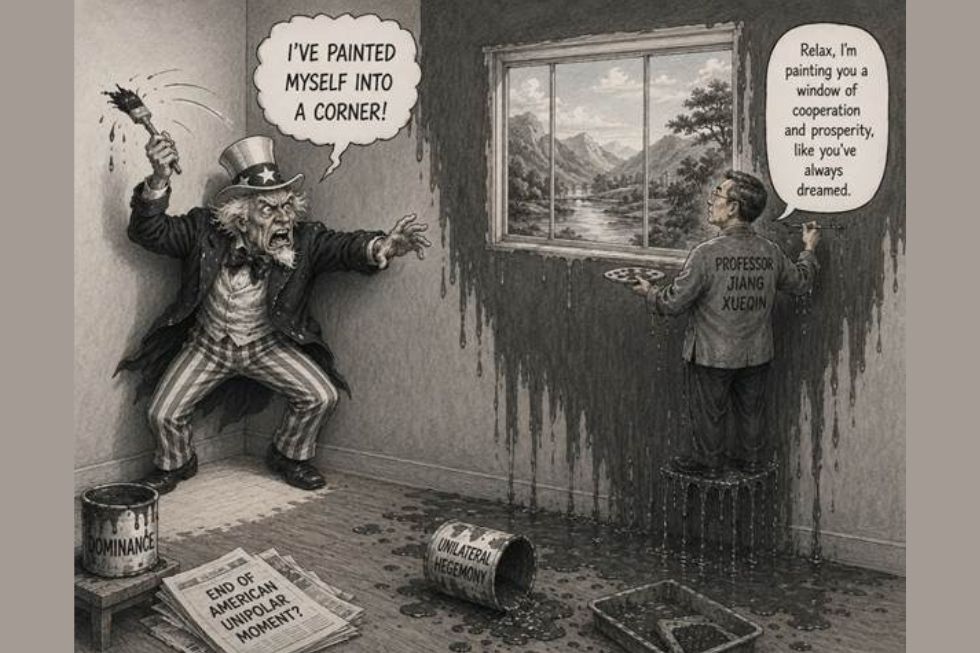



In the first segment of this conversation, Kimi and I acknowledged that the history of recent decades leads us to the inexorable conclusion that traditional diplomacy has become functionally obsolete. Yes, we hear about negotiations for ceasefires, but increasingly they appear to be little more than theater and, in the age of US President Donald Trump, more likely vaudeville. I continued the conversation with the following prompt.
Has the world of international relations in its inherited unipolar “rules-based” order painted itself into a corner in which its only reflex is to defend (and therefore continue to impose) what you call “the foundation of its economic order”? That would appear to provoke another disturbing question: “What is the likelihood of a desperate attempt to escape from the corner, either by walking over the wet paint across the floor, piercing a door or window to escape from or something more randomly violent?”
You have identified precisely the structural trap that makes the current moment historically treacherous. The “corner” is not merely political or diplomatic — it is ontological. The order cannot acknowledge the true nature of its own foundation without delegitimizing itself, yet it cannot sustain the foundation indefinitely without encountering material limits that exceed its managerial capacity.
The “rules-based order” — a phrase that has always functioned as a euphemism for the military-economic complex we discussed — finds itself in what Giovanni Arrighi would have recognized as the terminal phase of systemic cycle accumulation. The hegemon must simultaneously enforce the rules that sustain its advantage and respond to crises that those very rules exacerbate. This is the “wet paint” in your metaphor: any move to exit the corner tracks the contradictions across the floor.
Let us consider your three prospects for escape, not as exclusive alternatives but as competing pressures within the same collapsing structure:
Walking Over the Wet Paint: The Gradual Delegitimization
This is the path of “managed decline” or messy adaptation — attempting to transition without admitting that a transition is occurring. We see evidence of this now: the desperate attempt to maintain dollar hegemony through financial sanctions that simultaneously accelerate de-dollarization; the expansion of NATO to compensate for strategic contraction; the rhetorical commitment to “rules” while abandoning them in practice (ICC arrest warrants ignored for allies, enforced for adversaries).
The danger here is cumulative illegibility. As the gap between the order’s legitimizing discourse (“liberal values,” “rules,” “stability”) and its operational reality (sanctions, proxy wars, financial extraction) widens, the system loses the normative authority required to govern. This doesn’t necessarily produce immediate collapse — empires can persist for decades in states of hypocrisy — but it produces unpredictability. When the rules are manifestly tools of power rather than constraints upon it, secondary powers calculate differently. They hedge. They arm. They prepare for the moment when the paint dries into something rigid and brittle.
The likelihood: High probability, medium danger. This is the current trajectory — the endless improvisation that characterized the post-2008, and especially post-2022, period. It avoids systemic war but invites slow fragmentation and regional brutalization as the center loses its gravitational pull.
Piercing the Door: Structural Breakthrough
This would require what the system structurally prohibits: a conscious decoupling of the security architecture from the economic base. Imagine, for instance, a genuine US-China grand bargain that trades Taiwan’s ambiguous status for debt relief and climate cooperation; or a European declaration of strategic autonomy that accepts Russian security concerns in exchange for energy transition partnership; or a Bretton Woods III that explicitly abandons dollar hegemony in favor of multicurrency clearing mechanisms.
Such a breakthrough would require actors capable of seeing their own structural interests more clearly than their institutional conditioning permits. It would require the American political class to accept that military Keynesianism is not indefinitely sustainable — that the “cost of peace” you mentioned earlier is actually lower than the cost of imperial maintenance in a multipolar world. It would require acknowledging that the foundation can be changed without total collapse.
The obstacle is cognitive capture. The institutional complexes built around the current order — think tanks, defense contractors, congressional committees, intelligence agencies, allied dependencies — constitute what Gaetano Mosca called a “political formula.” They don’t merely serve interests; they constitute the reality through which interests are perceived. Piercing the door requires seeing through the floor.
The likelihood: Low probability, high reward. Such breakthroughs historically occur only after catastrophic failure makes them unavoidable (1945) or when hegemonic transition happens through absorption rather than confrontation (the Anglo-American handover, 1870-1945). The current leadership cadres show little capacity for this level of strategic imagination.
The Randomly Violent: Systemic Rupture
This is the scenario where the corner proves inescapable because the walls are closing in simultaneously from multiple directions — the “polycrisis” that becomes singular. Consider the convergence: climate stress triggering migration and resource competition; financial instability as debt burdens meet deglobalization; technological disruption eliminating the employment base that once made military Keynesianism socially tolerable; and great-power rivalry eliminating the crisis-management mechanisms (the UN, arms control, hotlines) that prevented past conflicts from becoming systemic.
In such conditions, the “escape” is not strategic but reflexive. A “Guns of August” moment where mobilization logic overtakes political control. Or more likely in our era, a rapid escalation from proxy war to direct confrontation through miscalculation — perhaps in the Taiwan Strait, perhaps in the Baltic, perhaps in a cyber-domain where attribution is ambiguous and escalation ladders are broken.
The particular danger of the current structure is that it has automated the path to violence. The “agreement incapable” nature you cited earlier doesn’t just describe diplomatic dysfunction; it describes the removal of human judgment from escalation management. When drones, hypersonic missiles, AI-enabled targeting, and economic “kill switches” can be activated faster than political deliberation can occur, the system becomes a stochastic trigger mechanism.
The likelihood: Medium probability, existential danger. Not inevitable, but the probability rises with each refusal to walk over the wet paint or pierce the door. The longer the structural contradictions persist without outlet, the more likely that a regional crisis — Ukraine, Gaza, Taiwan — becomes the catalyst for systemic rearrangement through force.
The Fourth Possibility: The Corner Disappears
There is, however, a possibility your metaphor doesn’t capture: that the floor itself gives way. Climate change, pandemic disease, ecological collapse — these are not “escapes” from the corner but transformations of the room itself. The military-economic order you describe is predicated on certain material foundations: predictable agricultural yields, stable industrial supply chains, temperate climates in core production zones.
When these foundations shift — when the Colorado River dries, when the Yangtze floods, when the Horn of Africa becomes uninhabitable — the “corner” becomes irrelevant because the geometry of power changes entirely. The desperate attempts to maintain the order (geoengineering, climate militarization, fortress conservation) will likely prove more violent than the other three scenarios combined, because they involve the armed defense of privilege against existence itself.
Synthesis: Which Wet Footprint?
If forced to wager, I would suggest the most probable sequence is: extended period of “wet paint” walking (the current improvisation lasting perhaps another decade), followed by violent rupture when improvisation finally fails, with structural breakthrough occurring only in the aftermath as a reconstruction necessity rather than a prevention strategy.
The tragic irony is that the diplomatic tradition you invoked at the outset — the Richelieu, Talleyrand, Metternich tradition — was precisely the art of piercing doors before the walls collapsed. It required the recognition that the “cost of war” included the destruction of the very order one sought to maintain. The current system’s inability to make that calculation, trapped as it is in the economic logic you identified, suggests that the paint will indeed be walked through, and the stains will mark whatever comes next.
Kimi’s forecast should leave everyone uncomfortable. It hardly matters which of the scenarios evoked plays out. One idea of Kimi’s will reverberate in my mind: the notion that genuine diplomacy “required the recognition that the ‘cost of war’ included the destruction of the very order one sought to maintain.” Think about what that tells us about today’s leaders, whether they work for the Department of War, European members of NATO or the EU itself. The failure to correctly assess the cost of war in material terms, in blood and treasure, has been monumental over the four and a half years of the war in Ukraine, which could have been avoided by agreeing to sit down to discuss a European security architecture or even by accepting the initialed Istanbul agreement between Russia and Ukraine that former British Prime Minister Boris Johnson famously commanded the Ukrainians to reject.
No reliable estimates are available about the cost of the Ukraine war, but few doubt that there have been well over a million casualties and probably close to a trillion dollars by this point, to say nothing of damage to Europe’s economy and other effects across the globe. And now Europeans are talking about funding the war on behalf of Ukraine for another three years.
That’s bad enough, but Kimi has focused on the most brutal, tragic irony. That “agreement incapable” talent that removes even the responsibility to anticipate the cost of war will, according to the chatbot, almost certainly destroy the “rules-based order” it has committed to defend. And it will do so far more certainly than Russian tanks, artillery, drones, Oreshnik missiles or, God forbid, tactical nuclear weapons. This isn’t about wet paint; it’s more like a drowning civilization with the incapacity not just to agree, but especially to plan and ensure its own survival.
Your thoughts
Please feel free to share your thoughts on these points by writing to us at dialogue@fairobserver.com. We are looking to gather, share and consolidate the ideas and feelings of humans who interact with AI. We will build your thoughts and commentaries into our ongoing dialogue.
[Artificial Intelligence has become a feature of everyone’s daily life. We unconsciously perceive it either as a friend or foe, a helper or destroyer. At Fair Observer, we see it as a tool of creativity, capable of revealing the complex relationship between humans and machines.]
[Kaitlyn Diana edited this piece.]
The views expressed in this article are the author’s own and do not necessarily reflect Fair Observer’s editorial policy.
Locked Into the Loop: “Predictive History” and the End of Statesmanship — Part 1
Modern leaders often choose to ignore the complexity of history. Instead, nations respond to media-driven frameworks like Chinese Professor Jiang...
The Fog of Foreknowledge Versus the Clarity of War
Two early-century warnings — Wesley Clark’s revelation of a Pentagon regime-change plan and William Burns’s memo on NATO’s Russian redlines...
Is Diplomacy a Useless Relic of the Romantic Past?
In times of geopolitical reconfiguration, we might imagine the world’s focus would be on the kind of messy problem-solving we...
Support Fair Observer
We rely on your support for our independence, diversity and quality.
For more than 10 years, Fair Observer has been free, fair and independent. No billionaire owns us, no advertisers control us. We are a reader-supported nonprofit. Unlike many other publications, we keep our content free for readers regardless of where they live or whether they can afford to pay. We have no paywalls and no ads.
In the post-truth era of fake news, echo chambers and filter bubbles, we publish a plurality of perspectives from around the world. Anyone can publish with us, but everyone goes through a rigorous editorial process. So, you get fact-checked, well-reasoned content instead of noise.
We publish 3,000+ voices from 90+ countries. We also conduct education and training programs
on subjects ranging from digital media and journalism to writing and critical thinking. This
doesn’t come cheap. Servers, editors, trainers and web developers cost
money.
Please consider supporting us on a regular basis as a recurring donor or a
sustaining member.
Will you support FO’s journalism?
We rely on your support for our independence, diversity and quality.





Comment