






 | ||
| ||
| ||
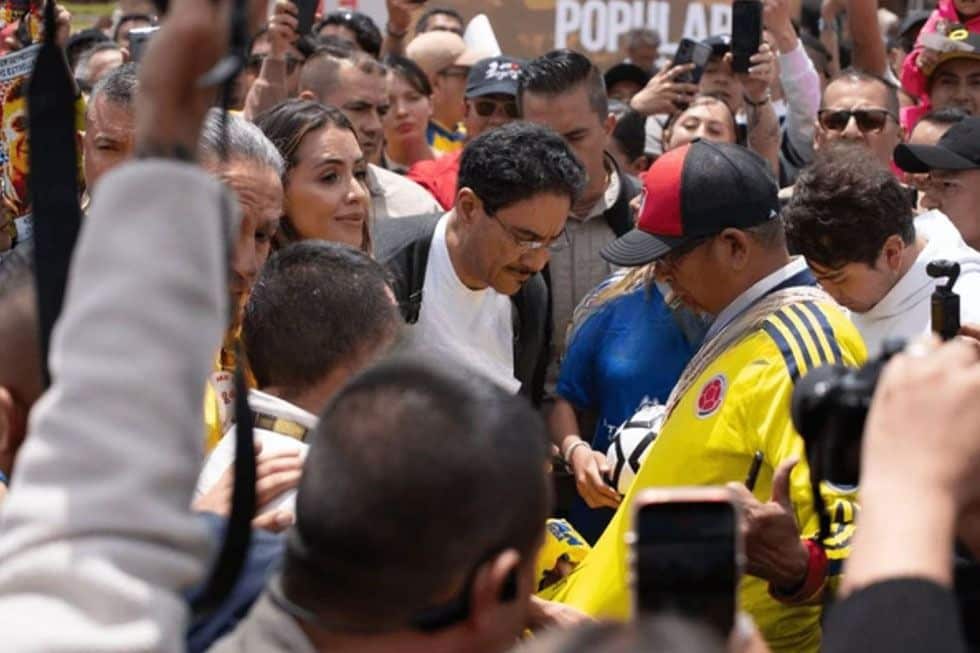
Dear FO° Reader, The Colombian election of 2026 has changed the Colombian political landscape in a crucial manner, as the country is widely seen to have tilted to the right. Colombia’s right-wing presidential-elect, Abelardo de la Espriella, seeks to emulate the preferred approach to governance of Javier Milei in Argentina, Nayib Bukele of El Salvador and Donald Trump.This election is also consequential in that it means an end to Colombia’s “first left-wing government” of Gustavo Petro, and it would enable Donald Trump to further his political agenda in the region (see the Donroe Doctrine). Trump has claimed that he wants to use US military force to “eradicate” cartels and gangs across Latin America. Furthermore, Colombia’s decades-long armed conflict has also had some bearing on the election’s outcome. Groups such as the National Liberation Army (ELN) and the Revolutionary Armed Forces of Colombia (FARC), economically fueled by the cocaine trade, have waged continued attacks against the Colombian government within the past year with increased sophistication. Sources: Colombia Presidential Election Heads to Run-Off: What to Know | Time Trump’s Colombia Prize | The New York Times Why This Guerrilla Army Is Winning Colombia’s Latest War | The Times National Security Strategy | The White House
De la Espriella capitalized on a wider regional trend The Colombian electorate’s choice of de la Espriella is a part of a wider trend of increased right-wing support in Latin America. As mentioned before, Espriella joins the ranks of Argentina’s Javier Milei, El Salvador’s Nayib Bukele, in addition to President Daniel Noboa of Ecuador, Nasry Asfura in Honduras, Laura Fernández Delgado in Costa Rica, and Peru’s Keiko Fujimori.Espriella, much like many other leaders of “Trumpian” movements in Latin America, has won audience favor by breaking the accepted norms of political campaigning. For example, in celebration of Donald Trump’s electoral win of 2024, Espriella celebrated by downing a shot of his personal brand of rum and posting it online. The most essential driving factor behind Colombia’s rightward turn is Espriella’s promise to take on armed guerrillas and drug cartels. Jonas Wolff, a professor of political science at Goethe University, also cites security concerns as reasons for this rightward political shift. This is mostly grounded in Colombia’s turbulent history of political violence from the 1960s onward. Sources: Colombia’s pivotal, polarised election could not be tighter | The Economist Latin America: Why are voters turning to the right? | DW Colombian paramilitaries in Colombian politics It is almost impossible to discuss contemporary political developments in Colombia without reference to the decades-long conflict that the Colombian government waged against guerrilla groups such as the ELN and the FARC. In 2016, it is worth noting that the Colombian government signed a peace agreement with the FARC, ending more than half a century of fighting. Gustavo Petro, furthermore, was formerly a member of M-19, another Colombian rebel faction, in the 1980s. The incoming Espriella government has vowed to abandon Petro’s “Total Peace” negotiations with the ELN and FARC dissident factions, favoring a military offensive over dialogue. Gustavo Petro, the former president of Colombia – was also a member of the Marxist guerrilla group M-19 (Movimiento 19 de Abril) – was elected to the Colombian House of Representatives in 1991, later became mayor of Bogotá, and in 2022 became the first leftist president in Colombia’s history. Ivan Cepeda, the leftist frontrunner during the 2026 Colombian electoral season, was also associated with the policies of Gustavo Petro’s unpopular previous presidential administration. During his campaign, Cepeda sought to cement Petro’s legacy, which he called “the first government of change,” particularly in regard to tackling “inequality, corruption and violence.” However, his backing of Petro’s Total Peace approach to ending Colombia’s decades-long conflict with the FARC was widely seen as naïve by supporters of Espriella. Proponents viewed the plan as a necessary step to negotiate an eventual ceasefire. Its detractors viewed it as giving space for armed guerrilla groups to expand their territory. Sources: Colombia’s 2026 Presidential Candidates: Cepeda, De la Espriella, and Valencia | AS/COA From guns to ballots: FARC’s campaign for votes in Colombia | NPR Gustavo Petro | Britannica Colombia has not had the best of luck with politics. Voter disenfranchisement most likely has led to this wider pattern of leaders of the extreme right displacing left-wing incumbent administrations in large swathes of Latin America. It’s not only that. Trump’s controversial multinational military coalition Shield of the Americas is another driving force behind the right-wing pivot. The Shield of the Americas conference took place on March 7 and is composed of the “Western hemisphere’s pro-Washington leaders.” With it comes potential economic incentives. Whatever the reason, Espriella’s election will have major implications for both Colombia and the region. Espriella now inherits a country where armed groups have never fully left. Whether “El Tigre” can deliver the security he promised, or simply escalates a conflict Colombia has fought for sixty years, will shape not just his presidency, but Washington’s next moves in the region. Source: The Shield of Americas Gathering and an Amplified Strategy to Counter China in the Western Hemisphere Alexandros Ouzounis | ||
We are an independent nonprofit organization. We do not have a paywall or ads. We believe news
must
be free for everyone from Detroit to Dakar. Yet servers, images, newsletters, web developers and
editors cost money.
So, please become a recurring donor to keep Fair Observer free, fair and independent. 
| ||
| ||
| About Publish with FO° FAQ Privacy Policy Terms of Use Contact |





Explore More FO° Spotlight

Support Fair Observer
We rely on your support for our independence, diversity and quality.
For more than 10 years, Fair Observer has been free, fair and independent. No billionaire owns us, no advertisers control us. We are a reader-supported nonprofit. Unlike many other publications, we keep our content free for readers regardless of where they live or whether they can afford to pay. We have no paywalls and no ads.
In the post-truth era of fake news, echo chambers and filter bubbles, we publish a plurality of perspectives from around the world. Anyone can publish with us, but everyone goes through a rigorous editorial process. So, you get fact-checked, well-reasoned content instead of noise.
We publish 3,000+ voices from 90+ countries. We also conduct education and training programs
on subjects ranging from digital media and journalism to writing and critical thinking. This
doesn’t come cheap. Servers, editors, trainers and web developers cost
money.
Please consider supporting us on a regular basis as a recurring donor or a
sustaining member.
Will you support FO’s journalism?
We rely on your support for our independence, diversity and quality.





Comment