


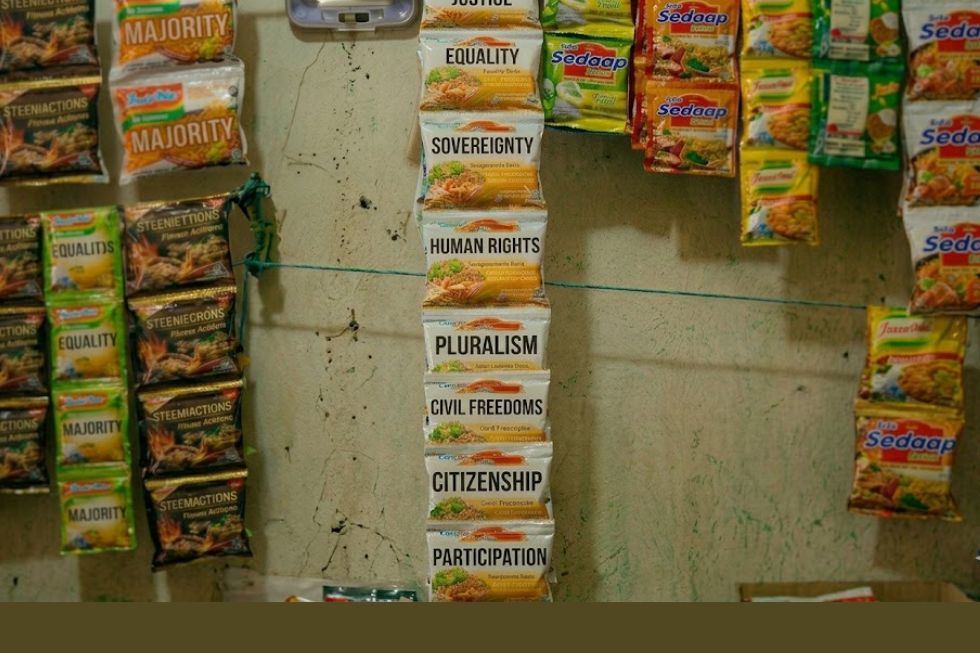



Walk into any warung (informal food stall) from Sabang to Merauke, and you can easily find shimmering rows of small, single-use plastic sachets dangling like urban seaweed. From caffeine hits to detergent, the sachet economy has long been Indonesia’s pragmatic response to precarious cash flows. It is a masterclass in microaccessibility. However, the logic of the sachet economy is no longer confined to consumer goods. Increasingly, it is shaping how citizens interact with the state. Traditionally, the social contract refers to the implicit bargain between citizens and government: citizens grant legitimacy, taxes and political participation, while the state provides public goods, security and civic rights.
This is what I call “sachet citizenship.” Just as sachet products allow consumers to purchase small quantities of shampoo or coffee instead of a full bottle or package, citizens are increasingly receiving state benefits in small, transactional increments. These may include one-off cash transfers, temporary welfare programs or simplified policy messaging designed for immediate consumption. Rather than strengthening durable rights and institutions, governance is increasingly delivered through isolated interventions that offer immediate benefits but little lasting security.
As a result, citizenship risks becoming less about a sustained relationship between citizens and the state and more about a series of short-term transactions. While this approach may appear efficient and responsive, it can discourage investment in the stronger institutions and long-term public goods that underpin democratic accountability and national resilience.
The politics of microtransactions
In the political sphere, the concept of sachet citizenship is most visible in the calculated blurring of social welfare and electoral loyalty. The recent election cycles at national and subnational levels underscored a troubling trend where social assistance (bansos) programs became functionally indistinguishable from sophisticated money politics. Rather than engaging the electorate in long-term ideological discourse, the state-citizen relationship has been reduced to a series of micro-transactions.
This is “pay-as-you-go” governance. When the state provides a sachet-sized portion of rice or a direct cash transfer in the immediate lead-up to a ballot, it is not investing in a shared national vision; it is purchasing a one-off service. Once the “product” — the vote — is extracted, the “packaging” — the citizen — is frequently discarded. This leaves behind a pervasive “political plastic” waste: a landscape of deep-seated cynicism and eroded institutional trust that persists long after the promotional cycle has ended.
Fulfillment through digital merit
This fragmentation extends into the burgeoning sharia economy. Indonesia has witnessed a significant surge in “micro-hijrah” culture, where spiritual and economic obligations are increasingly fulfilled through sachet-style Islamic finance. The traditional emphasis on community-led Waqf (endowments) designed to build lasting infrastructure, such as hospitals or universities, is being eclipsed by highly individualized, digital microdonations.
While the democratization of charity via financial technology is laudable, it frequently leads to a fleeting sense of spiritual satisfaction gained through very small digital transfers, such as a 5,000 rupiah (approximately $0.29) zakat payment. Such microinterventions lack the structural weight required to address the systemic roots of inequality. It risks reducing the profound complexities of Islamic social justice to a superficial retail experience, in which citizens purchase small units of merit without ever challenging the economic disparities that necessitate such charity in the first place.
Episodic defense
Even the most monolithic sector, such as national defense, is showing signs of sachet-style procurement and strategy, particularly within the maritime domain. For an archipelagic nation of over 17,000 islands, sovereignty requires a continuous, integrated presence. Instead, Indonesia’s approach often resembles a series of reactive, sachet-sized interventions.
For instance, in the North Natuna Sea, the state frequently deploys a sudden surge of patrols in response to viral incidents of illegal fishing or territorial incursions, only to retreat when fuel budgets or political appetites wane. Rather than a unified maritime architecture — where the Navy, Coast Guard (Badan Keamanan Laut/Bakamla) and fisheries surveillance operate as a single, durable entity — there are fragmented packets of authority. The Indonesian government may procure high-end Rafale jets in small batches, but without a robust interagency supply chain and sustained funding, the shield remains brittle and episodic.
The regressive cost of retail logic
Culturally, the medium of citizenship is being reconfigured through the lens of social media brevity. The Indonesian government increasingly bypasses formal parliamentary debates and rigorous press briefings in favor of key opinion leaders and “buzzers” who are organized to amplify specific narratives.
When complex legislation requires public buy-in, the state enlists influencers to market the policy in 60-second, easily digestible sachet videos. This approach prioritizes the aesthetic of engagement over the substance of civic discourse. It is a professionalized version of propaganda that sells the feeling of progress while stripping away the nutritional value of actual policy debate.
The tragedy of this “retail logic” is that it is mathematically regressive. Just as sachet shampoo is far more expensive per milliliter than the bottle, sachet citizenship imposes a heavy “poverty tax” on the very people it claims to serve. It creates a culture of immediate, small-scale gratification that obscures the crumbling foundations of healthcare, education and labor rights.
Toward durable citizenship
Indonesian people have long been masters of the sachet economy. It is a testament to their ingenuity and a necessary tool for surviving precarious cash flows. But while the sachet is a brilliant strategy for individual survival, it is a disastrous blueprint for national governance. From the rice packets of bansos to the hit-and-run patrols in the Natuna Sea, the state is offering a version of governance that is easy to open but impossible to sustain.
If the common people are forced to accept their rights in these tiny, transactional increments, they cannot be surprised when the “product” fails them during a systemic crisis. It is time to demand a model of citizenship that is not just easy to consume, but one that is built to last.
[Andrew Litz edited this piece]
The views expressed in this article are the author’s own and do not necessarily reflect Fair Observer’s editorial policy.
IUU Fishing: A Devastating Threat to Indonesia and the World
Illegal, Unreported and Unregulated Fishing is undermining Indonesia’s economy, marine ecosystems and maritime sovereignty. The issue is also linked to...

The Missing Backbone: How Young Women Sustain Indonesia’s Agri-Food System
The Free Nutritious Meals (MBG) program in Indonesia faces criticism for poor quality, mismanagement, and possible fraud, with delayed regulation...

Indonesia Shouldn’t Trade Workers’ Rights for Chinese Investment
Workers at the Chinese-owned company PT. CTLI in Indonesia protested for basic labor rights, highlighting systemic failures in enforcement and...

Feeding Indonesia’s Future, or Poisoning its Promise?
Indonesia’s Free Nutritious Meals program was established to provide millions of children with nutritious meals. Unfortunately, children have experienced food...
Support Fair Observer
We rely on your support for our independence, diversity and quality.
For more than 10 years, Fair Observer has been free, fair and independent. No billionaire owns us, no advertisers control us. We are a reader-supported nonprofit. Unlike many other publications, we keep our content free for readers regardless of where they live or whether they can afford to pay. We have no paywalls and no ads.
In the post-truth era of fake news, echo chambers and filter bubbles, we publish a plurality of perspectives from around the world. Anyone can publish with us, but everyone goes through a rigorous editorial process. So, you get fact-checked, well-reasoned content instead of noise.
We publish 3,000+ voices from 90+ countries. We also conduct education and training programs
on subjects ranging from digital media and journalism to writing and critical thinking. This
doesn’t come cheap. Servers, editors, trainers and web developers cost
money.
Please consider supporting us on a regular basis as a recurring donor or a
sustaining member.
Will you support FO’s journalism?
We rely on your support for our independence, diversity and quality.





Comment