


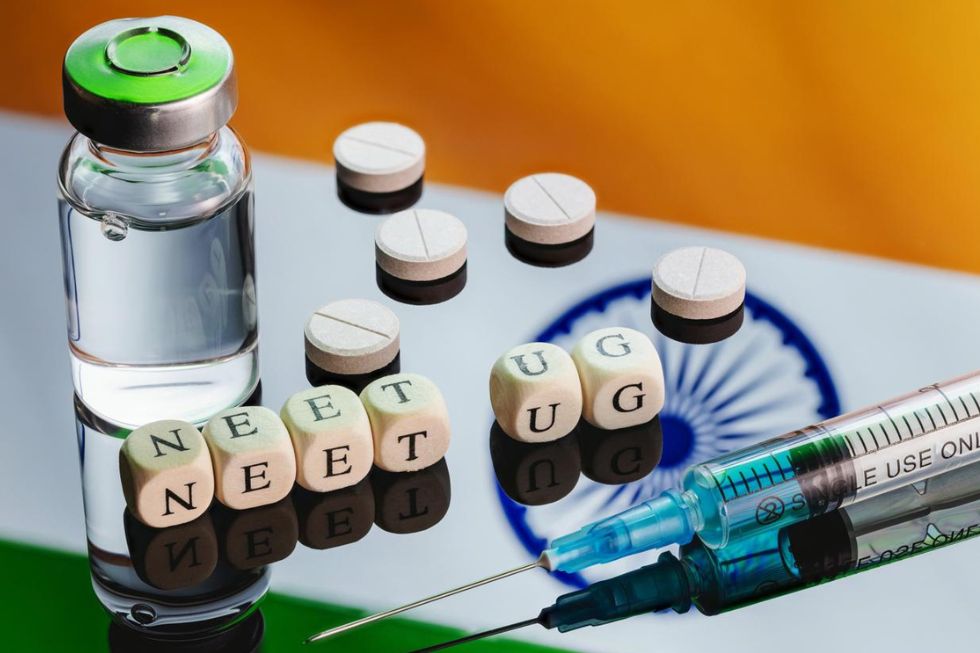



Repeated leaks, technical failures and malpractice allegations have shaken trust in India’s examination system and drawn students’ anger. Experts hold the National Testing Agency (NTA) responsible. They argue that the NTA was established as a society, which, under the Indian Constitution, refers to a voluntary association created for charitable or nonprofit purposes. This organization has limited experience in preparing specialized test papers, yet it has taken on the responsibility for millions of students without fully understanding the implications.
This year’s National Eligibility cum Entrance Test (NEET) for undergraduate medical admissions — one of the most important examinations for aspiring doctors in India — was held on May 3. Within days, however, authorities reported malpractice and decided to cancel the exam, which students had submitted after months and months of rigorous preparations. Thousands of disillusioned students took to the streets in protest, and local media reported that 11 students died by suicide in the lead-up to the re-test. NTA, which conducts the test, later announced June 21 as the retake date.
Paper leaks in entrance examinations are not new in India. Repeated leaks and systemic failures have repeatedly disrupted academic life across the country. Students are now directing their anger at the NTA and the Ministry of Education, which oversee major examinations such as NEET and the Central Board of Secondary Education (CBSE) system.
The NTA is registered as a society; it is not a statutory body, although it performs a profoundly public function that affects millions of students. Critics have raised concerns about the need for more robust legal and institutional oversight following numerous disputes. Due to the fact that NTA is autonomous in nature but is under the Ministry of Education’s jurisdiction, public discourse frequently degenerates into a blame game: Is it the agency or the ministry?
Dr. Anita Rampal, a former dean of the Faculty of Education at Delhi University, clearly noted on a Frontline Conversations podcast that NTA is not academically qualified and lacks the vision to administer large-scale exams, including online exams. She added, “NTA should not exist … we should really decentralize this.”
NEET: the high-stakes gateway to medical education
Every year, India produces thousands of medical graduates. Yet graduating from medical school is not the hardest step in becoming a doctor; for many students, the real hurdle is NEET, which is mandatory for admission to medical programs in both public and private institutions. A student’s NEET score can shape the course of their future. Families often invest huge sums in coaching classes, tutoring and online preparation in the hope of improving their children’s chances.
NEET was introduced as a single national examination, somewhat akin to the SAT in that it sought to standardize admissions across the country. It was first conducted in 2013, but after significant backlash and legal challenges over state autonomy, the Supreme Court struck it down. Following further legal review, it was reintroduced in 2016. Unlike the SAT, however, NEET is compulsory for medical admission and is held only once a year, making it a far higher-stakes test.
Before NEET, medical admissions in India were fragmented across multiple examinations. At the national level, the All India Pre-Medical Test (AIPMT), conducted by CBSE, governed admission to 15% of seats in government medical and dental colleges. The remaining 85% of state quota seats were filled through separate state-level entrance exams, such as Maharashtra Health and Technical Common Entrance Test (MHT-CET), the Uttar Pradesh Combined Pre-Medical Test (UP-CPMT), and the Engineering Agricultural and Medical Common Entrance Test (EAMCET) in Andhra Pradesh and Telangana. In addition, premier institutions such as All India Institutes of Medical Sciences (AIIMS) and the Jawaharlal Institute of Postgraduate Medical Education and Research (JIPMER) conducted their own entrance examinations. The result was a decentralized and often confusing admissions system.
Today, more than two million students sit for NEET each year in the hope of securing a seat in one of the 823 medical colleges recognized by the National Medical Commission. This year, nearly 2.28 million students registered for 129,602 seats across 551 cities in India, 14 cities abroad and more than 5,342 examination centers, according to an NTA notice. It is roughly 18 students per seat, making it a competitive make-it-or-break-it scenario.
Over the past decade, NEET has repeatedly been dogged by disruptions, including allegations of cheating, corruption and paper leaks. Despite its reputation as one of the country’s toughest entrance exams, the system has repeatedly failed to prevent the paper from being stolen or leaked. The exam is conducted offline in pen-and-paper format and consists of 180 questions across biology, physics and chemistry, for a total of 720 marks.
In 2024, NEET was rocked by another scandal. Eighty students reportedly received perfect scores, an unusually high number that triggered concern among educators. A subsequent police investigation found that 1,563 students had been awarded grace marks, a decision that was later reversed. Yet the highly competitive exam was neither canceled nor rescheduled, prompting widespread public outrage. These discrepancies deepened distrust among students, parents, and teachers.
CBSE faces fresh scrutiny over on-screen marking
The crisis in exam credibility has not been limited to NEET. This year, CBSE, the school board affiliated with more than 24,000 schools in India and abroad, also faced controversy over the evaluation of Class 10 and 12 examinations. The board had introduced an on-screen marking (OSM) system for large-scale evaluation, replacing physical answer-book grading with digital assessment. Coempt Edu Teck, an ed-tech company based in Hyderabad, was awarded the contract. But the system soon drew criticism over technical glitches, blurry scanned images, poor resolution and improper marking, all of which cast doubt on the results.
Although Education Minister Dharmendra Pradhan said he accepted responsibility and that technical defects were being addressed, it remains striking that such a large-scale shift appears to have been implemented despite serious gaps in oversight. The fate of millions of students was effectively handed to a technology company that, critics argue, failed to meet its responsibilities.
Adding to the controversy, Sarthak Sidhant, a 17-year-old student, said he found irregularities in public tender documents related to the ed-tech contract. He posted his findings on social media, alleging that the eligibility criteria had been modified in ways that benefited Coempt and helped it secure the contract.
The high-stakes coaching industry
Behind all this lies another uncomfortable reality: the enormous coaching industry that thrives on high-stakes examinations. India’s test-preparation sector has expanded dramatically, profiting from the aspirations and anxieties of students and families. On average, coaching institutes charge anywhere from ₹40,000 (~$424) to ₹200,000 (~$2,120) per student over a two-year period.
The industry has grown rapidly over the past decade. Last year, its market size was estimated at roughly $7.2 billion, and it is expected to continue growing over the next several years. Urbanization, digitalization and intensifying professional competition have all fueled this expansion.
Coaching centers have dominated India’s academic scene way before NEET or NTA came along. These centers are essential for many students, offering structured guidance and resources to navigate complex subjects. As a result, they play a significant role in shaping the future of aspiring medical and engineering professionals. Some critics argue that they dictate the terms in various aspects of these centralized exams.
Taken together, these failures have intensified student frustration, exposed weak government communication and underscored a growing political disconnect. In a recent interview with In Focus, The Hindu podcast, Dr. G. R. Ravindranath, general secretary of the Doctors’ Association for Social Equality, said that discrepancies in major examinations inflict severe mental and emotional distress on students and their families. He argued that both the central government and the NTA must be held accountable and suggested that the NTA should be replaced by a new body, similar to the Union Public Service Commission, with stronger public oversight.
The crisis surrounding NEET and CBSE reveals a deepening collapse of trust that shapes the future of millions of young Indians. If these institutions continue without credibility, the damage will reverberate beyond the day of the result.
[Kaitlyn Diana edited this piece.]
The views expressed in this article are the author’s own and do not necessarily reflect Fair Observer’s editorial policy.
Declining Standards in Higher Education in India
Indian higher education was once renowned for its intellectual vigor and contributions to knowledge. It has since dramatically declined due...

Support Fair Observer
We rely on your support for our independence, diversity and quality.
For more than 10 years, Fair Observer has been free, fair and independent. No billionaire owns us, no advertisers control us. We are a reader-supported nonprofit. Unlike many other publications, we keep our content free for readers regardless of where they live or whether they can afford to pay. We have no paywalls and no ads.
In the post-truth era of fake news, echo chambers and filter bubbles, we publish a plurality of perspectives from around the world. Anyone can publish with us, but everyone goes through a rigorous editorial process. So, you get fact-checked, well-reasoned content instead of noise.
We publish 3,000+ voices from 90+ countries. We also conduct education and training programs
on subjects ranging from digital media and journalism to writing and critical thinking. This
doesn’t come cheap. Servers, editors, trainers and web developers cost
money.
Please consider supporting us on a regular basis as a recurring donor or a
sustaining member.
Will you support FO’s journalism?
We rely on your support for our independence, diversity and quality.





Comment