




“There is a tide in the affairs of men
Which, taken at the flood, leads on to fortune;
Omitted, all the voyage of their life
Is bound in shallows and in miseries.
On such a full sea are we now afloat;
And we must take the current when it serves,
Or lose our ventures.”
– William Shakespeare, Julius Caesar
In January 1776, Thomas Paine, a major figure during the American Revolution, published Common Sense in support of the Patriots’ cause. According to Wikipedia, “[w]riting in clear and persuasive prose, Paine collected moral and political arguments to encourage common people in the Colonies to fight for egalitarian government.” Historians believe that Common Sense had a huge impact on the widespread support for the Declaration of Independence.
Paine wasn’t always successful, however. His life in England “was marked by repeated failures. He had two brief marriages. He was unsuccessful or unhappy in every job he tried. He was dismissed from the excise office after he published a strong argument in 1772 for a raise in pay as the only way to end corruption in the service.” Sound familiar? Then he met Benjamin Franklin in London, who gave him letters of introduction and suggested he go to America and seek his fortune there. The rest is history.
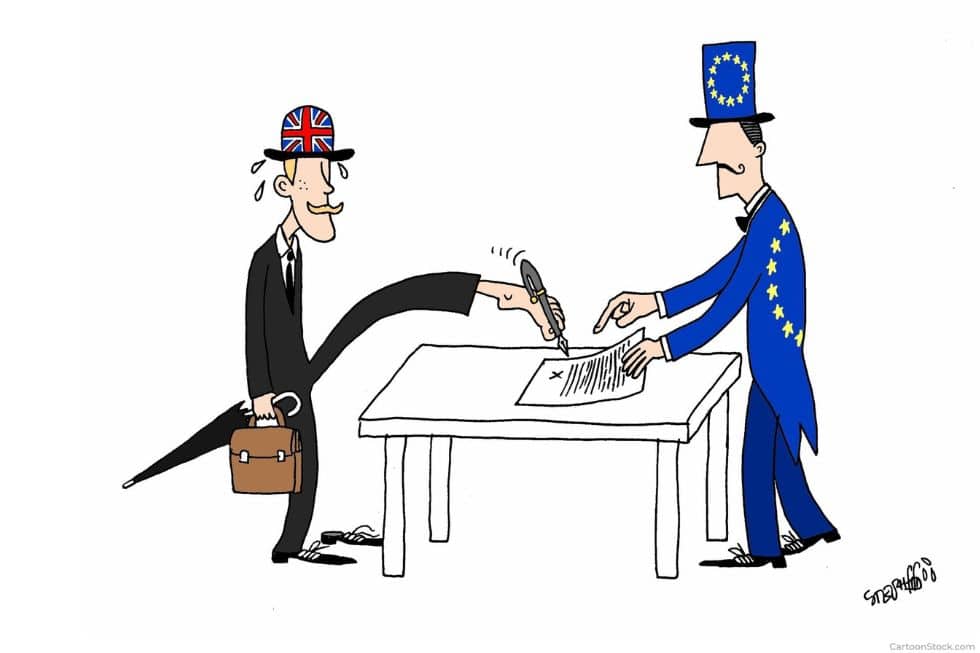
That is why there is delicious irony in allying Paine with the reverse proposition of Brexit: the push for the UK rejoining the EU — in some capacity, ASAP. This, in effect, would be a third chapter of a long-running UK–EU saga. First, the UK joined the European Economic Community (EEC), the forerunner to the EU, in 1973. Second, the UK decided to leave the EU in 2016, formally exiting in 2020 — largely due to concerns about loss of sovereignty and whipped-up negative public sentiment about the EU.
Note that Paine had a negative sentiment about the UK. That is why he left for the New World and became a Founding Father of the US. So it is ironic that Paine’s words hit the nail on the head when it comes to the timing of a new UK–EU relationship. In 1776, Paine wrote, “the time hath found us” in regards to the question of when the perfect time would be for America to seek independence from Britain. As this English-born American knew, timing is everything. That timing for the UK and the EU is now when it comes to the question of returning to a closer relationship, including full membership.
The upsides of a closer relationship
For a tighter re-union, the EU and UK each need to identify the significant net benefits of a closer, re-formalized relationship where timing is propitious. Lengthy articles, discussions and political maneuvering have held forth ad nauseam on this issue. Action is needed now. As with prophetic, peripatetic Paine, here are several reasons for and against the UK and EU seeking a “de jure” agreement — yet again.
The biggest “pro” identified is trade. The UK’s largest trading partner is the EU. In 2024, the EU accounted for 41% of UK exports and 51% of UK imports. The EU imports machinery, mineral and chemical products, transport equipment, and base metals from the UK. The UK imports the same from the EU, plus foodstuffs, beverages and tobacco. Financial services, travel and telecommunications flow both ways.
The UK also has significant value-added capabilities for the EU when it comes to defense. Already, the UK has bilateral agreements with France’s Lancaster House, Germany’s Trinity House and Norway’s Lunna House. In addition, the UK and Poland are negotiating a defense and security treaty. Plus, the UK has significant defense partnerships beyond the EU: a NATO membership; the Five Eyes Agreement, an intelligence-sharing alliance with the US, Canada, Australia and New Zealand; and the UK–US Technology Prosperity Deal, a series of financial investments from US tech firms.
In 2024–25, the UK had a $80.7 (£60.2) billion defense budget, which is expected to increase to $83.4 (£62.2) billion in 2025–26. There is also the UK’s nuclear deterrent, selective global force projection and lead Commonwealth status. This is all useful towards a stronger EU in today’s and tomorrow’s unpredictable relationship with the US, especially considering the US has threatened to withdraw troops from Germany.
However, the UK is struggling with budgetary issues. This is where the UK would greatly benefit from recent defense initiatives by the EU. The European Defence Fund (EDF), European Defence Industry Programme (EDIP) and Security Action For Europe (SAFE) are some examples. These initiatives support EU member states, developing, strengthening and rationalizing their defense industrial base through loans and grants.
Additionally, the traditional decision-making triangle between France, Germany and the UK is now broken. Paris and Berlin have been left in a difficult tête-à-tête. This is true on many subjects, but especially on defense. This is due to the lack of military culture in modern Germany, coupled with the need to increase its defense budget and forces — a need pushed by Washington and, more importantly, by the Russia–Ukraine War. A rapprochement with the UK would certainly help facilitate the defense debate between the top EU member states. In this context, the UK, France and Germany should advocate for a healthy ménage-à-trois.
Of course, there are also the practical reasons. The UK and EU are compatible geographically, socially and politically. Both entities share important common values, especially location, which can never be understated. English remains the predominant working EU language, and yet, ironically, the UK is no longer a member of the current EU!
A partnership is also completely reasonable when you consider how economic, political and cultural issues will benefit, especially when it comes to industries such as agriculture, fisheries, tourism and entertainment. In addition, the UK, as demonstrated historically, is a useful historical counterbalance (aka bulwark) — or rather a complement — to Germany and France, providing long-term political, social and economic stability and heft to the EU. As far as health or phytosanitary standards, the UK population’s attitude and request for safety is now closer to the rest of Europe than to the current US deregulatory policy.
There is also the foreign policy aspect to think of. By formalizing its relationship with the EU, the UK can add a powerful “anti-venom” to neutralize positions taken by the current US administration. Canada, Greenland/Denmark, Iran, Lebanon, NATO and the Falkland Islands are examples of American fiascos in handling international relationships. These fiascos underscore the need for the UK and the EU to come up with more forceful consolidated responses to the US on international issues.
Constant monitoring is the only way to avoid the cons
Of course, as with everything, there are downsides. In the UK’s eyes, the biggest con for a UK–EU partnership is perceived expanded bureaucracy. This was a previous problem that caused a majority of the UK voting population to sour towards EU membership. The UK government had already kept its distance from Brussels, notably by opting out of the common currency, the euro. Yet the idea of the loss of national sovereignty became popular amongst Brexit supporters who voted to reclaim it in 2016. The situation on the other side of the channel is, however, different from what it was ten years ago. The European Commission, under pressure from the EU member states and the European Parliament, has started a process of simplification: cutting red tape wherever necessary to ease life for citizens and businesses. This development, however, needs close attention and better communication with constituents in member states as well as the UK.
A new UK–EU relationship will also require continuous vigilance, monitoring and action to ensure costs don’t exceed benefits, and that those benefits are collectively affordable and proportionate. It is important to mention here, however, that the benefits from being part of the “EU club” are far from being tangible or financially quantifiable. Nevertheless, the benefits are real, including soft power attraction, stabilization and education. Again, this needs proper communication. Politicians, public intellectuals and journalists must explain to the British population the multiple dimensions of the rapprochement. The “remain” camp never explained these complex benefits properly at the time of the Brexit referendum. In light of that experience, pedagogy is crucial.
For all the benefits of closer ties with the EU, the UK has to be watchful. The 27-member EU needs new mechanisms for coming up with its budget and handling collective decision-making. As demonstrated by Hungary’s blocking of a $103 billion EU loan to Ukraine, individual states are able to veto EU Council decisions because many of them require unanimity. What could happen to Ukraine could also happen to the UK. Having said that, there are no clear showstoppers within the EU barring a closer relationship with the UK. Of course, British voters who voted for Brexit ten years ago could choose to steer clear of the EU again.
A step-by-step strategy is better than a one-time approach
While the pros seem to outweigh the cons, it also seems unlikely that a direct, immediate approach to rejoin the EU would be successful. Currently, there is too much unresolved political scar tissue largely due to the UK’s constant volte “farces” and referendums. Note that referendums are often unpredictable and counterproductive. France, the driving force behind the formation of the EU, nearly voted no in a referendum on the 1992 Maastricht Treaty, which led to the founding of the EU.
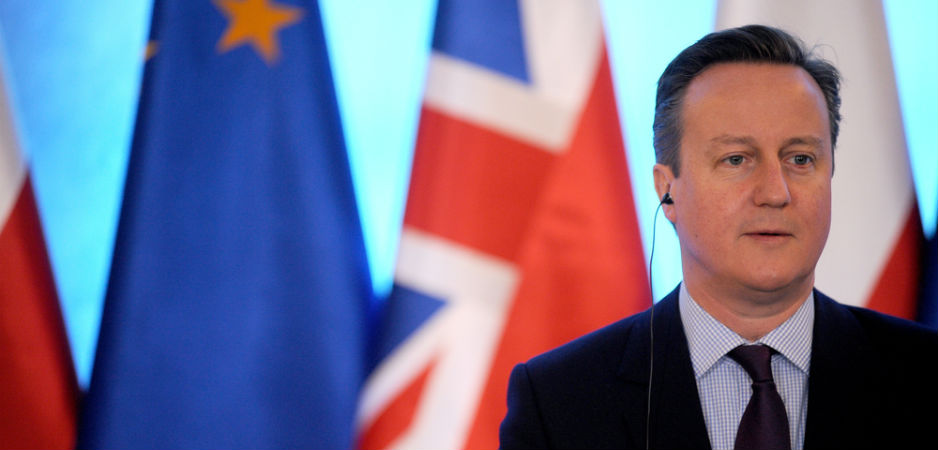
David Cameron, the British prime minister from 2010 to 2016, did not learn from this French experiment. In retrospect, his foolish decision to hold a referendum on the UK’s EU membership backfired spectacularly. In 2013, Cameron claimed that if his Conservative Party won the next general election, he would negotiate the UK–EU relationship and then hold an in/out referendum on staying in the EU. Other party leaders claimed he only suggested a referendum to placate the Euroskeptic faction in his party and retain his hold on power. In the 2016 referendum, around 52% of voters opted for Brexit.
British voters have been divided on this emotive issue. So, rather than a direct re-application to rejoin the EU near term, a step-by-step approach seems more sensible. This approach should also give the necessary time for a proper, fact-based communication campaign. The “leave” campaign led by Boris Johnson and Nigel Farage won the narrative war against “remainers” Cameron and George Osborne. This time, the pro-EU Brits will have to dominate the narrative.
The pro-EU camp needs a new communication approach that tackles the issue of sovereignty. so dear to extremists. This camp must explain how, in the 21st century, the sovereignty of the UK is better protected within the EU. As a small island nation of about 70 million people, the UK does not have much leverage against behemoths like China, the US or Russia. The UK within the EU is much stronger than the UK all alone.
Yet no pro-EU campaign can shy away from addressing issues such as bureaucracy or migration. Note that both issues are increasingly being tackled more openly and effectively in the EU than a decade ago. Recently, David Miliband, a former British foreign secretary, has insisted that the UK needs “national consensus” on rejoining the EU. He has also said that the UK needs a reset of its relations with the EU, but admitted that rethinking the UK–EU relationship is a long-term, not immediate, goal.
As Miliband said, the EU is in constant evolution. British leaders have to take this into account and explain that, just like the UK, the EU today is quite different from what it was prior to Brexit. The UK would be joining a more realistic and effective EU — this is an important argument in the narrative favorable to rapprochement. Furthermore, the world itself has changed. As pointed out earlier, the Trump administration has presided over far too many international fiascos. Changes like he Covid pandemic, Russi–Ukraine War and the US/Israel–Iran War have forced the EU and even the UK to change.
THE GIBRALTAR GAMBIT
Gibraltar, a British Overseas Territory, shares a border with Spain, which is part of the EU. The 2026 EU–UK Trade and Cooperation Agreement, which established cooperation between the two entities following Brexit, did not address the Gibraltar–Spain border. This left many individuals and businesses in a gray area, as the UK is not part of the Schengen Area, the EU’s open-border zone that allows for free travel between EU member states.
The UK and the EU arrived at the 2026 agreement after years of negotiations. This agreement is still in the process of ratification. Yet it is a useful proxy to refer to on how to maneuver through the UK–EU relationship under current circumstances. There are several key aspects of the 2026 draft agreement. The first is border freedom: The deal aims to remove la verja de Gibraltar, the fence on the border between Spain and Gibraltar. Removal of the fence enables Gibraltar to become part of the EU Schengen area. The agreement also secures the rights of over 15,000 daily commuters who live in Spain but work in Gibraltar. While technically outside the EU single market/customs union, Gibraltar will align its laws on goods, customs and travel with European Entry Exit Systems at its airport and port.
In addition, the agreement ensures that Spain’s sovereignty claim over Gibraltar remains intact while allowing for the new operational arrangements. In 1704, British and Dutch forces captured the Gibraltar peninsula during the War of the Spanish Succession. Spain then ceded the territory to Great Britain under the Treaty of Utrecht, which ended the war. Notably, though, Spain does not acknowledge UK sovereignty over Gibraltar. During the 1980s, Spain began demands for the UK to cede the territory back.
So, though not yet ideal or necessarily scalable, the Gibraltar gambit could provide a useful step-by-step precursor for the UK to rejoin the EU. In addition, there are accommodations regarding Northern Ireland, the Channel Islands and other regions, which could contribute to a step-by-step approach toward a closer UK–EU relationship.
Timing is everything and the time is now
When voters chose Brexit, they assumed that the UK would regain the bulk of its sovereignty back from the EU and avoid much of the EU’s bureaucracy. That assumption has proved largely false. Moreover, the costs of Brexit are now painfully clear. These costs have been well researched and have proven to be significant, even though Brexit has been a bit of a slow burn.
Based on almost a decade of data since the 2016 referendum, estimates suggest that Brexit had hit economic growth. By 2025, Brexit had reduced the UK’s GDP by 6–8%. The latest economic forecast from the UK’s Office for Budget Responsibility assumes that imports and exports will be an estimated 15% lower in the long run.
Voters had also assumed that migration to the UK would decline. This, too, has proven false. Migration to the UK has increased since the 2016 days. Clearly, the narrative of blaming the EU for the migrant crisis during the Brexit referendum was far from true.
In a nutshell, the UK and the EU have changed, and so has the world itself. Given the increasing unreliability of the US, the rising aggression of Russia and the meteoric rise of China, the UK and the EU need each other. Their economies are intertwined inextricably. Geographically and culturally, the UK and the EU are extremely close. Therefore, a “re-union” with the EU is in the UK’s best interest.
Yet this reunion cannot occur tomorrow or with another referendum. Sovereignty in the UK lies with the British Parliament. Therefore, an act passed by a simple majority suffices to reestablish closer ties with the EU and, in the not-too-distant future, a “re-union.” Just as the UK should follow its well-established rules, so should the EU. Returning to Paine’s Common Sense, “the time hath found us,” and we need to act now.
[Cheyenne Torres edited this article.]
The views expressed in this article are the author’s own and do not necessarily reflect Fair Observer’s editorial policy.






Join the conversation
Share your perspective
Log in to share your thoughts and take part in the discussion.